










Advance Agrolife targets 25-30% selected-product COGS cut
Key highlights
- Advance Agrolife targets a 25-30% COGS reduction for specific products through Unit IV technical manufacturing.
- Advance Agrolife plans to increase 2,4-D capacity fourfold from 2,500 MT to 10,000 MT by Q4FY28.
- Advance Agrolife cites 13 TPD capacity for its captive Pretilachlor and PEDA manufacturing strategy.
- Advance Agrolife reports 500+ registrations, comprising 460 formulations and 40 technicals.
powered by IRIS
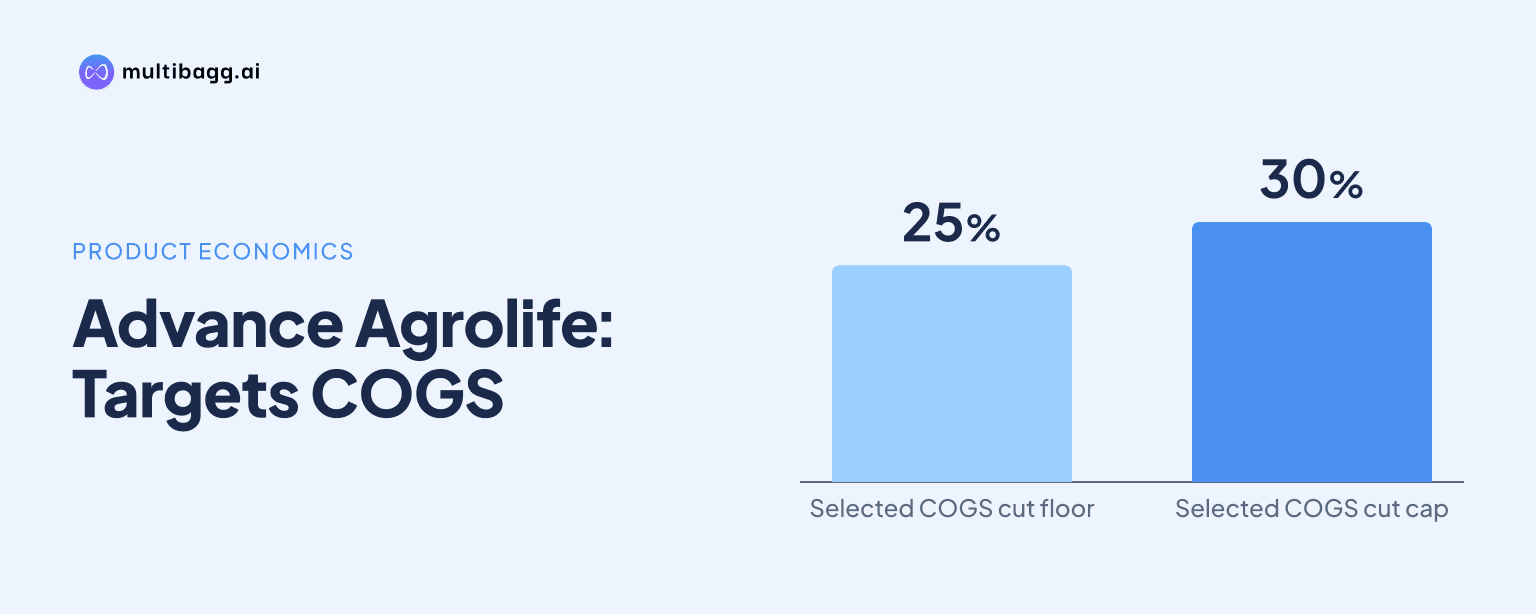
Advance Agrolife Limited targets a 25-30% reduction in Cost of Goods Sold (COGS) for specific products through in-progress technical manufacturing at Unit IV, after converting Unit I to make technical-grade pesticides. The company also plans to raise 2,4-D capacity fourfold from 2,500 metric tonnes (MT) to 10,000 MT by Q4FY28.
Know Advance Agrolife inside out
Results, valuation, peers and who's buying, in one view.
How is Advance Agrolife becoming a technical manufacturer?
Advance Agrolife is replacing some external purchases of active ingredients with in-house technical-grade pesticide production to capture supplier margin and reduce intermediate logistics costs. The company says its historic pure-play formulation model provided revenue stability but had capped margins because it depended on external active-ingredient sourcing. Its integrated model links Unit I technical production with downstream formulation and packaging operations.
Unit I is the completed first phase of this shift, according to the presentation. Advance Agrolife says the unit now manufactures herbicide, insecticide and fungicide technicals and has begun supplying its formulation units. Direct captive supply is intended to avoid the packaging and transit required for externally sourced inputs, while also reducing dependence on third-party procurement for the technicals produced internally.
Unit IV is the second phase and remains in progress. Advance Agrolife says this facility will add technical production for fungicides and herbicides, with the 25-30% COGS reduction target applying to specific products. The presentation does not state that the target covers all formulations, all technical products or the company-wide cost base, and it provides no Unit IV capacity figure.
What is Advance Agrolife planning for 2,4-D capacity?
Advance Agrolife plans to increase 2,4-D production capacity to 10,000 MT by Q4FY28 from 2,500 MT currently, representing a fourfold expansion. The company describes the project as a response to a structural domestic supply gap and says greater volume is intended to lower unit costs through economies of scale.
The expansion is associated with the Unit-5 facility at Dahej II, Bharuch, Gujarat, where construction has commenced on 17,734.54 square metres of land for technical-grade pesticides. Advance Agrolife says the location places a raw-material-intensive product closer to inputs such as phenol and chlorine, potentially through pipelines, and gives access to a port for exports. It does not disclose capital expenditure, utilisation assumptions or a commissioning date beyond the Q4FY28 capacity marker.
The Dahej project differs from Unit IV in the evidence disclosed. Unit IV carries the company’s selected-product COGS reduction target for fungicide and herbicide technicals, whereas the 2,4-D project has a quantified capacity increase from 2,500 MT to 10,000 MT. Both projects form part of Advance Agrolife’s stated plan to move from a net buyer of technicals toward integrated manufacturing.
Got a follow-up? Ask IRIS
How does Pretilachlor fit Advance Agrolife’s integration strategy?
Advance Agrolife says it has commenced and stabilised captive manufacturing of Pretilachlor technical and its intermediate, Diethyl-n-(2-propoxy ethyl) Aniline, known as PEDA. The presentation labels this Pretilachlor strategy with 13 tonnes per day (TPD) of capacity, extending the company’s internal production beyond the final technical to a critical intermediate.
The company links this strategy to anti-dumping duty imposed by the Government of India on Pretilachlor and PEDA imports from China. Advance Agrolife characterises the duty as creating a pricing umbrella for domestic manufacturers and discouraging dumping, which is management’s view of the policy effect. The presentation does not disclose the duty rate, effective date, Pretilachlor revenue or the company’s share of the relevant market.
Pretilachlor is identified as a post-emergence herbicide for paddy, or rice, and Advance Agrolife says its relevance across the Kharif and Rabi seasons can support capacity utilisation. This product chain illustrates a different integration mechanism from the 2,4-D scale-up: it combines captive manufacture of a technical and its intermediate with a cited import-policy backdrop. The source does not give a separate production-capacity figure for Unit I or Unit IV beyond the 13-TPD Pretilachlor reference.
How is Advance Agrolife changing its formulation mix?
Advance Agrolife is moving away from commoditised bulk chemicals toward specialised formulations, including water-dispersible granules (WDG) and suspension concentrates (SC). The company says Unit II has dedicated capabilities for these complex delivery systems, which are intended to address specific farmer requirements rather than compete only through bulk chemical pricing.
Management says specialised formulations can generate higher customer loyalty and superior gross margins, with a potential benefit to Return on Capital Employed. These are management assertions rather than reported outcomes: the presentation provides no current sales contribution from WDG or SC, product-level gross-margin data, or before-and-after Return on Capital Employed figures for the portfolio shift.
The formulation strategy operates alongside technical integration. Units I and IV are intended to alter input sourcing and production economics, while Unit II is focused on the downstream product mix. Advance Agrolife also reports 500+ registrations, comprising 460 formulations and 40 technicals, and says large business-to-business customers can link approvals to a specific manufacturing site, making supplier changes subject to regulatory refiling and stability testing.
Conclusion
Advance Agrolife’s plan combines internally produced technicals, a fourfold 2,4-D capacity increase and a move toward WDG, SC and other specialised formulations. The clearest quantified cost objective is a 25-30% COGS reduction for specific products at Unit IV, while the most defined scale objective is 10,000 MT of 2,4-D capacity by Q4FY28, compared with 2,500 MT currently.
The next disclosed milestones are progress at Unit IV and the Q4FY28 2,4-D capacity target tied to the Dahej Unit-5 project. Management also targets export revenue share of 20% by FY29, from 2% currently, while the presentation’s FY29 chart labels Rs 1,100 crore of revenue and an EBITDA margin of more than 12%.