










Aelea pushes CNSL and solar starts to December 2026
Key highlights
- Aelea expects CNSL and solar operations to start by mid or late December 2026.
- Solar work was delayed by substation approvals and rain-related restrictions on civil work.
- CNSL work was delayed by technical modifications, including piping-pressure-related work.
- Management said factory utilisation was about 95% to 97% on November 4, 2026.
powered by IRIS
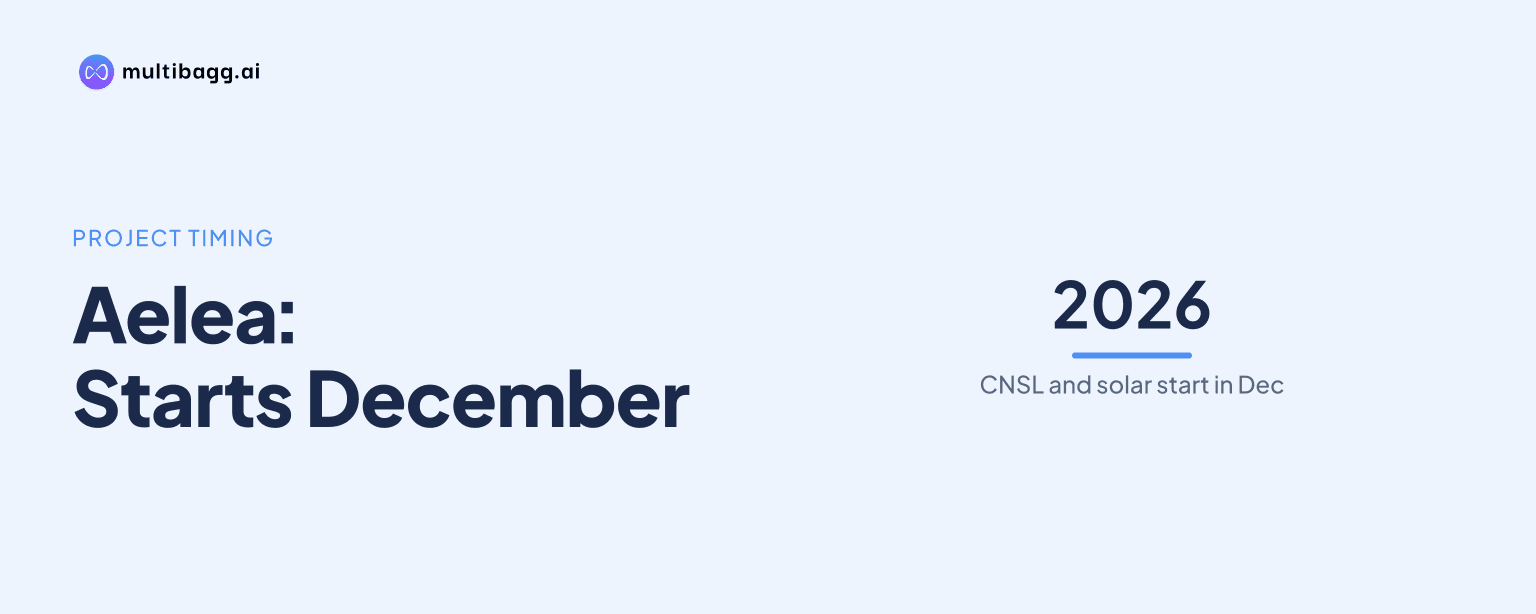
Aelea Commodities Limited expects its CNSL and solar projects to start in mid or late December 2026, after delayed substation approvals, rain-related civil-work disruption and technical modifications postponed earlier expectations. Management said on November 4, 2026 that both projects were in their final stages, although the revised timing remained subject to approvals.
Know Aelea Commodities inside out
Results, valuation, peers and who's buying, in one view.
Why did Aelea delay the CNSL and solar projects?
Aelea delayed the solar project because it did not receive required substation approvals in time, management said on the November 4, 2026 call. The substation arrangement was required to route the electricity generated by the solar installation, and management said that this approval had subsequently been completed.
Rain created a second obstacle for the solar project after the approval issue. Management said civil work could not be carried out extensively during the rains, extending the construction schedule even after the substation-related requirement had been addressed. The delay therefore involved both an external approval process and weather-related disruption.
Aelea attributed the CNSL project delay to technical modifications made during development. Management referred to changes involving piping pressure and other technical work that took longer than expected. Unlike the solar project, the stated reason for the CNSL delay was principally project design and execution work rather than an approval or weather issue.
Management acknowledged that both projects had been delayed. It said incorporating changes while the CNSL project was still being built was preferable to proceeding without those changes, even though the work extended the timeline. The comparison shows that solar faced approval and civil-work constraints, while CNSL required technical revisions.
When will Aelea start the CNSL and solar projects?
Aelea expects both the CNSL and solar projects to start by mid or the end of December 2026, management said on November 4, 2026. Management described the timetable conservatively and said completion remained subject to approvals and other final-stage requirements.
The company said both projects were in their final stages when it gave the December expectation. For solar, management said the required substation approval had been completed, while rain had slowed civil work. For CNSL, the remaining delay was linked to the technical modifications, including piping-pressure-related requirements.
The revised window is later than expectations discussed by investors during the call. One analyst said solar had been expected to be complete by October 31, while another question referred to an earlier expectation of CNSL completion within 30 days. Management did not restate either earlier expectation as formal guidance, but agreed that the projects had been delayed.
The December date is an expected operational start rather than a quantified financial milestone. Aelea did not disclose commissioning capacity, output, project expenditure or a specific date within December for either operation. Its disclosed position was that final work was underway and that approvals still mattered to the revised timing.
What could the delayed projects mean for Aelea’s H2?
Aelea said the CNSL and solar projects would have a positive impact on H2, or the second half of the financial year, once they start. Management gave that response after an investor asked whether the mid- or late-December start could support H2 performance, but it did not provide a numerical forecast.
The timing limits the visibility available from the call. A mid- or late-December 2026 start would leave only part of H2 for operations, and management did not say how quickly either project could reach planned activity after starting. It also did not quantify expected revenue, cost savings, profit contribution or cash-flow effects.
The CNSL project sits alongside management’s stated plan to move deeper into the value chain. In discussing future profit growth, management said benefits could arise from higher capacity and savings in logistics, capital efficiency and logistical efficiency. It did not assign any of those potential benefits specifically to CNSL or set a target for the project.
The solar project may affect the company through its electricity generation, but the call disclosed no installed capacity, expected generation volume or power-cost saving. Aelea’s stated positive H2 expectation should therefore be distinguished from any assumption about the amount of financial contribution. The transcript supports an expected benefit, not a calculation of its scale.
Got a follow-up? Ask IRIS
How will Aelea communicate future project timelines?
Aelea said it has learned not to communicate internal project timelines as though they were non-negotiable deadlines for the broader shareholder group. Management made that comment after acknowledging the CNSL and solar delays and said some project elements are not fully within its control.
The solar project illustrates the issue management identified. Its schedule depended on a substation approval process, followed by civil work that was affected by rains. The CNSL project also changed during execution because management chose to make technical modifications, demonstrating why an internal target can move before operations begin.
Management referred to a newer project that had been given a 30-month timeline. It did not identify that project in this part of the call or disclose its start date, but said the 30-month period reflected lessons from the delayed projects. The company’s stated approach is to be more careful about treating internal schedules as shareholder-facing commitments.
Aelea linked this caution to its broader capacity-expansion approach. Management said existing factory utilisation was about 95% to 97% and that additional volume growth requires added capacity. It said it intends to expand conservatively when utilisation is at a level where it is comfortable that utilisation will not subsequently fall.
What remains unresolved after Aelea’s December target?
Aelea has not specified the remaining approvals or completion steps needed before the mid- or late-December 2026 start. Management said the projects were in final stages and described the expected timing as subject to approvals, leaving the precise commissioning sequence undisclosed.
The company also did not disclose the financial effect of the delay itself. No figure was provided for additional project cost, lost solar generation, delayed CNSL output, revenue foregone or change in H2 profit. As a result, the call does not establish whether the schedule change has a measurable financial cost.
Aelea similarly gave no separate performance targets for either project after commissioning. Management said the projects should positively affect H2, but did not provide a target for output, utilisation, margin, energy savings or payback. The next reported update will be needed to show whether operations began within the stated December window.
Conclusion
Aelea’s delayed CNSL and solar starts reflect distinct execution issues rather than a cancellation of the projects. Solar was held up by substation approvals and rains affecting civil work, while CNSL required technical modifications. Both were in final stages on November 4, 2026, and management expected operations to begin by mid or late December 2026 with an unquantified positive H2 effect.
The next item to watch is whether outstanding approvals and final technical work allow commissioning within the December 2026 window. Management has also set out a communication change after the delays, referring to a 30-month timeline for a newer project and indicating that it will be more cautious about presenting internal project schedules as fixed commitments.