










Aelea proposes Rs 114 crore Surat capacity expansion plan
Key highlights
- Aelea proposes Rs 114 crore for a Vasravi, Surat manufacturing and staff-housing project.
- The proposal includes 60 MT of added processing capacity and a 30 MT cardanol unit.
- Aelea reports 140 MT existing capacity at 100% utilisation on the project page.
- H1 FY27 EBITDA was Rs 23.31 crore, compared with Rs 15.25 crore in H1 FY26.
powered by IRIS
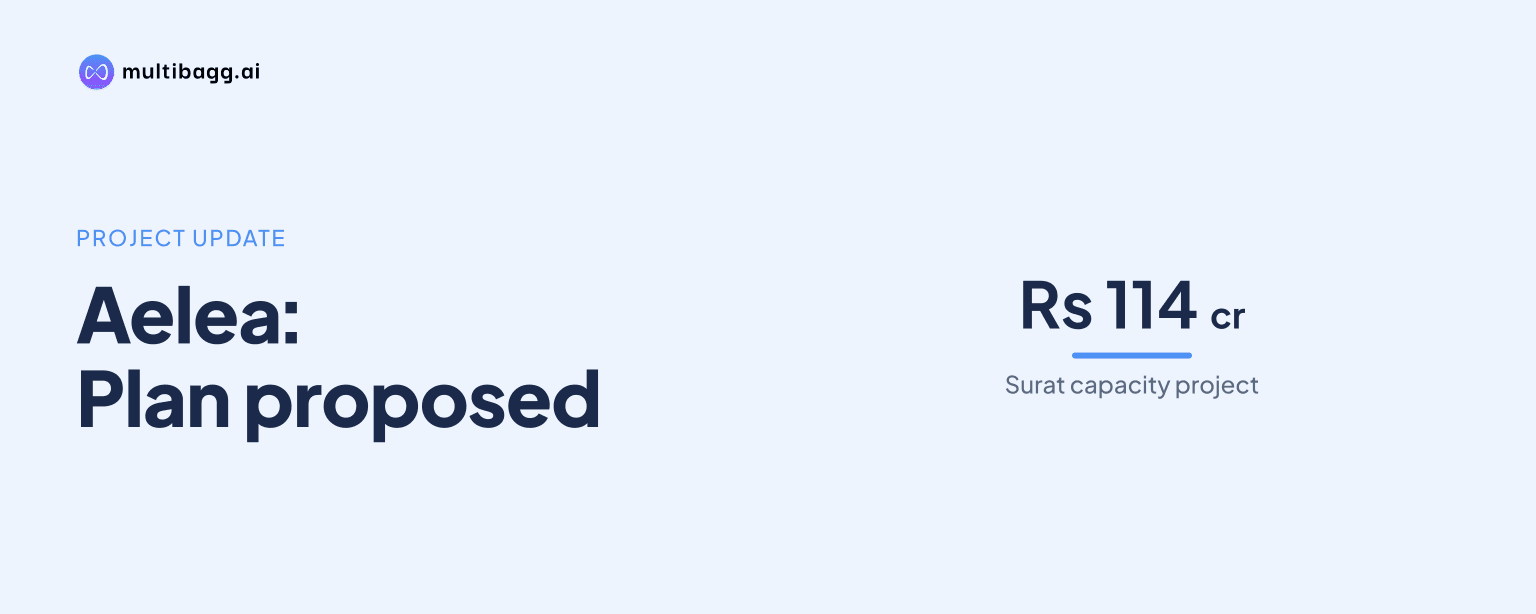
Aelea Commodities Limited proposes a Rs 114 crore Surat expansion due to start in February 2027 and take 30 months, including 60 metric tonnes (MT) of added processing capacity and a proposed 30 MT cardanol unit. The plan follows reported 100% utilisation of its existing 140 MT capacity and supports Strategy 2037 diversification.
Know Aelea Commodities inside out
Results, valuation, peers and who's buying, in one view.
What does Aelea’s Rs 114 crore Surat project include?
Aelea’s proposed project allocates Rs 100 crore to land acquisition and a manufacturing unit, and Rs 14 crore to a staff housing colony, for a total proposed investment of Rs 114 crore. The presentation identifies internal accruals and/or debt as funding sources, without specifying the proportion expected from either source.
The manufacturing facility is proposed at Block No. 451/B2, Vasravi, Surat, on approximately 14,268 square metres of land. Aelea says the site would support a new manufacturing facility and expanded processing capabilities, while the Rs 14 crore housing colony would be developed on its existing Vasravi land for employee welfare and operational infrastructure.
The proposal is scheduled to commence in February 2027 and has a stated completion period of 30 months. Aelea cites growing market demand, existing-customer requirements, manufacturing expansion and long-term business growth as the strategic rationale, but does not disclose regulatory approvals, a fixed funding mix or project-level revenue expectations.
How much capacity does Aelea plan to add in Surat?
Aelea proposes to add 60 MT of processing capacity and establish a 30 MT cardanol processing unit at Surat. The project page lists existing capacity at 140 MT and says it is operating at 100% utilisation, presenting the expansion as a response to full use of the current platform.
The presentation uses different capacity labels in separate sections. Its manufacturing profile states installed processing capacity of 140 metric tonnes per day (MTPD), while the project page says 140 MT and does not state a daily basis for either the 60 MT addition or the proposed 30 MT cardanol unit. It therefore does not provide a directly comparable final capacity figure.
Aelea’s existing Surat manufacturing footprint covers 2,38,454 square feet and is described as having automation-led production systems and Food Safety System Certification 22000-certified operations. The company sources raw cashew nuts from African origins, Indian traders and multinational companies through pre-shipment, port-level and spot purchases.
Got a follow-up? Ask IRIS
How does Strategy 2037 move Aelea beyond cashew kernels?
Aelea’s Strategy 2037 sets out Food, Fuel, Feed and Fertility as four routes for extracting value from cashew kernels and by-products. The company describes the strategy as a long-term blueprint to evolve from a cashew processor into a diversified agri-industrial platform spanning food, energy and industrial applications.
The Food pillar builds on products already listed by Aelea, including plain kernels, roasted and salted cashews, flavoured cashews, institutional packs, private-label solutions and premium retail products. Its consumer brands are TRYBLE and SUPREME CASHEW, and its listed channels include business-to-business, business-to-consumer, retail, institutional, private label and export.
The Fuel route links cashew nut shell to cashew nut shell liquid, which Aelea maps to biodiesel, residol and cardanol. The proposed 30 MT cardanol unit is the clearest disclosed project connection to this downstream route, although the presentation does not provide expected cardanol output, sales volume, customer contracts or commissioning date.
For Feed and Fertility, Aelea identifies cashew husk as a source of animal feed and cashew de-oiled cake as a potential input for soil amendments and biochar. It also lists charcoal or met coke, ethanol, carbon soil amendments and cashew nut shell liquid oil water as pesticides, while noting that broader processing requires inventory across multiple stages.
What do Aelea’s financial and working-capital disclosures show?
Aelea reported revenue from operations of Rs 246.74 crore in H1 FY27, up 42.06% year on year from Rs 173.69 crore in H1 FY26. Earnings before interest, tax, depreciation and amortisation (EBITDA) rose to Rs 23.31 crore from Rs 15.25 crore, while EBITDA margin increased to 9.45% from 8.78%.
Profit after tax declined to Rs 8.64 crore in H1 FY27 from Rs 8.70 crore a year earlier, even as profit before tax increased 0.9% to Rs 12.54 crore. Management attributes the movement in net profit primarily to deferred-tax accounting, with deferred tax rising to Rs 0.90 crore from Rs 0.68 crore.
The presentation reports total borrowings of Rs 232.72 crore in H1 FY27, compared with Rs 111.26 crore in H2 FY26, while finance cost was Rs 8.39 crore versus Rs 8.36 crore. Short-term borrowings were Rs 229.78 crore, compared with Rs 107.51 crore as of March 31, 2026, and management says the increase funded raw-material and inventory float near the period-end.
Aelea’s pricing illustration explains that raw-cashew prices are passed through, while value addition per kilogram is fixed. At cashew prices of Rs 150, Rs 175 and Rs 200 per kg, the illustration holds EBITDA at Rs 7 per kg, but shows EBITDA margin falling from 4.67% to 3.50% as revenue rises; this means reported margin percentages can move even when stated per-kg earnings do not.
Conclusion
The Surat proposal combines Rs 100 crore for land and a manufacturing unit with Rs 14 crore for staff housing, and connects capacity expansion to Aelea’s Food, Fuel, Feed and Fertility strategy. The 60 MT processing addition and 30 MT cardanol unit are the tangible disclosed elements of a plan to process more value from cashew shells, husks and other by-products.
The next disclosed milestones are a February 2027 start and completion over 30 months. What to watch is Aelea’s eventual mix of internal accruals and debt, clarification of the capacity measurement for the 60 MT and 30 MT proposals, and any later disclosure on commercial volumes, sales or returns from cardanol and other downstream products.