










Aelea approves ₹114 crore expansion for 200-tonne capacity
Key highlights
- Aelea approved a ₹114 crore expansion on November 2, 2026, with a 30-month implementation period.
- The project would increase shelling capacity by 60 tonnes a day, from 140 tonnes a day to 200 tonnes a day.
- Aelea reported H1 FY27 revenue of ₹246 crore, up 42%, and EBITDA of ₹23 crore.
- H1 FY27 borrowings were ₹232 crore, while finance cost was ₹8.39 crore versus ₹8.36 crore in H2 FY26.
powered by IRIS
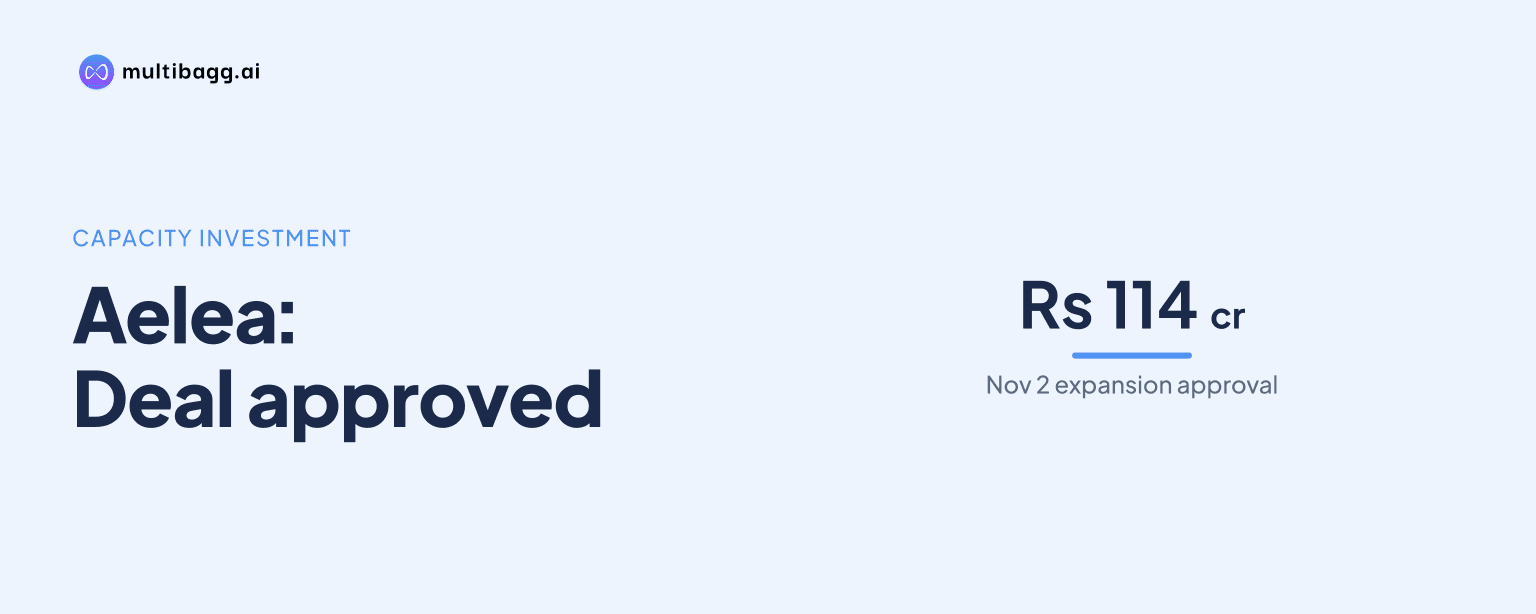
Aelea Commodities Limited approved a ₹114 crore expansion on November 2, 2026, to increase fully utilised shelling capacity from 140 tonnes a day to 200 tonnes a day over 30 months. The project adds 60 tonnes a day of capacity and includes manufacturing facilities, cardanol work and ₹14 crore of staff housing.
Know Aelea Commodities inside out
Results, valuation, peers and who's buying, in one view.
What did Aelea approve on November 2, 2026?
Aelea approved a ₹114 crore project to add 60 metric tonnes a day of shelling capacity, lifting installed capacity to 200 tonnes a day from 140 tonnes a day. Management disclosed the board approval during its H1 FY27 earnings call on November 4, 2026, and said the existing 140-tonne daily capacity had been fully utilised.
The project has a 30-month implementation period and will be funded through internal accruals and debt, according to management. Management said the timetable was set so that a major part of the work could be completed within the period while approvals are obtained, but did not provide a commissioning date for the additional 60 tonnes a day.
How much will Aelea's shelling capacity increase?
Aelea plans a 43% increase in shelling capacity, from 140 tonnes a day to 200 tonnes a day, through the proposed 60-tonne daily addition. Management cited full use of existing capacity as the reason for pursuing the expansion and for its confidence that the added processing capability can be utilised.
The new shelling capacity will be developed on land adjacent to the existing shelling unit. Aelea said its raw cashew purchases originate in Africa, although it contracts with merchant traders based in the United Arab Emirates, Singapore, the United Kingdom, Switzerland and other established trading locations rather than directly with African counterparties.
African-origin procurement has become more important as Aelea's scale has increased, management said. Shipments travel from Africa to India for processing, and management said this sourcing model provides procurement control, although it also exposes the business to longer sea transit times of about 100 days at the time of the call.
What is included in Aelea's ₹114 crore project?
Aelea's ₹114 crore project includes about ₹100 crore for land and the manufacturing unit and ₹14 crore for a staff housing colony. Management said the housing would accommodate staff and certain labour personnel on land already purchased for the site.
The project also includes cardanol development, which management said would begin immediately after the shelling-related component is completed. Aelea did not disclose a separate capital allocation, production capacity, revenue target or commissioning schedule for cardanol within the total ₹114 crore budget.
Aelea presented the investment alongside its processing strategy across food, fuel, feed and fertility applications from cashew and related materials. However, management did not quantify the future revenue, earnings before interest, tax, depreciation and amortisation (EBITDA), or profit after tax contribution expected from the 60-tonne daily shelling addition.
Why is Aelea expanding after H1 FY27?
Aelea is expanding after reporting H1 FY27 revenue of ₹246 crore, a 42% increase from the comparable prior-year period, while existing 140-tonne daily capacity was fully utilised. EBITDA was ₹23 crore in H1 FY27, and management described higher volume capacity as the next stage of growth rather than giving a financial target for the new plant.
Profit after tax was ₹8.63 crore in H1 FY27, compared with ₹8.70 crore in H1 FY26, despite the rise in revenue. Management said the small decline reflected tax differences, while profit before tax was ₹12.54 crore in H1 FY27 compared with ₹12.43 crore in H1 FY26.
Management said percentage EBITDA margins can decline when raw cashew prices rise because raw-material cost passes through revenue while value addition per kilogram remains broadly fixed. Its illustration showed EBITDA of ₹7 per kilogram at raw cashew prices of ₹150, ₹175 and ₹200 per kilogram, while the corresponding margin percentages fall from 4.67% to 4% and 3.5%.
Got a follow-up? Ask IRIS
How will working capital affect Aelea's expansion funding?
Aelea said the ₹114 crore expansion would be financed with a combination of debt and internal accruals, while clarifying that its H1 FY27 borrowings were principally short-term working-capital borrowings. Closing borrowings were ₹232 crore at the end of H1 FY27, compared with ₹111 crore at the end of H2 FY26.
Finance cost was ₹8.39 crore in H1 FY27, compared with ₹8.36 crore in H2 FY26, even though the H1 FY27 closing borrowing balance was higher. Management attributed the working-capital increase to higher raw cashew prices, longer cargo transit periods and additional finished-goods inventory because Diwali occurred later than in the prior year.
Management said cargo transit from West African countries had lengthened to about 110 to 112 days from about 35 to 45 days following logistics disruption around the Red Sea and Bab el-Mandeb. To protect production, Aelea said it procured material from local markets, cargo already at sea or nearing arrival, while continuing to honour regular import contracts.
What could affect use of Aelea's added capacity?
Aelea's ability to use 200 tonnes a day of capacity will depend partly on the availability and movement of African-origin raw material, with transit still taking about 100 days when management answered questions on November 4, 2026. Management said the expected margin benefit from buying closer to origin had not materialised in the period because logistics cycles had lengthened unusually.
Management said it expects procurement and additional-margin benefits from origin-side buying when conditions normalise, without setting a date for that outcome. The company has also begun merchant exports to some Middle Eastern countries, where management sees demand for premium grades such as 180 and 240 when higher prices can reduce Indian demand.
Management said export sales did not then provide materially higher margins than domestic sales, and that India remained the better price-paying market. The Middle East strategy was presented as a route with lower logistics complexity and shorter proximity than more distant markets, rather than as a quantified replacement for domestic demand.
Conclusion
Aelea's ₹114 crore approval addresses a disclosed production constraint by adding 60 tonnes a day to a fully utilised 140-tonne daily shelling base. The expansion combines added shelling capacity with cardanol work and staff housing, while H1 FY27 revenue increased 42% to ₹246 crore but profit after tax was marginally lower at ₹8.63 crore than ₹8.70 crore a year earlier.
The next disclosures to watch are progress against the 30-month project period, the eventual split between debt and internal accruals, and approvals needed for completion. Management also identified unresolved shipping conditions as relevant, with African cargo transit at about 100 days and no timetable for normalisation of the direct-sourcing margin benefit.