










Aelea says sourcing margin gains await logistics normalisation
Key highlights
- Aelea said African shipment times remain about 100 days, versus an earlier 35-to-45-day range.
- Total borrowing was Rs 232 crore at the end of H1 FY27, compared with Rs 111 crore at the end of H2 FY26.
- H1 FY27 revenue was Rs 246 crore, up 42%, while earnings before interest, tax, depreciation and amortisation were Rs 23 crore.
- Aelea approved a Rs 114 crore project to raise shelling capacity from 140 to 200 tonnes per day.
powered by IRIS
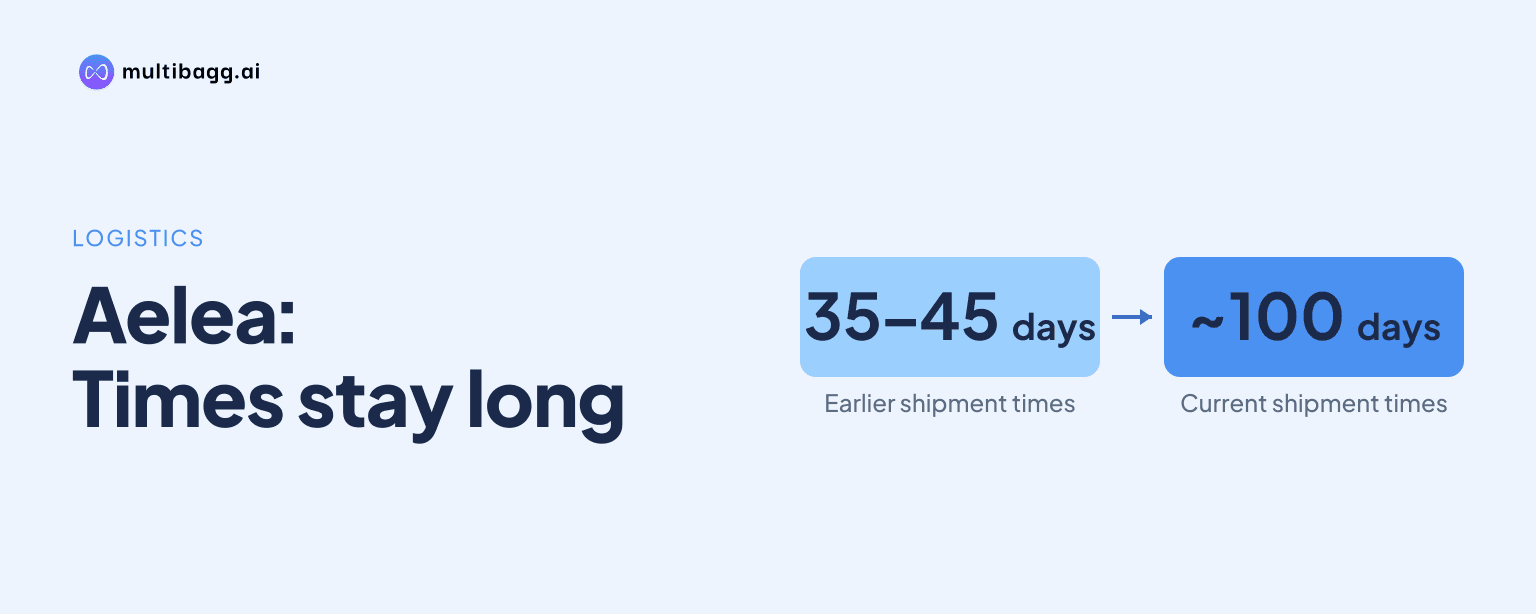
Aelea Commodities Limited said its African-origin sourcing strategy had not delivered the expected additional procurement margin in H1 FY27 because shipment times remained about 100 days, versus an earlier 35-to-45-day range. Management said longer logistics cycles had offset the benefits of buying closer to origin and gave no date for normalisation.
Know Aelea Commodities inside out
Results, valuation, peers and who's buying, in one view.
Why has Aelea's African-origin sourcing not lifted margins?
Aelea said the extended shipping cycle has prevented African-origin sourcing from delivering the added margins it expected in H1 FY27. Management said buying deeper in the procurement chain was intended to improve purchasing control and create additional margins, but described the current logistics environment as an exception that had offset those benefits.
Aelea does not contract directly with African counterparties. It said it contracts with merchant traders based in the United Arab Emirates, Singapore, Europe, the United Kingdom or Switzerland, while raw cashew nut shipments originate in Africa. Management said this contractual model operates within defined legal frameworks, while its larger scale requires purchases from origin rather than only after cargo has arrived in India.
Management linked the disruption to events described on its November 4, 2026 earnings call. It said air strikes involving Iran and the United States began in February and March 2026, conditions worsened in April and May, and the Strait of Hormuz closed by late June. While that closure did not directly obstruct Aelea's raw-cashew logistics, management said rising oil and freight costs increased agricultural-input prices.
The more direct supply-chain impact came from Red Sea disruption and rerouting following the inclusion of Bab el-Mandeb in the conflict, according to management. Aelea said it procured raw materials locally, from cargo already at sea and from nearer arrivals to avoid production disruption, while honouring existing origin-import contracts. That protected factory supplies but required the company to carry inventory through a longer transit cycle.
How long are Aelea's African shipments taking now?
Aelea said shipments from African origins are still taking about 100 days, compared with an earlier 35-to-45-day transit range. Management said some shipments from West African countries had reached 110 to 112 days after vessels were rerouted, and it did not indicate that transit times had returned to normal during H1 FY27.
When asked whether direct-origin procurement could improve margins in H2 FY27 or the next financial year, management said the benefit should arise when logistics normalises. It did not provide a target date, expected transit duration or margin forecast. The timing of any sourcing benefit therefore remains tied to external shipping conditions rather than a company-set schedule.
Aelea declined to compare its approach with other companies sourcing from Africa, saying it did not know their strategies in sufficient detail. Its disclosed strategy is instead based on procurement control and origin access. Management's acknowledgement was that the longer route has so far prevented the expected incremental benefit from appearing in the reported margin outcome.
Got a follow-up? Ask IRIS
Why did Aelea's working-capital borrowing rise in H1 FY27?
Aelea said higher raw-cashew prices, longer cargo transit and additional seasonal inventory increased working-capital funding needs in H1 FY27. Total borrowing was Rs 232 crore at the end of H1 FY27, compared with Rs 111 crore at the end of H2 FY26. Management characterised the increase as mainly short-term working-capital borrowing.
Management said the balance-sheet borrowing figure and the profit-and-loss finance-cost figure measure different things. Finance cost was Rs 8.39 crore in H1 FY27, Rs 3 lakh above Rs 8.36 crore in H2 FY26. It attributed the higher funding requirement to more cash needed for the same physical cashew volume, a longer working-capital cycle and finished-goods inventory held because Diwali was about a month later in the Adhik Maas year.
Aelea reported H1 FY27 revenue of Rs 246 crore, up 42% from the prior-year period, and earnings before interest, tax, depreciation and amortisation of Rs 23 crore. Profit after tax was Rs 8.63 crore, compared with Rs 8.70 crore in the comparison period, and management said earnings per share was 3 rupees lower. The company said this reflects how higher cashew values can raise revenue and funding needs without necessarily increasing value addition per kilogram.
How does Aelea assess margins when cashew prices change?
Aelea said it assesses profitability mainly through absolute earnings before interest, tax, depreciation and amortisation per kilogram, rather than a percentage margin, because raw-cashew prices change the revenue denominator. Management illustrated that a raw-cashew price of 150 rupees per kg, value addition of 27 rupees per kg and operating cost of 20 rupees per kg would produce earnings of 7 rupees per kg, or 4.67% of revenue.
In the same example, a raw-cashew price of 175 rupees per kg leaves value addition, operating cost and earnings per kg unchanged at 27 rupees, 20 rupees and 7 rupees, but reduces the percentage margin to 4%. At 200 rupees per kg, the same 7 rupees per kg becomes 3.5% of revenue. Management said the percentage falls because the commodity-linked revenue base rises while the amount earned per kg remains unchanged.
This approach was also behind management's response to a question on a double-digit profit-after-tax margin. It said a 50% decline in cashew prices could produce a double-digit percentage in H2 through a smaller revenue denominator, while a 50% price increase would have the opposite effect. Management said it focuses on operational efficiency and forward selling to preserve absolute margin per kg.
Aelea nevertheless said its H1 FY27 earnings before interest, tax, depreciation and amortisation margin improved from the prior-year period, while earnings broadly rose in line with the 42% revenue increase. It did not disclose the prior-period earnings amount or the relevant margin percentages on the call. The direct-origin sourcing issue is narrower: management said the extra margin anticipated from that strategy has not yet been realised.
Conclusion
Aelea's H1 FY27 disclosure shows an origin-sourcing strategy operating with a shipment cycle of about 100 days rather than 35 to 45 days. The delay has required more inventory and contributed to total borrowing of Rs 232 crore, while management says the expected procurement-control and margin benefits have not yet reached reported results.
The next disclosed milestones are the solar and CNSL projects, which management expected to start around mid- or end-December, subject to approvals. Investors can also watch the board-approved expansion from 140 to 200 tonnes per day, which has a Rs 114 crore cost and a 30-month timeline, as well as any indication that African shipping times are normalising.