










Aelea says 110-day transit lifted borrowings to Rs 232 crore
Key highlights
- Aelea reported terminal borrowings of Rs 232 crore at the end of H1 FY27, compared with Rs 111 crore at the end of H2 FY26.
- West African raw-cashew transit increased from 35-45 days to 110-112 days, and management said it remained about 100 days.
- Aelea's H1 FY27 finance cost was Rs 8.39 crore, compared with Rs 8.36 crore in H2 FY26.
- Aelea reported H1 FY27 revenue of Rs 246 crore, EBITDA of Rs 23 crore and PAT of Rs 8.63 crore.
powered by IRIS
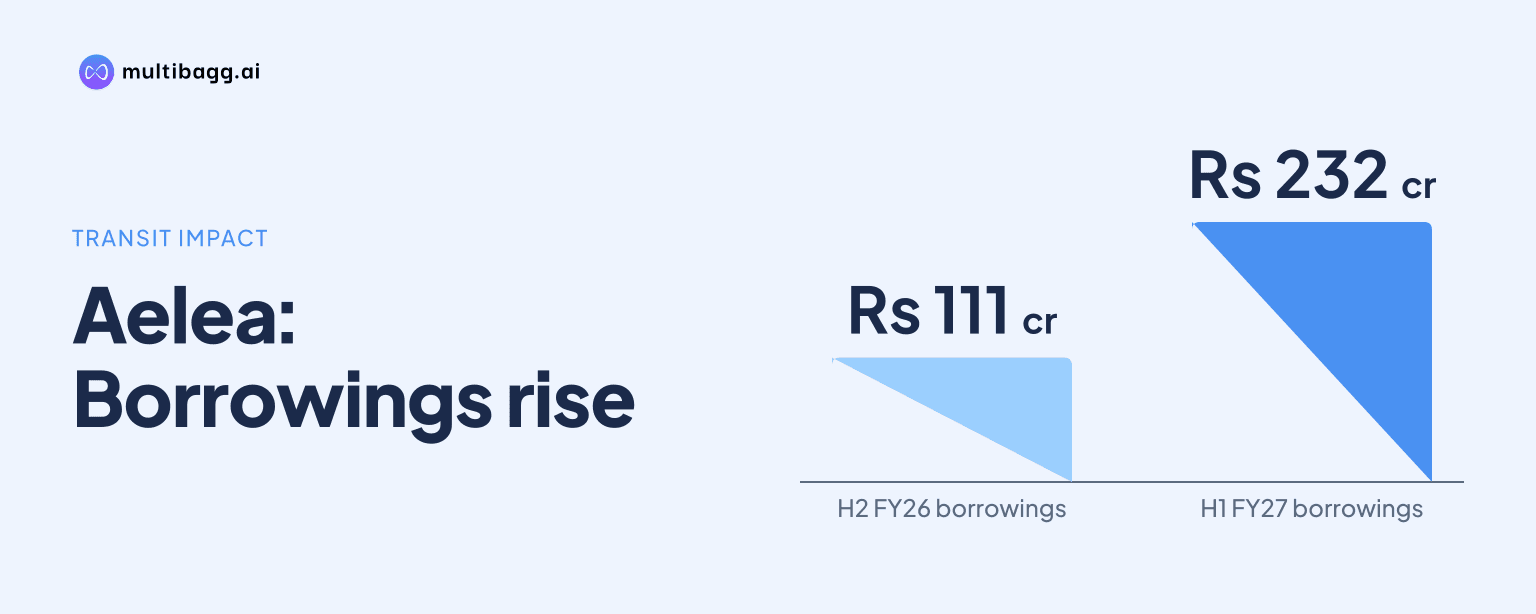
Aelea Commodities Limited said borrowings reached Rs 232 crore at the end of H1 FY27, up from Rs 111 crore at the end of H2 FY26, as West African raw-cashew transit stretched from 35-45 days to 110-112 days. Management said higher cashew prices and later Diwali inventory also increased working-capital needs.
Know Aelea Commodities inside out
Results, valuation, peers and who's buying, in one view.
Why did Aelea's borrowings rise to Rs 232 crore?
Aelea said the Rs 232 crore closing borrowing balance was primarily short-term working capital required for more expensive raw cashew, a longer import cycle and additional finished-goods inventory. The balance was Rs 111 crore at the end of H2 FY26, making the H1 FY27 position Rs 121 crore higher at the reporting date.
Management illustrated the raw-material effect using cashew costing Rs 150 per kilogram and then Rs 200 per kilogram. For the same physical factory requirement, the Rs 50-per-kilogram increase requires additional funding even if processing volume does not change. Aelea said it needs to maintain a certain volume of raw material for production, linking commodity prices directly to working-capital demand.
The seasonal element was also material at September 30, 2026. Management said Adhik Maas put Diwali about a month later than in the prior year, so Aelea was holding a larger quantity of finished inventory at the end of H1 FY27. The company identified this inventory build, along with raw-cashew prices and the longer transit cycle, as the three reasons for the higher borrowing balance.
How did Red Sea rerouting affect Aelea's cashew supply chain?
Aelea said Red Sea and Bab el-Mandeb disruption increased transit from West African origins to 110-112 days, compared with its usual 35-45 days. In the November 4, 2026 question-and-answer session, management said shipments were still taking about 100 days rather than returning to their previous transit time.
Management said the Strait of Hormuz closure by the end of June did not directly disrupt its raw-cashew logistics, but higher oil and logistics costs raised the price of imported agricultural inputs. The Red Sea disruption created the more direct issue for Aelea's cashew sourcing because rerouting extended the sea journey from African origins to India.
Aelea purchases cashew of African origin but contracts with merchant traders based in the United Arab Emirates, Singapore, Europe, the United Kingdom or Switzerland. The shipments nonetheless originate in Africa, and management said the company needs origin-based buying because of its scale. This differs from buying material only after it has landed in India.
Aelea said it prevented the shipping delays from interrupting production by procuring material from local markets, cargo already at sea and consignments close to arrival. It also honoured its existing original-import contracts. That approach supported production continuity, but cash remained tied up for longer while raw material stayed in transit for about 100 days.
Why was Aelea's finance cost nearly unchanged despite higher borrowings?
Aelea said finance cost was nearly unchanged because the Rs 232 crore borrowing figure is a balance-sheet amount at September 30, while finance cost is a profit-and-loss expense measured across six months. Finance cost was Rs 8.39 crore in H1 FY27, compared with Rs 8.36 crore in H2 FY26, a difference of Rs 3 lakh.
The comparison therefore combines different measurements: a closing debt balance and a six-month expense. The September 30 borrowing balance captured the effect of longer cargo transit and inventory held before the later Diwali period, whereas H1 FY27 finance cost accumulated through the six months ending September 30, 2026.
Management did not disclose an average borrowing balance, borrowing rate, repayment schedule or an H2 FY27 finance-cost forecast during the call. It also did not state that the Rs 232 crore balance would remain through H2 FY27. Its disclosed explanation focused instead on the three current working-capital drivers: commodity prices, transit duration and seasonal inventory.
Got a follow-up? Ask IRIS
What did Aelea report for H1 FY27 earnings?
Aelea reported H1 FY27 revenue of Rs 246 crore, up 42% from the previous year, and earnings before interest, tax, depreciation and amortisation, or EBITDA, of Rs 23 crore. Profit after tax, or PAT, was Rs 8.63 crore, compared with Rs 8.70 crore in H1 FY26.
Management said profit before tax was Rs 12.54 crore in H1 FY27, marginally above Rs 12.43 crore in H1 FY26. It attributed the lower PAT figure to differences in current tax and deferred tax. Earnings per share was 3 paise lower than the prior-year period, though the call did not provide the absolute earnings-per-share number.
Aelea said percentage EBITDA margin is less relevant to its model than absolute value addition per kilogram because raw-cashew prices move through revenue. In management's illustration, a Rs 27-per-kilogram value-addition margin less Rs 20 per kilogram of operating cost leaves EBITDA of Rs 7 per kilogram whether raw cashew costs Rs 150, Rs 175 or Rs 200 per kilogram. The percentage margin falls as the raw-material price increases, even while the example's per-kilogram EBITDA remains Rs 7.
What funding and operating plans could affect Aelea next?
Aelea said its board approved a capacity expansion on November 2, 2026, lifting shelling capacity to 200 tonnes per day from 140 tonnes per day. The 60-tonnes-per-day addition will be on land next to the existing shelling unit. Management said the existing capacity had been fully utilised before the approval.
Management estimated the expansion project at about Rs 114 crore, including Rs 14 crore for staff housing, with a 30-month project span. It said internal accruals and debt would fund the project to some extent, but did not disclose the debt share or a commissioning date. The plan also includes cardanol work after the cashew nut shell liquid, or CNSL, component is completed.
Aelea also said its CNSL oil plant and solar plant were in final stages as of November 4, 2026. Management expected completion conservatively by mid- or end-December, subject to approvals, and said the projects should have a positive H2 impact. It did not quantify their revenue, margin, cost-saving or cash-flow contribution.
Conclusion
Aelea's higher H1 FY27 borrowings were linked to a defined working-capital cycle: raw cashew became costlier, transit from West Africa extended to 110-112 days, and a later Diwali required more finished inventory at September 30. These factors lifted closing borrowings to Rs 232 crore from Rs 111 crore, while finance cost was Rs 8.39 crore versus Rs 8.36 crore in H2 FY26.
The next points to watch are whether transit remains around 100 days, whether seasonal inventory converts after Diwali, and whether the CNSL oil and solar plants start by mid- or end-December subject to approvals. Management has also outlined a Rs 114 crore, 30-month shelling expansion with some debt funding, but has not disclosed its funding mix or a borrowing target.