










AIA Engineering plans 25,000-tonne FY28 volume growth
Key highlights
- AIA Engineering is internally planning for 25,000 to 30,000 tonnes of annual volume growth in FY28 and FY29.
- AIA Engineering sold about 126,000 tonnes in H1 FY27 versus roughly 124,000 to 125,000 tonnes in H1 FY26.
- Mining sales were about 39,700 tonnes in Q2 FY27 and about 79,000 tonnes in H1 FY27.
- Freight cost was close to 10% of Q2 FY27 sales versus management’s normal 7% to 8% range.
powered by IRIS
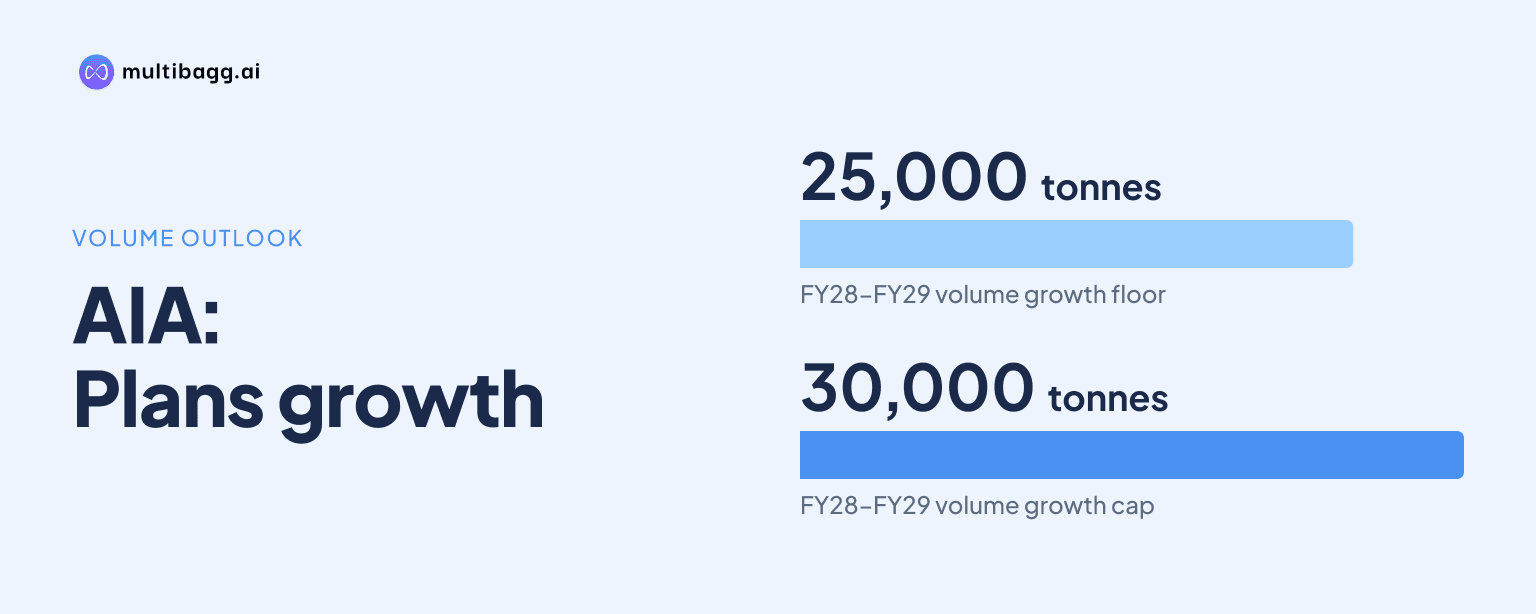
AIA Engineering Limited is internally planning to add 25,000 to 30,000 tonnes of annual volume in FY28 and FY29 after selling about 126,000 tonnes in H1 FY27, only slightly above the roughly 124,000 to 125,000 tonnes sold a year earlier. Management said on November 3, 2026 that the range is not formal guidance.
Know AIA Engineering inside out
Results, valuation, peers and who's buying, in one view.
What is AIA Engineering’s FY28 volume-growth plan?
AIA Engineering plans internally to return to annual volume growth of 25,000 to 30,000 tonnes from FY28, but management has not issued this as a target or formal guidance. Executive Director Kunal Shah said the company had started planning for FY28 and FY29 around that range and viewed it as within the realm of possibility based on current information.
Management said FY27 appears likely to remain flat after two years in which growth expected from trials, new products and other initiatives did not return. It did not provide a total FY28 sales-volume forecast, a quarterly run rate, revenue outlook or margin target linked to the proposed incremental tonnes.
An Axis Capital analyst described the range as roughly 10% to 15% growth, and management did not challenge that calculation. However, AIA Engineering declined to break down how much could come from grinding media, liners, NGDS or other products, saying it would provide more detail only when confidence in the number improves.
Why are AIA Engineering’s FY27 volumes flat?
AIA Engineering said flat FY27 volumes reflect import-duty effects, a temporary mine stoppage and freight-related uncertainty rather than one broad demand issue. Mining sales were about 39,700 tonnes in Q2 FY27 and about 79,000 tonnes in H1 FY27, which management said represented some increase from the corresponding periods a year earlier.
Mexico was one identified source of lost mining volume. Management said Mexico imposed a 50% duty on imports from most countries, including India, after transit-duty actions by the Trump administration, but it did not quantify the tonnes affected. It called the market material but not a large mining country and said it did not expect further duty-related volume reduction.
A Chilean mine also stopped production for nearly two months during Q2 FY27, reducing dispatches to that customer. Management said the mine had returned to normal activity from the current quarter, so an analyst’s assumption of a steady 3,000 to 4,000 tonnes of quarterly dispatches to the site did not apply to Q2.
Non-mining volumes fell 12% year on year and 14% quarter on quarter, according to figures raised by an analyst on the call. Management said the movement reflected timing rather than a structural weakness, and said non-mining may add some volume but is not predictable or expected to be the main driver of the FY28 plan.
How do NGDS trials affect AIA Engineering’s growth outlook?
AIA Engineering’s strategy is to offer liners and NGDS as a package, with grinding-media volume expected to follow successful conversions. Management said trials at several mining sites, including large mines, have taken longer than expected but remain under way as of the November 3 call.
Management said it believes successful liner and NGDS efforts could begin to show results in the second half of FY27, while explicitly declining to give a timing commitment. The company’s plan is to establish the package offering first and then capture related grinding-media volume, rather than lead with grinding media alone.
Trials are therefore relevant to the FY28 growth range, although management did not say the 25,000 to 30,000 tonnes would be delivered regardless of trial outcomes. Shah said the company had refocused on restoring growth in existing conditions, while also stating that NGDS could be an additional contribution, or top-up, to the internal volume range.
Management described each conversion as more than a commodity replacement because it involves engineering, measured outcomes, trials and commercial discussions with a customer. That process explains why it would not assign a completion date to NGDS opportunities or quantify their specific FY28 contribution.
Got a follow-up? Ask IRIS
How is freight affecting AIA Engineering’s volume recovery?
Freight is affecting AIA Engineering through both cost and shipping reliability, with freight expense close to 10% of Q2 FY27 sales versus management’s normal long-term range of 7% to 8%. Management said the Q2 ratio was elevated by high sea freight and some air freight, and expected it to move toward the usual range in the current quarter.
Export freight increased by more than 3.5% year on year in Q2 FY27 and H1 FY27, according to management. It said this contributed to a 2.5% to 3% decline in operating earnings before interest, tax, depreciation and amortisation, while reported earnings before interest, tax, depreciation and amortisation declined by almost 5%.
Management said higher freight lifted realisation by about Rs 178 per kilogram because some cost was passed on to customers, but pass-through does not occur immediately across all contracts. Product mix also influenced the quarter because Q1 had a higher proportion of other castings than Q2, partly offsetting the effect of higher freight-related realisations.
For South American customers, AIA Engineering said shipping delays can become an added obstacle during conversion discussions. Its mitigation approach is to maintain about two months of stock on the ground and another three months of cargo at sea in containers, reducing the risk that interruptions affect a customer’s operations.
What could change AIA Engineering’s FY28 plan?
AIA Engineering said it may provide more colour on the 25,000 to 30,000-tonne range in the next quarter or the quarter after that, when management expects to have more confidence. Progress in mining trials, the normalisation of freight and logistics, and the return of dispatches to the Chilean mine are the disclosed variables behind that update.
The company has kept proposed Ghana and China expansion on hold for one more quarter, while management said it hoped to reconsider geographic expansion by the end of the next quarter. AIA Engineering incurred Rs 86 crore of capital expenditure in H1 FY27 and expected another Rs 250 crore in H2, largely for a corporate-house land transaction plus Rs 50 crore to Rs 75 crore of maintenance and incremental spending; it did not link that expenditure to a stated capacity addition.
Conclusion
AIA Engineering has outlined an internal path back to volume growth after H1 FY27 sales of about 126,000 tonnes remained close to the previous year’s roughly 124,000 to 125,000 tonnes. The proposed 25,000 to 30,000 tonnes of annual growth from FY28 depends on a combination of resumed mine activity, a recovery from duty-related disruption, trial progress and less friction in global logistics, rather than a single disclosed order or contract.
The next point to watch is management’s proposed update in the next quarter or the quarter after that, when it may offer firmer commentary on the volume range. Investors can also watch whether liner and NGDS trials start contributing in H2 FY27, whether freight moves from about 10% of sales toward 7% to 8%, and whether the Ghana and China expansion review is revived by the end of the next quarter.