










AIA Engineering Limited Publishes September 2026 Call Recording
Key highlights
- AIA Engineering made its investor-call recording for the quarter and half year ended September 30, 2026 available on its website.
- AIA Engineering reported Q1 FY27 revenue of ₹1,153 crore and sales volume of 64,644 tonnes.
- Q1 FY27 EBITDA was ₹424.56 crore, with an EBITDA margin of 36%.
- FY26 sales volume was 258,000 tonnes and profit after tax was ₹1,270 crore.
powered by IRIS
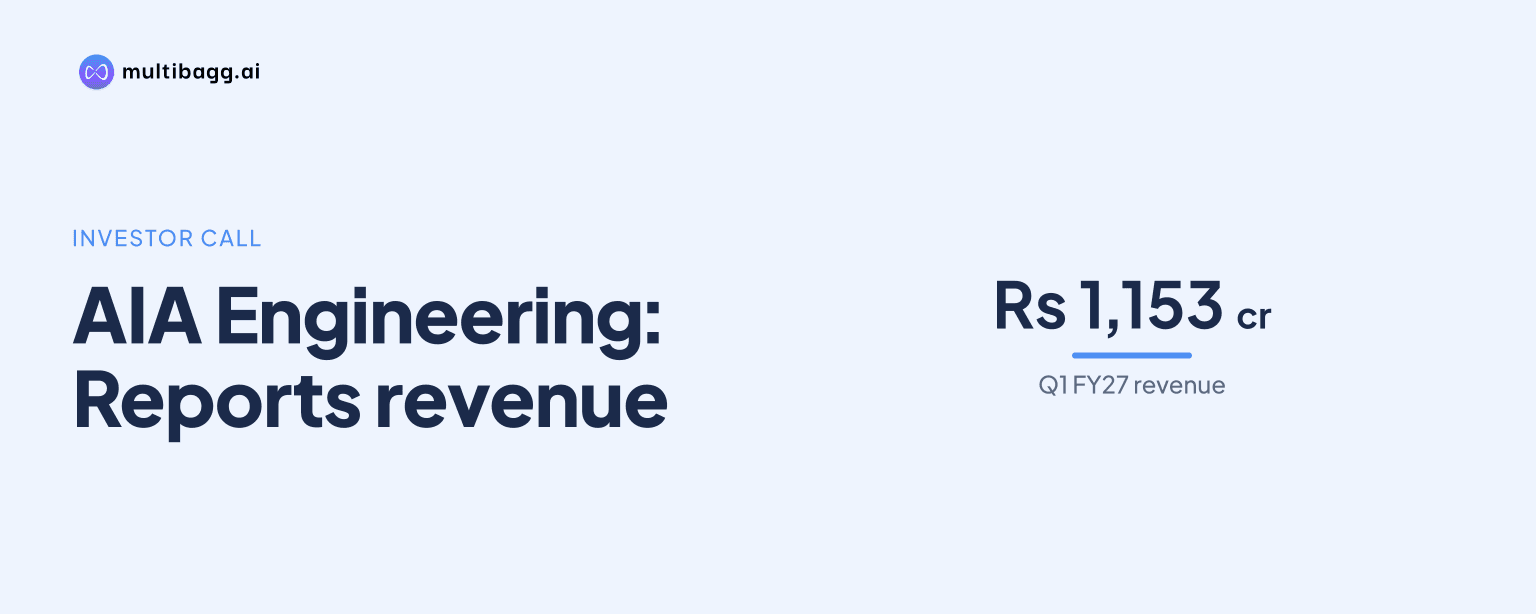
AIA Engineering Limited has made the audio recording of its investor call for the quarter and half year ended September 30, 2026 available on its website, extending disclosure access under SEBI regulations. The latest disclosed operating benchmark in the supplied material is Q1 FY27 revenue of ₹1,153 crore on sales volume of 64,644 tonnes.
Know AIA Engineering inside out
Results, valuation, peers and who's buying, in one view.
What did AIA Engineering disclose for September 2026?
AIA Engineering said it had submitted the audio recording of its investor call concerning financial results for the quarter and half year ended September 30, 2026. The company stated that the recording is available through a link hosted on its website.
The disclosure was made under Regulations 30 and 46(2)(oa) of the Securities and Exchange Board of India (Listing Obligations and Disclosure Requirements) Regulations, 2015. Regulation 30 covers material-event disclosures by listed companies, while the cited website-disclosure provision requires specified investor information to be made available to shareholders and the wider market.
The announcement does not include the financial results, management commentary, or a transcript of the September call. It is therefore a disclosure about access to the recorded discussion rather than a standalone release of new quarterly operating or financial figures.
For investors, the recording can provide management commentary that accompanies the reported results, including discussion of business conditions, volumes, costs, demand, capital allocation, and other issues raised during the call. Any conclusions on performance, however, should be read alongside the company’s formally filed financial statements and presentations.
What earlier investor-call information has AIA Engineering reported?
AIA Engineering has maintained a record of earnings-call disclosures across recent reporting periods. The supplied material identifies a Q1 FY27 call held on August 12, 2026, with its transcript submitted on August 14, 2026, to discuss unaudited results for the quarter ended June 30, 2026.
For Q4 FY26 and the year ended March 31, 2026, the company submitted the transcript of a conference call held on May 26, 2026. Its historical call record also includes Q2 FY26 on November 7, 2025, Q1 FY26 on August 13, 2025, and Q4 FY25 on May 23, 2025.
The availability of recordings and transcripts gives investors a way to compare management’s commentary across periods. It also separates two important parts of company communication: statutory financial results, which contain reported numbers, and earnings calls, which provide management’s explanation and responses to investor questions.
What were AIA Engineering's latest disclosed operating figures?
AIA Engineering reported Q1 FY27 sales volume of 64,644 tonnes and revenue of ₹1,153 crore in the earnings-call highlights included in the supplied material. The volume compared with about 60,000 tonnes in Q1 FY26, indicating a higher sales volume in the reported quarter.
The same Q1 FY27 information cited EBITDA of ₹424.56 crore and an EBITDA margin of 36%. Other income totalled ₹124 crore, including ₹14.78 crore of export benefits, ₹85.35 crore of treasury income, and a foreign-exchange gain of ₹25 crore.
For Q4 FY26, AIA Engineering reported quarterly sales volume of 70,000 tonnes. Full-year sales volume was 258,000 tonnes, compared with 255,000 tonnes in the preceding full year. The company also reported Q4 FY26 EBITDA of ₹502 crore, full-year EBITDA of ₹1,744 crore, Q4 FY26 profit after tax of ₹393 crore, and full-year profit after tax of ₹1,270 crore.
Got a follow-up? Ask IRIS
Why does the September call recording matter to investors?
The September recording matters because it allows shareholders and prospective investors to hear the discussion that followed the company’s results for the first half of FY27. Access to the call can help users assess management’s explanations against the financial statements and the operating metrics disclosed in prior quarters.
The Q1 FY27 data provide a useful reference point for such assessment. Revenue of ₹1,153 crore, EBITDA of ₹424.56 crore, and a 36% margin were the figures cited for the June quarter. Investors reviewing the September discussion can compare any management comments on volumes, margins, other income, or market conditions with these earlier disclosed measures.
The source material also contains a separate table describing revenue from operations of ₹8 crore for the quarter to September 2026 and a year-on-year decline of 55.6%. As this figure differs materially from the other operating information supplied and is not accompanied by the underlying results statement, investors should rely on AIA Engineering’s official filed financial statements for confirmation and context.
The disclosure itself does not state a market-price reaction, new production plan, customer development, or forecast. It therefore does not establish an immediate change in the company’s financial outlook. Its immediate significance is transparency: investors now have access to management’s recorded remarks on the September-period results.
How do SEBI disclosure rules shape AIA Engineering's communication?
SEBI’s Listing Obligations and Disclosure Requirements framework requires listed companies to provide timely, accessible information on material events and specified investor communications. AIA Engineering cited Regulations 30 and 46(2)(oa) when submitting both the September recording notice and earlier conference-call transcripts.
This framework is relevant to retail and institutional investors because management calls often contain operational context not visible in headline profit figures. At the same time, earnings-call remarks should be considered alongside audited or unaudited result filings, since the latter remain the primary source for reported financial measures.
AIA Engineering’s series of transcripts and recordings indicates a recurring approach to investor communication around quarterly results. The historical list spans calls from FY25 through FY27, enabling users to trace changes in disclosed volume trends and management commentary over multiple reporting periods.
Conclusion
AIA Engineering’s latest disclosure makes the September 2026 investor-call recording available under the SEBI listing framework. The filing adds a channel for investors to review management’s discussion of the quarter and half year ended September 30, while the latest detailed operating figures in the supplied material remain Q1 FY27 revenue of ₹1,153 crore and sales volume of 64,644 tonnes.
The next item to watch is the company’s formal financial filing and any transcript associated with the September 2026 call. Those documents can clarify the reported half-year financial performance, provide context for the separately cited September-quarter revenue figure, and allow a direct comparison with the Q1 FY27 metrics already disclosed.