










AIA Engineering Limited says Mexico duty hit under 8,000 tonnes
Key highlights
- AIA Engineering said Mexico’s 50% import duty cut mining volume, with peak annual exposure under 8,000 tonnes.
- AIA Engineering sold 61,500 tonnes in Q2 FY27 and about 126,000 tonnes in H1 FY27.
- Mining sales were about 39,700 tonnes in Q2 FY27 and 79,000 tonnes in H1 FY27.
- Freight was close to 10% of Q2 FY27 sales, versus management’s stated normal range of 7% to 8%.
powered by IRIS
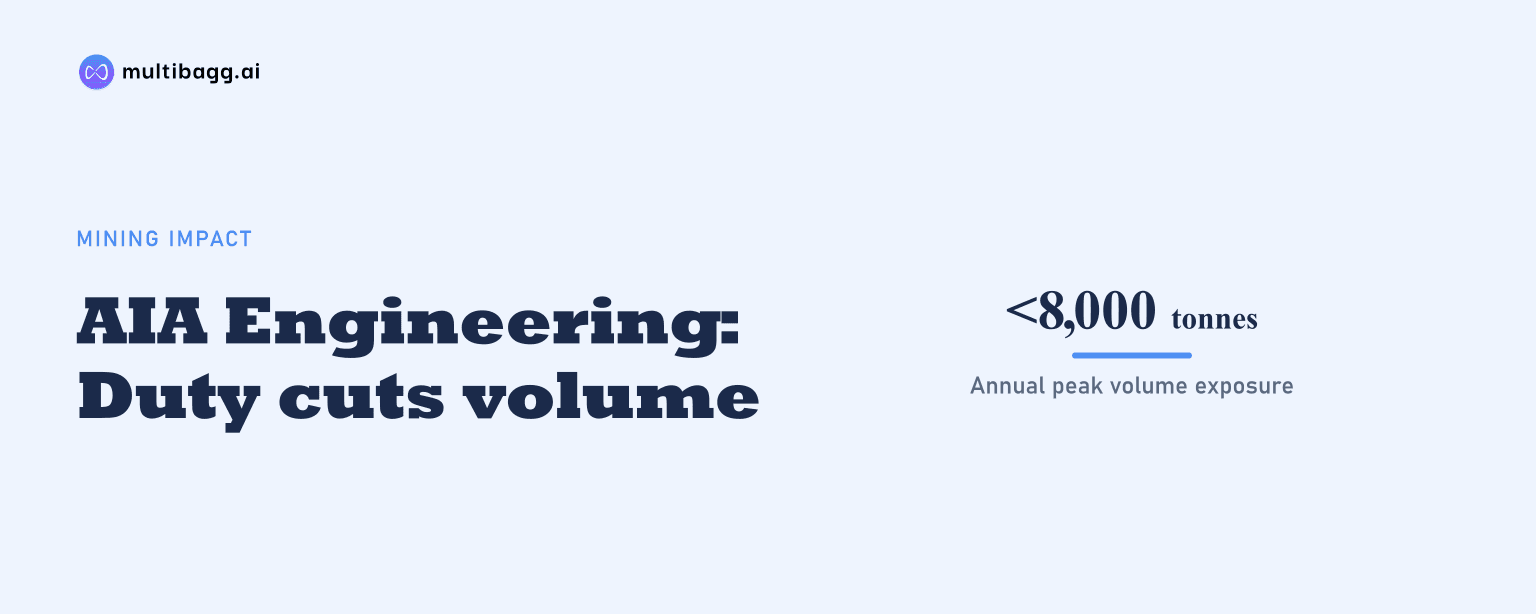
AIA Engineering Limited said on November 3, 2026 that Mexico’s 50% import duty had reduced mining volumes, but the market’s peak exposure was under 8,000 tonnes a year. Management said the effect was already included in Q2 and H1 FY27 volumes and that it did not expect another duty-related reduction.
Know AIA Engineering inside out
Results, valuation, peers and who's buying, in one view.
How did Mexico’s 50% import duty affect AIA Engineering volumes?
AIA Engineering said Mexico’s 50% duty on imports from most countries, including India, caused some volume loss over the preceding 12 months. Management called the affected tonnage material, but said Mexico was not a large mining country and that there was no local producer in the market.
The company rejected the suggestion that its wider mining business was still losing volume. It said the duty had created a specific trade-policy impact, but that the resulting reduction was now in its reported base and represented the “absolute bottom” in relation to the Mexico issue. Management did not disclose whether the levy had been removed, reduced or passed through to customers.
How large was AIA Engineering’s Mexico exposure?
AIA Engineering said its peak annual exposure to Mexico was under 8,000 tonnes. The figure sets an upper bound on the country-specific effect, while management’s Q2 FY27 group sales were 61,500 tonnes and H1 FY27 sales were about 126,000 tonnes.
Management described Mexico as one of several factors behind flat overall volumes in FY27, rather than the sole reason for the performance. Its assessment was that the current-year volume outcome should remain flat, with the duty impact already reflected in the numbers rather than becoming a new source of further reduction.
What did Q2 and H1 FY27 volumes show?
AIA Engineering reported 61,500 tonnes of total sales in Q2 FY27 and about 126,000 tonnes in H1 FY27, slightly above roughly 124,000 to 125,000 tonnes in the corresponding prior-year first half. Q2 production was about 63,600 tonnes, exceeding quarterly sales by 2,100 tonnes.
Mining sales were about 39,700 tonnes in Q2 FY27 and 79,000 tonnes in H1 FY27. Management said both the quarterly and first-half mining comparisons showed an increase from a year earlier, although a Chilean mine had stopped production for almost two months during the quarter, reducing dispatches to that customer.
The Chilean operation had been associated with an expected order run rate of 3,000 to 4,000 tonnes a quarter, according to the analyst who raised the issue. Management said the mine had resumed normal production from the current quarter, making its low dispatches a separate operational factor from the Mexico import-duty effect.
Got a follow-up? Ask IRIS
What other factors affected AIA Engineering’s volume and freight performance?
AIA Engineering said non-mining volume movements were a timing issue rather than a structural weakness. An analyst said non-mining volumes had declined 12% year on year and 14% quarter on quarter in Q2 FY27, while management said the segment should be assessed annually because it is less predictable and not expected to be a major driver of group growth.
Freight was another constraint in Q2 FY27, with freight cost close to 10% of sales against management’s stated normal range of 7% to 8%. Management attributed the higher quarterly level to a mix that included air freight and elevated sea freight, and said it expected the ratio to return to the 7% to 8% range in the current quarter.
The company said export freight cost had risen by more than 3.5% year on year in both Q2 and H1 FY27. It linked that increase to a roughly 2.5% to 3% decline in operating earnings before interest, tax, depreciation and amortisation, or EBITDA, while saying Q2 reported EBITDA declined by nearly 5%.
Management also described shipping reliability as an issue for mining conversions, particularly in South America. It said it could mitigate delivery risk by placing more cargo in containers, including keeping additional material at sea beyond stock held at customers’ sites, but called geopolitical logistics uncertainty an additional friction point in customer discussions.
What is AIA Engineering planning after the Mexico duty impact?
AIA Engineering is internally working toward annual volume growth of 25,000 to 30,000 tonnes in FY28 and FY29 after expecting FY27 to remain flat. Management explicitly said this was not formal volume guidance and that it would provide firmer guidance only when it had greater confidence in the outlook.
The company’s mining strategy is to pursue liner and NGDS packages through customer trials, then seek related grinding-media volumes after those solutions gain traction. Management said trials at mining sites, including large mines, had taken longer than expected, but it believed some results could become visible in H2 FY27 without providing a firm timetable.
Management said NGDS-related volumes could be additional to its broad 25,000-to-30,000-tonne internal planning range. It also said expansion plans in Ghana and China would remain on hold for one more quarter, with a possible reconsideration by the end of the next quarter as the company focuses on trials and customer conversions.
Conclusion
Mexico’s 50% import duty was a defined headwind for AIA Engineering, but management put peak exposure at under 8,000 tonnes a year and said the impact was already embedded in current volumes. Group sales still reached about 126,000 tonnes in H1 FY27, slightly above the comparable prior-year period, while freight costs and a temporary Chile mine stoppage also influenced the quarterly outcome.
The next indicators are whether liner and NGDS trials begin contributing in H2 FY27, whether freight returns from nearly 10% of Q2 sales toward management’s 7% to 8% range, and whether the internal FY28 and FY29 growth plan becomes formal guidance. Management also expects to reconsider its paused Ghana and China expansion plans by the end of the next quarter.