










AIA Engineering says shipping uncertainty slows mine conversions
Key highlights
- AIA Engineering proposed holding an additional three months of cargo at sea beyond about two months of customer stock on the ground.
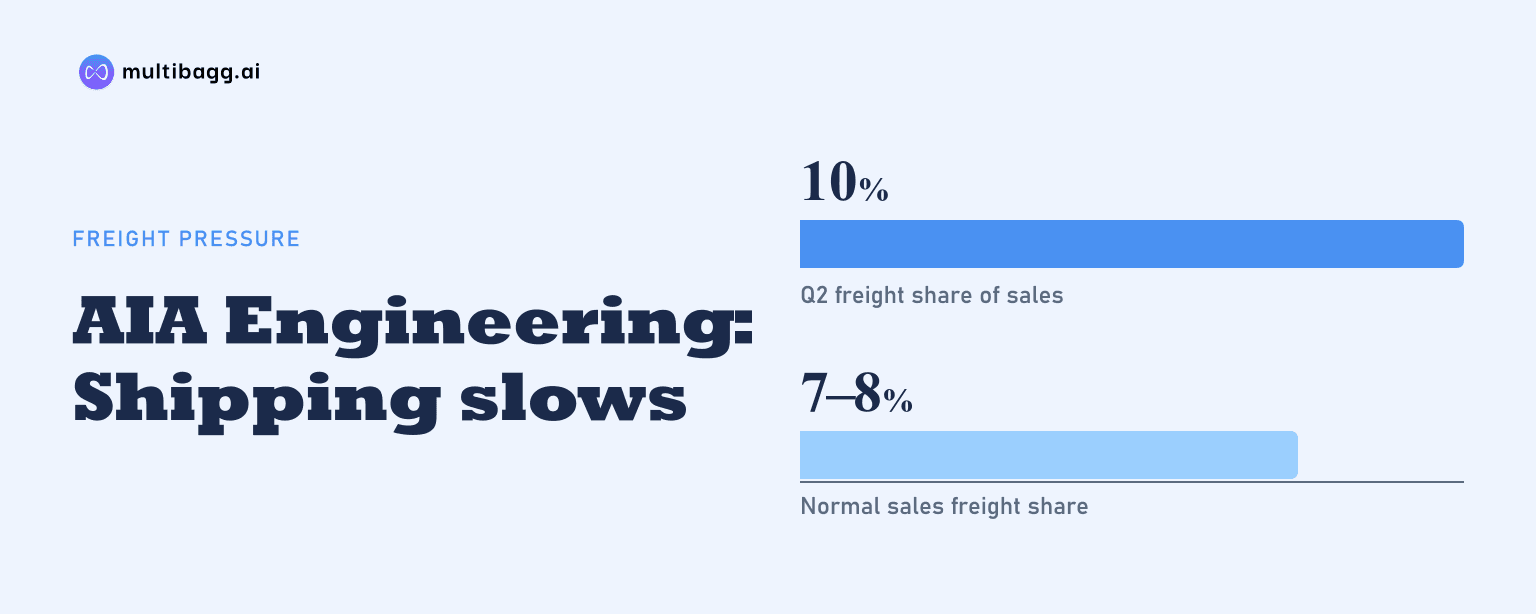
- AIA Engineering said freight was close to 10% of sales in Q2, versus management's normal 7% to 8% range.
- AIA Engineering said 25,000 to 30,000 tonnes of incremental volume looks possible from next year, but this is not guidance.
- An analyst cited order backlog of about Rs 1,070 crore, which AIA Engineering attributed to recent order inflow rather than dispatch delays.
powered by IRIS
In Q2, AIA Engineering said uncertain shipping was slowing complex mine conversions and proposed keeping an additional three months of customer cargo at sea, beyond about two months of stock on the ground. Management said the issue was a commercial friction in solution-led conversions, not solely a freight-cost problem.
Know AIA Engineering inside out
Results, valuation, peers and who's buying, in one view.
What is slowing AIA Engineering's mine conversions?
AIA Engineering said long and uncertain shipping lead times are adding friction to discussions with mine customers, particularly in South America. Management cited disruption around the Red Sea and Hormuz, among other geopolitical developments, and said some customers wanted the environment to settle before proceeding. The concern is continuity of mine operations if deliveries are delayed or interrupted, rather than only the cost of transport.
AIA Engineering said a conversion is not a straightforward commodity replacement. The process includes an engineered solution, expected operating outcomes, measurement, trials and solution engineering for the customer, alongside commercial and currency considerations. Shipping uncertainty is therefore another decision point in a process that already requires technical validation, and management said normalization would remove a friction point rather than automatically create demand upside.
How will AIA Engineering protect customers from shipping delays?
AIA Engineering's proposed mitigation is to put more cargo into containers and extend the supply buffer in transit. Management described a model in which a customer holding about two months of stock on the ground would also have another three months of cargo at sea. The stated aim is to prevent a mine's operations from suffering if sea shipments are delayed or interrupted.
The proposed three-month cargo-in-transit buffer is directed at delivery reliability during a conversion, when a customer needs confidence in supply continuity while adopting an engineered solution. AIA Engineering said it has mitigation measures but hopes broader disruption resolves sooner rather than later. The response makes inventory positioning part of the commercial offer, rather than relying on a change in spot freight prices.
How large was AIA Engineering's Q2 freight-cost impact?
AIA Engineering said freight cost was close to 10% of sales in Q2, compared with management's normal range of 7% to 8%. Management attributed the higher share to a freight mix that included some air freight as well as elevated sea freight. It said it expected freight to move back to the 7% to 8% range in the current quarter, while recognizing that shipping conditions remain uncertain.
Management said higher freight cannot be passed through immediately on a spot basis. Part of the increase was passed through in Q2 and part was expected to flow into the next quarter, creating a timing effect on costs and realizations. It also said Q2 had a lower contribution from other castings than Q1, so product mix partly offset the effect of higher freight in quarter-on-quarter comparisons.
Got a follow-up? Ask IRIS
Is AIA Engineering's higher order book caused by shipping delays?
AIA Engineering said its higher open-order position was not caused by delayed dispatches of finished goods. An analyst cited order backlog of about Rs 1,070 crore, compared with a range of roughly Rs 500 crore to Rs 700 crore from FY21 to FY25 or FY26. Management said the increase reflected good and reasonably large purchase orders received in the final month of Q2.
AIA Engineering said its contracts are long term and the order book records purchase orders received under those contracts. Management specifically rejected the suggestion that orders had accumulated because goods could not be dispatched. That separates the order-book increase, which it linked to new order inflow, from the shipping risk it described in conversion discussions and customer inventory planning.
What does shipping uncertainty mean for AIA Engineering's growth plan?
AIA Engineering said the current year appears likely to remain flat, while its internal plan is to return to growth from next year, with 25,000 to 30,000 tonnes of incremental volume considered possible. Management stressed that this was not guidance and said it would offer firmer commentary only after gaining confidence. It identified freight as a continuing variable, alongside the impact of duties in Mexico.
Management said NGDS, the programme name used by management, could be additional volume beyond the 25,000-to-30,000-tonne directional comment. However, two trial outcomes remain unresolved: one mine trial has been delayed and another has moved into redesign and reiteration. Management said success in NGDS and liner-based volumes could become visible in the second half of the current fiscal, with grinding-media volume expected to follow, but gave no firm timetable.
Conclusion
AIA Engineering's Q2 discussion places shipping disruption at the centre of its mine-conversion challenge. Freight close to 10% of sales versus management's normal 7% to 8% range affected costs, but management's broader concern is whether mines can depend on supply while evaluating conversions involving trials, engineering and operating measurement. The additional three months of cargo at sea is intended to address that reliability concern.
The next issues to watch are whether freight returns toward the 7% to 8% range in the current quarter, whether management reconsiders Ghana and China expansion by the end of the next quarter, and updates on the delayed and redesigned NGDS trials. Management also said it may provide more detail on the 25,000-to-30,000-tonne volume outlook in the next quarter or the quarter after that.