










Alpex pauses ingot-wafer project over China restrictions
Key highlights
- Alpex said its almost-ready ingot-wafer factory is paused pending Chinese policy clarity, with a decision expected around January 5 or January 10.
- Alpex expects its 2.2-gigawatt solar-cell line to reach complete capacity from January 1 at 95%-96% utilisation.
- Alpex has paused its planned 3.6-gigawatt module expansion and may lease module capacity if required.
- Management guided for around Rs 1,200 crore of second-half revenue and disclosed an order book of Rs 1,600 crore to Rs 1,700 crore.
powered by IRIS
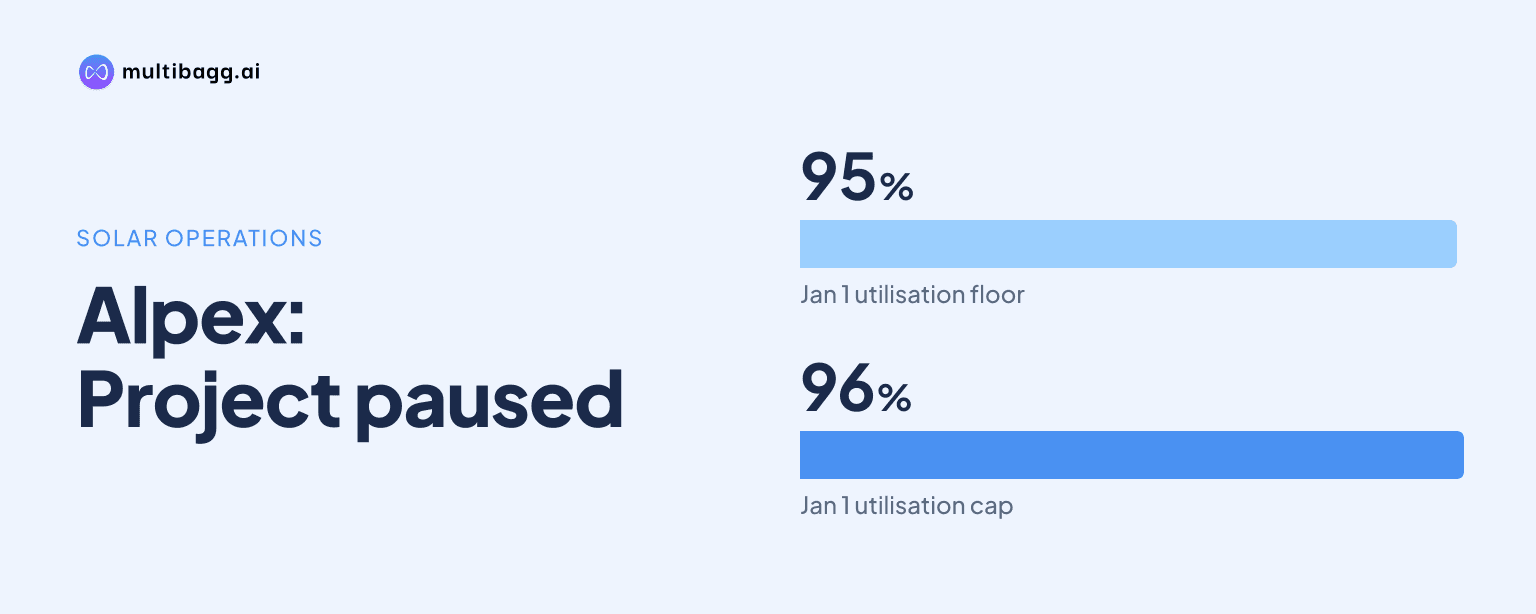
Alpex has paused its almost-ready ingot-wafer factory pending clarity on Chinese technology-export restrictions, with management planning a decision around January 5 or 10, even as its 2.2-gigawatt solar-cell line is expected to reach full capacity from January 1. The pause also coincides with a hold on the planned 3.6-gigawatt module expansion.
Know Alpex Solar inside out
Results, valuation, peers and who's buying, in one view.
Why has Alpex paused the ingot-wafer project?
Alpex paused the ingot-wafer project because management said Chinese policy on technology transfer and solar-manufacturing equipment remained unclear. Management said the factory was almost ready, its technology tie-up was in place and financial arrangements had been completed to a great extent. It said the final form of the Chinese restrictions was expected in the public domain within two weeks of the call.
Management said the issue extends beyond a single machine because solar-cell production requires every linked manufacturing step to be available. It cited atomic layer deposition, or ALD, equipment as an example of high-technology machinery affected by restrictions. According to management, the absence of one stage in a production chain can prevent solar-cell output even if the other equipment is installed.
The company said its existing 2.2-gigawatt cell line faces a different position because the complete line had already reached the site and was operating. For the ingot-wafer project, however, Alpex said it would wait for the written Chinese policy and then decide around January 5 or January 10. Management also said Tata and Adani had paused solar-wafer projects, without disclosing capacities or timelines for those companies.
What is the status of Alpex’s solar-cell line?
Alpex said its 2.2-gigawatt solar-cell line was stabilising and that complete capacity would be available from January 1. Management described 100% utilisation as the industry-standard 95%-96% operating level, rather than output at every hour of theoretical installed capacity. It had earlier said full capacity would be reached by the end of the month discussed on the call, followed by roughly 10 days of stabilisation.
The cell line is central to Alpex’s near-term operating plan because management intends to sell cells while being selective in the module market. It said it would continue using its module factories for its own demand but would not pursue aggressive panel sales. The stated reason was module pricing that management said was not remunerative for producers selling at very low prices.
Management said about 80% of the equipment for its cell-production capacity came from China, with some capacity sourced from Taiwan. It said this equipment had already arrived, limiting the immediate effect of new Chinese restrictions on the operating line. For any future expansion subject to an import embargo, management identified Taiwan, Korea and Germany as possible equipment sources but did not disclose costs, lead times or supplier commitments.
Got a follow-up? Ask IRIS
Why did Alpex also pause module expansion?
Alpex paused its planned 3.6-gigawatt module expansion because management said ample module capacity was already available in the market. It said the company may lease capacity if needed rather than immediately build additional owned capacity. Management did not disclose the potential leased capacity, a lease counterparty or a date for restarting the 3.6-gigawatt plan.
Management attributed the different treatment of cells and modules to market conditions. It said Indian module capacity was 225-250 gigawatts against demand of 60-70 gigawatts, while imports were also allowed in parts of the market. These were management’s estimates during the call, and they explain its stated decision to reduce module sales rather than accept orders that could reduce profitability.
The change in module strategy also reduced the company’s stated revenue expectation for the second half. Management guided to around Rs 1,200 crore of revenue for that period. An analyst on the call said a previous discussion had indicated more than Rs 2,000 crore for the combined third and fourth quarters; management responded that competitive module pricing, rather than the domestic-content policy alone, had changed the sales approach.
Can frames and policy listings reduce Alpex’s supply-chain risk?
Alpex said its aluminium-frame business can reduce exposure to a separate supply-chain risk. Management said it began frame manufacturing two years earlier and had started an expansion intended to double or triple capacity. It said frames represent about 10%-11% of a solar panel’s cost and that a shortage of frames could stop a module factory from operating.
Management linked the frame expansion to domestic policy measures. It said Bureau of Indian Standards, or BIS, requirements for frames would apply from December, while an anti-dumping-duty investigation had started and could have an effect within another two to three months. Alpex said internal frame output would insulate it from a frame-availability disruption, although management did not quantify the business’s revenue or profit contribution.
On demand, management said the Approved List of Models and Manufacturers-II, or ALMM-II, was already active, but commercial and industrial demand had received a six-month reprieve. It said that reprieve would end on January 1, adding demand for domestic manufacturing. Alpex also said its Rs 1,600 crore to Rs 1,700 crore order book could rise after its expected listing process, though the timing and extent of any increase were not disclosed.
Conclusion
Alpex’s pause means its backward integration into ingot and wafer production is waiting on policy clarity rather than being abandoned. The company said its facility, technology tie-up and much of its financing preparation were in place, but Chinese restrictions could affect the equipment and technology route required to complete the project. At the same time, Alpex is prioritising its 2.2-gigawatt cell line and limiting module exposure while the 3.6-gigawatt module expansion remains on hold.
The next disclosed event is the expected release of clearer Chinese policy details within two weeks of the call, followed by Alpex’s proposed decision around January 5 or January 10. Management’s January 1 target for complete cell-line capacity, defined as 95%-96% utilisation, and any update on leasing module capacity or the relevant domestic listing process are the other stated milestones to watch.