










Alpex Solar targets Rs 1,200 crore H2 revenue at least from cells
Key highlights
- Alpex Solar guided for at least Rs 1,200 crore of H2 FY27 revenue on November 18, 2026.
- Alpex Solar expects about 35% EBITDA margin at the cell level from its 2.2-gigawatt line.
- Management expects 500 megawatts to 600 megawatts of cell production and sales during the initial ramp-up period.
- Alpex Solar reported an order book of Rs 1,600 crore to Rs 1,700 crore on November 18, 2026.
powered by IRIS
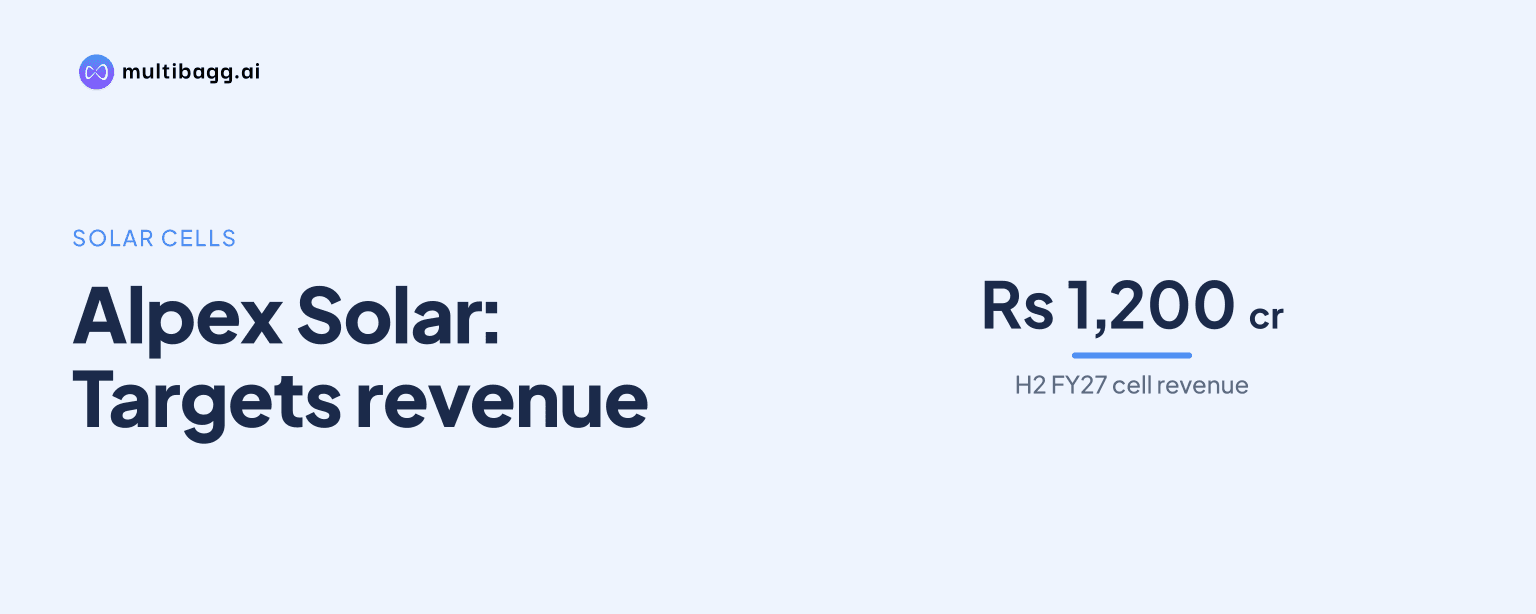
Alpex Solar Limited is targeting at least Rs 1,200 crore of revenue in H2 FY27 while prioritising sales from its 2.2-gigawatt cell line over module orders that management considers non-remunerative. Management gave the target on November 18, 2026, as trial production at the cell factory moved into ramp-up.
Know Alpex Solar inside out
Results, valuation, peers and who's buying, in one view.
What is Alpex Solar’s H2 FY27 revenue target?
Alpex Solar’s H2 FY27 revenue target is around Rs 1,200 crore, which management later described as a minimum. Managing Director Ashwani Sehgal gave the guidance in response to a question on second-half sales, while saying the company was not pursuing revenue growth regardless of the return generated by module orders.
The H2 target follows what management called a “small hit” to top line in the reported quarter after Alpex Solar declined certain module sales. The company did not provide separate Q3 and Q4 revenue forecasts, and it did not disclose a specific H2 profit after tax, or PAT, target.
Management said it could end FY27 with consolidated PAT of Rs 200 crore to Rs 250 crore, after reporting around Rs 60 crore at the time of the November 18 call. It also said blended margin could be lower than it had expected because module economics remained under pressure, although it did not withdraw the full-year PAT indication.
Why is Alpex Solar rejecting module orders?
Alpex Solar is rejecting module orders that management considers non-remunerative because it says excess capacity has reduced module margins. Sehgal said some manufacturers were selling solar panels at prices that could cause losses, while Alpex Solar had decided not to chase top-line growth under those conditions.
The company has 2.4 gigawatts of operating module capacity, which management said allows it to be selective. Alpex Solar said it would use its module factories for its own demand but take a separate approach to aggressive third-party module sales until pricing becomes more favourable.
Cells are the alternative sales route when module orders do not produce sufficient cash generation, according to management. Sehgal said the cell business would be the principal contributor to profitability in the shorter term, while management expects module-market pressure to ease from April after possible industry consolidation or factory closures.
That expectation is management’s assessment rather than a quantified industry forecast. The call did not specify how much module capacity could close, identify affected competitors, or provide a date by which module margins would recover beyond the reference to April.
How will the 2.2-gigawatt cell line support revenue?
Alpex Solar expects its 2.2-gigawatt TOPCon cell line to support H2 revenue and become the main near-term contributor to profitability. Management maintained its expectation of cell-level earnings before interest, tax, depreciation and amortisation, or EBITDA, margin of about 35%.
Trial production had started by November 18, and management said the first production line would be completed immediately, followed by the second and third lines at intervals of six to seven days. It expected the full 2.2-gigawatt line to be operational by November 30, with roughly another 10 days required for stabilisation.
Management said it had visibility for four to four-and-a-half months of cell capacity and estimated that 500 megawatts to 600 megawatts could be produced and sold as cells or solar panels. It also said the line should begin operating at what it called 100% utilisation from January 1, clarifying that industry-standard utilisation is 95% to 96%.
The initial sales mix depends partly on domestic-compliance listing. Alpex Solar said it could sell cells as non-domestic-content cells before the listing, while sales as domestic-content-compliant cells would follow approval. Management said fees had been paid, processes completed and officials were expected to inspect the factory around November 24 or 25.
Got a follow-up? Ask IRIS
Which policy developments could affect Alpex Solar’s sales?
Alpex Solar said the domestic-cell requirement was already active, although commercial and industrial, or C&I, demand had a six-month reprieve that management said would end on January 1. Management expects the expiry to add demand for locally made cells and said it was receiving enquiries for TOPCon cells.
The company described its cell line as a G12R TOPCon facility and said India’s module capacity stood at 225 gigawatts, with almost 60% in TOPCon cells. Those industry figures were cited by management to support its view that demand exists for domestic-content-compliant cells despite the current module oversupply.
Alpex Solar also pointed to changes affecting aluminium frames, which management said represent around 11% of a solar panel’s cost. It said Bureau of Indian Standards requirements would apply to frames from December, while an anti-dumping investigation had begun and could have a conclusive effect within two to three months.
The company said it began producing frames two years ago and has started expanding that business, without disclosing a final capacity figure. In contrast, it has paused its planned 3.6-gigawatt module expansion because market capacity is ample, though management said it could lease capacity if required.
How do inventory and orders affect H2 delivery?
Alpex Solar said its inventory increased as it commissioned a second G12R module factory and prepared materials for the cell line. Management said it held more than 200 megawatts of raw materials for solar-cell production, including inputs needed to support a continuous manufacturing process.
Wafers, silver paste, gases and other cell inputs have long lead times and are not available in India, according to management. Alpex Solar therefore expects inventory to increase in the short term as it buys more raw materials, even while it expects total inventory to decline somewhat by March 31 as turnaround time improves.
The company reported an order book of Rs 1,600 crore to Rs 1,700 crore on November 18 and said it should grow after the domestic-compliance listing. Management said the availability of orders was not the main constraint, but selective acceptance of module business means not all demand will necessarily translate into H2 revenue.
Alpex Solar has also paused its ingot-and-wafer project despite saying its factory was almost ready. Management cited uncertainty over Chinese restrictions on technology transfer and equipment, and said it would take a decision after the policy position became clearer around January 5 to January 10.
Conclusion
Alpex Solar’s at-least-Rs-1,200-crore H2 FY27 revenue target reflects a deliberate mix decision rather than a broad volume target. Management is directing the 2.2-gigawatt cell line toward sales with an expected cell-level EBITDA margin of about 35%, while limiting module orders that it says could impair profitability.
The next points to watch are the completion and stabilisation of the cell line after November 30, the expected domestic-compliance listing process following the November 24 or 25 inspection, and the January 1 end of the C&I reprieve. Management’s decision around January 5 to January 10 on the paused ingot-and-wafer project, as well as its expectation that inventory will decline somewhat by March 31, will also affect the execution path.