










Alpex plans 5 GW each of solar glass and ingot-wafer capacity
Key highlights
- Alpex plans 5 GW each of solar-glass and ingot-wafer manufacturing capacity over the next three years.
- Alpex targets production from a 100 MW ingot-wafer pilot by the end of Q1 FY 2027-28.
- The presentation projects a 107 GW domestic wafer supply gap in FY35E, with 163 GW demand and 56 GW supply.
- Alpex reported FY 2025-26 revenue from operations of Rs 2,223.27 crore and EBITDA of Rs 327.39 crore.
powered by IRIS
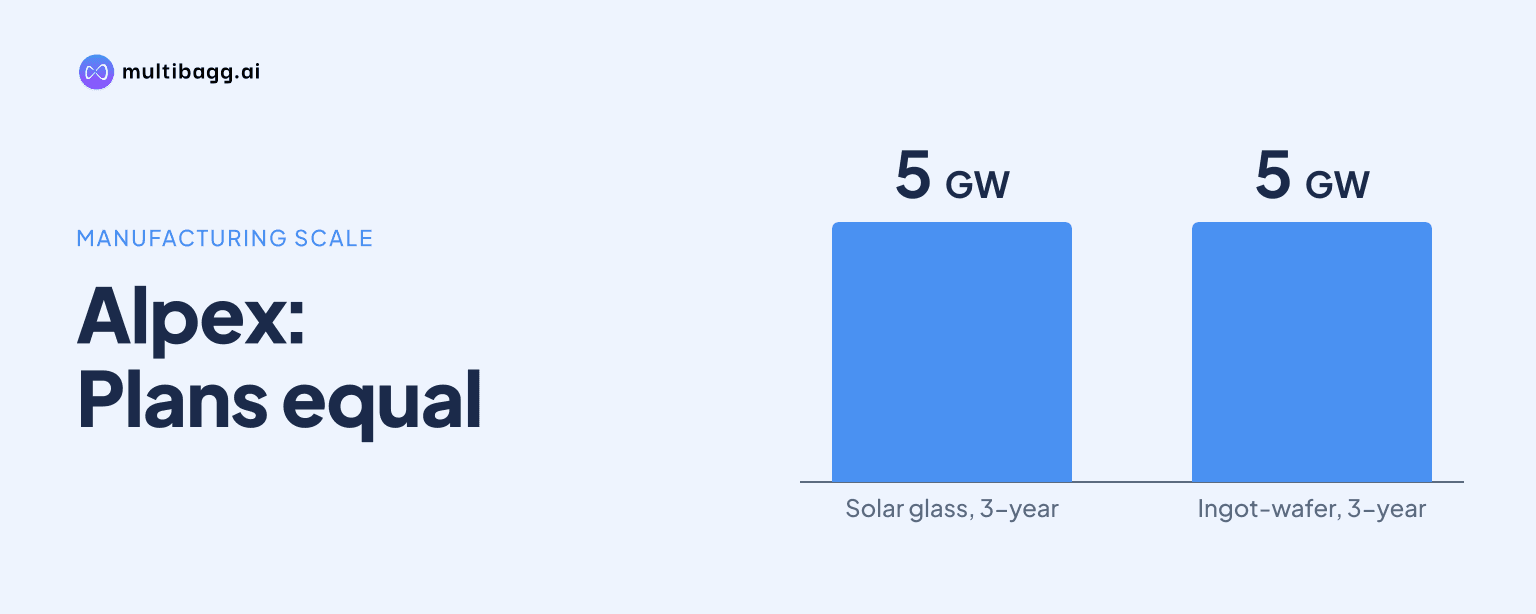
Alpex Solar Limited plans phased 5 gigawatt (GW) solar-glass and 5 GW ingot-wafer capacity over the next three years, starting with a 100 megawatt (MW) pilot likely to enter production by the end of Q1 FY 2027-28, as it seeks to extend manufacturing upstream from modules and cells.
Know Alpex Solar inside out
Results, valuation, peers and who's buying, in one view.
What upstream capacity is Alpex planning?
Alpex is planning 5 GW of solar-glass manufacturing and 5 GW of ingot-wafer manufacturing through phased implementation over the next three years. The proposal sits alongside its cell-production roadmap and would extend its manufacturing chain across modules, cells, ingots and wafers.
The first disclosed step is a 100 MW ingot-wafer pilot plant that Alpex says is likely to begin production by the end of Q1 FY 2027-28. Management says the pilot will familiarise its core team with advanced technology and processes before the larger phased ingot-wafer build-out.
Alpex says it is in advanced stages of finalising technology partners, while land acquisition for the proposed facilities is expected to conclude shortly. Both plants are planned for Uttar Pradesh, where Alpex says six units are near operational readiness and could provide ecosystem and execution synergies.
Why is Alpex moving into wafers and solar glass?
Alpex is moving upstream because its presentation projects a persistent domestic wafer deficit, with demand reaching 163 GW in FY35E against supply of 56 GW. That 107 GW projected gap is materially different from modules, where supply is forecast to reach 144 GW in FY35E against demand of 163 GW.
The projected imbalance is especially pronounced in FY27, when domestic wafer demand is shown at 62 GW and supply at 2 GW. In contrast, domestic module supply is projected at 89 GW against demand of 63 GW in FY27, while domestic cell supply is forecast at 48 GW against demand of 63 GW.
For solar cells, the presentation projects supply below demand from FY25 through FY28, including a 15 GW gap in FY27. Supply is forecast to rise to 89 GW in FY29 versus 68 GW of demand, although the presentation says there will be no meaningful cell overcapacity until FY30.
How could cell manufacturing change Alpex margins?
Management says the commencement of cell manufacturing could nearly double Alpex's historical earnings before interest, taxes, depreciation and amortisation (EBITDA) margin of 16-17% and profit after tax (PAT) margin of 8-9%. This is management's expectation, based on enhanced value addition and operational leverage, rather than a financial-year-specific earnings forecast.
Reported EBITDA margin declined to 14.73% in FY 2025-26 from 16.42% in FY 2024-25, while PAT margin fell to 9.06% from 10.70%. Over the same period, revenue from operations increased to Rs 2,223.27 crore from Rs 780.15 crore and EBITDA rose to Rs 327.39 crore from Rs 128.13 crore.
Across the four years shown, Alpex's revenue from operations rose from Rs 194.68 crore in FY 2022-23 to Rs 2,223.27 crore in FY 2025-26. EBITDA increased from Rs 12.70 crore to Rs 327.39 crore, while PAT increased from Rs 3.74 crore to Rs 201.51 crore; EBITDA margin moved from 6.52% to 14.73% and PAT margin from 1.92% to 9.06%.
Got a follow-up? Ask IRIS
What market gap does Alpex say supports the plan?
Alpex says India has 225 GW of solar-module capacity under the Approved List of Models and Manufacturers, List I (ALMM-I), including 200 GW of TOPCon module capacity. It puts functional TOPCon module capacity at 120 GW, or 60% of that 200 GW figure, compared with 22 GW of TOPCon solar-cell capacity under ALMM-II.
The presentation states that total solar-cell capacity under ALMM-II is 47 GW, of which 46%, or 22 GW, is TOPCon. Alpex characterises the gap between 200 GW of TOPCon module capacity and 22 GW of TOPCon cell capacity as a cell shortage, and says India remains import-dependent for ingots and wafers.
Management says Alpex is aligning cell production with ALMM-II and preparing for ingot and wafer manufacturing under ALMM-III by June 2028 as Phase 1. The end-Q1 FY 2027-28 production target for the 100 MW pilot precedes that June 2028 reference, but the presentation does not specify the scale or commissioning dates of later phases.
What remains unconfirmed in Alpex's expansion plan?
Alpex has not disclosed the capital expenditure, funding method, customer commitments or a detailed commissioning schedule for the two 5 GW facilities. The stated next steps are finalising technology partners and completing land acquisition for the Uttar Pradesh projects.
The market outlook is also based on projections rather than disclosed orders or contracted utilisation. The presentation forecasts domestic wafer demand rising from 38 GW in FY25 to 163 GW in FY35E, while supply rises from 1 GW to 56 GW, but it does not state Alpex's expected capacity utilisation, pricing or profitability from the proposed projects.
Conclusion
Alpex's plan would add 5 GW each of solar-glass and ingot-wafer capacity to its manufacturing roadmap, with a 100 MW ingot-wafer pilot as the first disclosed operating step. The strategic rationale presented by management is the projected FY35E wafer deficit of 107 GW and the prospect of greater value addition from cell production and deeper integration.
The next disclosed milestones are the likely end-Q1 FY 2027-28 start of pilot production and preparation for ALMM-III Phase 1 by June 2028. Investors will also need to watch for the completion of land acquisition, technology-partner decisions, and disclosures on investment outlay, funding and phase-by-phase commissioning for the 5 GW projects.