










Alpex Solar Limited targets Rs 200-250 crore FY27 PAT
Key highlights
- Alpex Solar expects its 2.2-gigawatt TOPCon cell line to be fully operational by November 30, 2026.
- Management targets consolidated FY27 PAT of Rs 200-250 crore after saying PAT was around Rs 60 crore by November 18, 2026.
- Alpex Solar expects to manufacture and sell 500-600 megawatts of cells in the current quarter.
- Management guided for around Rs 1,200 crore of H2 FY27 top line and cited around 35% cell-level EBITDA margin.
powered by IRIS
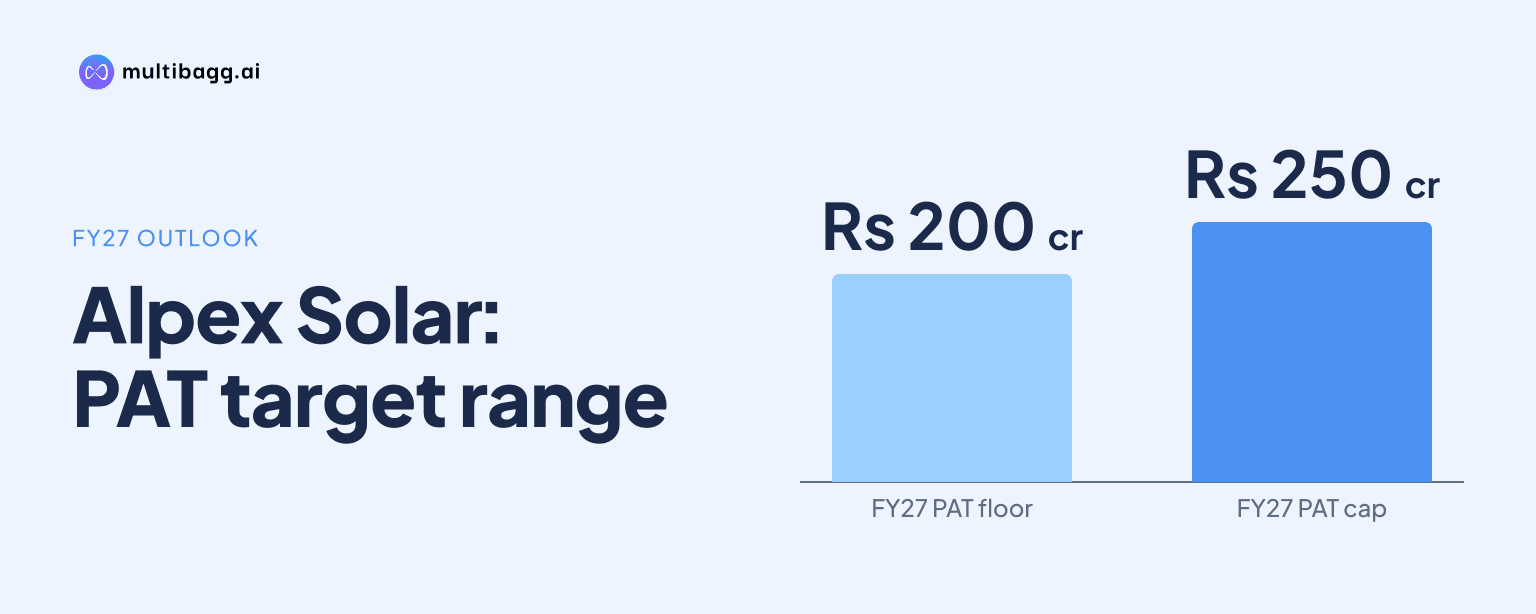
In November 2026, Alpex Solar said its 2.2-gigawatt TOPCon solar-cell line would be fully operational by November-end and management targeted consolidated FY27 profit after tax of Rs 200-250 crore, after saying it had generated around Rs 60 crore of PAT so far. The target depends on the cell-production ramp and sales in the second half.
Know Alpex Solar inside out
Results, valuation, peers and who's buying, in one view.
When will Alpex Solar’s 2.2-GW cell line be operational?
Alpex Solar said trial production had started and all 2.2 gigawatts of its TOPCon cell line would be operational by November 30, 2026. Managing Director Ashwani Sehgal said on the November 18 call that the first line would be completed that day or the following day, with the second and third lines following at intervals of six to seven days.
The company described the facility as a Generation 3 cell line established in 16-17 months. Management said the supporting utilities were already operational, including gases, TMA and other chemicals required for solar-cell manufacturing, and called the line a complete production setup rather than an equipment-only installation.
Alpex Solar said it had paid the applicable fees and completed processes for its listing application. Government officials were expected to visit the factory on November 24 or 25, 2026, and management expected the listing process to be completed soon thereafter, while later indicating a maximum timeline of 10 to 12 days for approval.
What FY27 earnings is Alpex Solar targeting?
Alpex Solar management targeted consolidated FY27 PAT of Rs 200-250 crore, compared with around Rs 60 crore of PAT it said had been achieved by the November 18, 2026 call. This is management guidance rather than a reported full-year outcome, and the company did not give a separate quarterly PAT forecast for the December or March quarters.
Management said it expected four to four-and-a-half months of cell capacity to be available for selling into the market. On that basis, it estimated that about 500-600 megawatts of cells could be manufactured and sold as cells or as solar panels in the current quarter.
Sehgal cited an average realization of around Rs 22 for a panel, but the transcript did not specify the unit of measurement for that realization. Management said this cell output would contribute to the business but did not quantify its revenue or PAT contribution separately for Q3 and Q4 of FY27.
For H2 FY27, Alpex Solar guided for around Rs 1,200 crore of top line. Management declined to provide a further H2 PAT or earnings before interest, tax, depreciation and amortisation, or EBITDA, figure when asked, saying it would take more time to provide that detail.
Why is Alpex Solar relying on cell production for profitability?
Alpex Solar said cell manufacturing would be the principal contributor to profitability in the shorter term because module manufacturing was facing overcapacity and insufficient margins. Management said it had already declined module orders it considered non-remunerative, which it said contributed to a small decline in top line in the quarter discussed on November 18.
Management reiterated an expectation of around 35% EBITDA margin at the cell level. It did not endorse an analyst’s proposed 18%-20% blended FY27 margin, saying module contribution remained uncertain and that blended profitability would be lower than the company’s earlier expectation while module pricing was under pressure.
The company said it would sell cells into the market if its module business did not generate sufficient cash, rather than pursue module volumes at prices management considered uneconomic. Its operating module capacity was 2.4 gigawatts as of the call, compared with the 2.2-gigawatt cell line being brought online by November-end.
Management linked the demand case to domestic manufacturing rules. It said the Approved List of Module Manufacturers framework was imposed from June 2026 and that the next phase, referred to in the call as ALCM or ALMM List 2, requires domestically made cells in applicable modules. It also said certain demand categories had received a six-month reprieve and would add to the demand pool from January.
Got a follow-up? Ask IRIS
How does approval affect Alpex Solar’s cell sales?
Alpex Solar said it could sell its cells as non-DCR products before receiving the domestic-content listing, while DCR-compliant sales would follow the listing. DCR refers to the domestic-content requirement category cited by management, and the company said the approval process would be relevant for marketing cells as made-in-India products under that category.
Management said there was already demand for DCR panels and cells, including enquiries for locally made TOPCon cells. It cited total solar-module capacity of 225 gigawatts, of which it said almost 60% was TOPCon capacity, while arguing that domestically made TOPCon cells were currently in short supply.
The inspection expected on November 24 or 25 is therefore a near-term milestone for Alpex Solar’s DCR offering, although it is not a prerequisite for all cell sales. Management did not disclose a confirmed approval date, only its expectation that the process would be completed very soon after the visit.
What is Alpex Solar’s inventory outlook during the ramp?
Alpex Solar said total inventory should decline somewhat by March 31, 2027, although cell-related inventory would increase in the short run. An analyst said inventory days had risen from around 73 days to more than 130 days, and management attributed the movement to raw-material preparation for its second G12R module factory, the cell line and finished goods.
The company said it already held raw materials for more than 200 megawatts of cell production. Management identified wafers, silver paste, gases and other inputs as materials with long lead times that are not available in India, requiring advance purchases to support a continuous cell-manufacturing process.
Management also linked higher inventory to its decision to drop lower-priced module sales. It said sales should improve from the next month and described Q4 as likely to be healthy, but it gave no numerical target for inventory balances, debtors or operating cash flow at the March 2027 year-end.
Conclusion
Alpex Solar’s Rs 200-250 crore consolidated FY27 PAT target is tied directly to the November 2026 ramp of its 2.2-gigawatt TOPCon cell line. Management expects 500-600 megawatts of output to be manufactured and sold in the current quarter, while selectively managing module sales because it says cell margins, estimated at around 35% EBITDA, offer the clearer near-term profit contribution.
The next disclosures to watch are the expected November 24 or 25 factory inspection, completion of the domestic-content listing process and execution against the around Rs 1,200 crore H2 FY27 top-line guidance. Management has also said inventory may rise initially as imported cell inputs are stocked, before declining somewhat by March 31, 2027.