










Anawil targets 500-plus FY28 towers as Kutch approvals near
Key highlights
- Anawil targets more than 500 towers in FY28, compared with more than 300 towers in FY27.
- Anawil produced 107 towers in H1 FY27, up from 62 towers in H1 FY26.
- Anawil said Kutch produced about 10 towers in H1 FY27, versus about 100 at Karnataka.
- Anawil reported a Rs 395 crore confirmed order book covering 320 towers on October 13, 2026.
powered by IRIS
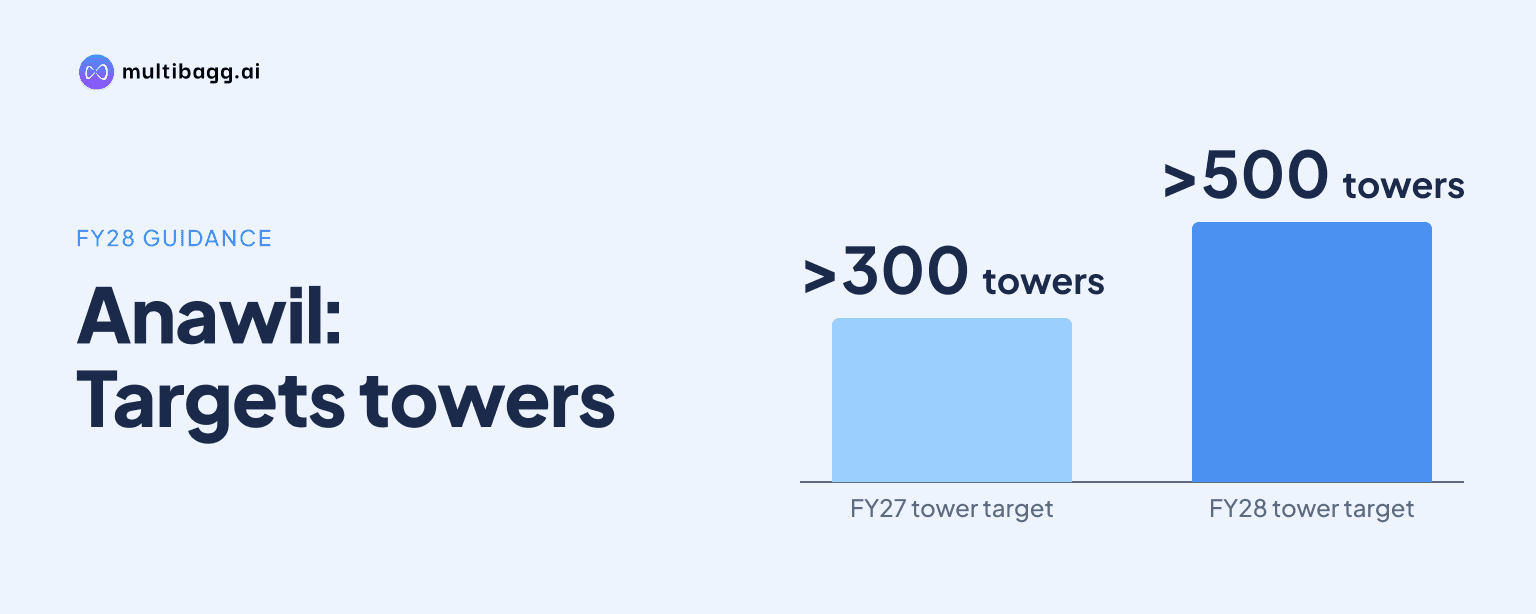
Anawil Wire and Engineering Limited targets more than 500 wind-turbine towers in FY28, compared with more than 300 towers in FY27, management said on November 9, 2026. The plan relies on customer approvals at its Kutch plant, production of at least 200 towers there, more than 300 in Karnataka, and newly ordered machinery.
Know Anawil Wire and Engineering inside out
Results, valuation, peers and who's buying, in one view.
Is Anawil targeting more than 500 towers in FY28?
Yes, Anawil’s management said it was targeting more than 500 towers in FY28 after setting a target of more than 300 towers for FY27. Management’s operating plan is to manufacture at least 200 towers at Kutch and more than 300 towers in Karnataka once Kutch certification and customer-approval work is complete.
The target is a utilisation plan rather than an announced new-facility expansion. Anawil reported annual manufacturing capacity of 612 towers, comprising 420 at Karnataka and 190 at Kutch, although those individual figures total 610. Kutch was not being fully used in FY27 because approvals were pending, while management said Karnataka was fully booked.
The key change from FY27 to FY28 is therefore expected production at Kutch. In H1 FY27, Karnataka manufactured about 100 towers, while Kutch contributed about 10, according to management. Anawil said certain Kutch work involved a Suzlon hybrid tower, with about 70% lattice structure and the balance tubular, which it did not count in the same way as standard tower production.
What needs to happen before Anawil can ramp Kutch?
Anawil needs original equipment manufacturer, or OEM, plant approvals before Kutch can fulfil the role management assigns it in FY28. In prepared remarks, management said trial-run approvals were ongoing and it expected the remaining process to be completed by the end of November 2026, allowing Kutch to contribute in the final two quarters of FY27.
Management identified International Organization for Standardization, or ISO, 14001 and 45001 certifications as part of the approval process. During the question-and-answer session, it said those certifications had been completed, customer concerns had been addressed, and Envision and Senvion were expected to visit in the first week of December 2026. It also said it was working on Kutch approvals for Suzlon, Inox and Senvion.
The timeline remains conditional on customer decisions rather than representing a completed operating milestone. Management initially expected the process to finish before December 15, 2026, and said Kutch could perform from December through March. Its FY28 target consequently assumes that site reviews lead to customer orders and sustained use of the plant.
How will machinery and heavier towers support production?
Anawil expects new rolling and re-rolling equipment to raise throughput and process heavier tower designs. Management said a newly ordered machine was due to arrive in Mumbai on the 13th of November 2026, with production expected to start by month-end. It said the equipment would increase both the number of towers processed and the tonnage handled.
At Karnataka, management estimated that the new machine could increase productivity by seven to eight towers per month. The arrival delay meant Anawil still expected a 35:65 first-half-to-second-half revenue pattern in FY27, rather than a potential 45:55 split in future periods as customers increasingly build tower inventory before site erection.
Kutch is also due to receive a re-rolling machine, which management expected to be erected by January 1, 2027 after transport from Europe. Separate rolling and re-rolling operations would then be available at the site. Management said Rs 30.69 crore of capital work in progress included three machines, Kutch welding equipment and extendable column booms, and expected this expenditure to be completed by March 31, 2027.
The machinery is intended to accommodate a move toward heavier towers. Management said earlier models used steel plates up to 55 millimetres thick, while newer designs could require 70-millimetre plates. It described current towers as generally above 400 tonnes, with some 5-megawatt models at 450 tonnes, compared with 250 to 350 tonnes for earlier work.
Got a follow-up? Ask IRIS
What does H1 FY27 indicate about Anawil’s ramp economics?
H1 FY27 showed higher production and earnings per tower before Kutch was fully operating. Revenue from operations rose 272% year on year to Rs 153.97 crore, exceeding Rs 143.27 crore for all FY26. Tower production rose about 73% to 107 towers from 62 towers in H1 FY26.
The business mix also changed in H1 FY27, as integrated-supply contracts contributed about 64% of revenue. Management said this reduced earnings before interest, tax, depreciation and amortisation, or EBITDA, margin to 23.4% from 24.5% in FY26 because revenue under these contracts includes steel and other material costs. Absolute EBITDA per tower nevertheless rose about 105% to Rs 32.82 lakh from Rs 16.03 lakh.
Management expects EBITDA per tower to reach about Rs 35 lakh to Rs 40 lakh, compared with around Rs 32 lakh to Rs 33 lakh currently. This is management’s expectation, supported in part by plans to begin using internally manufactured tower internals in January and February. It is not a reported financial target or formal guidance.
Heavier models may also lift revenue per tower even if output volumes rise more slowly. Management cited conversion revenue of about Rs 58 lakh for an earlier 3.5-megawatt Envision tower, compared with Rs 69 lakh for a 400-tonne tower for the same company and independent power producer. It said tower tonnage had increased about 30% to 35% as manufacturers moved towards 4-megawatt and 5-megawatt turbines.
Does Anawil have orders to support near-term execution?
Anawil reported a confirmed order book of Rs 395 crore covering 320 towers as of October 13, 2026, which exceeds its FY27 volume target of more than 300 towers. It also held letters of intent worth Rs 44 crore covering 44 towers, though management said execution depends on customer schedules and project readiness.
Management said the second half is historically the larger execution period, contributing around 70% to 80% of annual revenue because monsoon conditions can delay site access and erection. For FY27, it still expected a 35:65 first-half-to-second-half split because of the machinery delay, despite H1 output of 107 towers and customer efforts to build inventory before erection.
Conclusion
Anawil’s FY28 aim of more than 500 towers depends mainly on converting Kutch from limited FY27 use into a plant producing at least 200 towers, while Karnataka delivers more than 300. H1 FY27 provides evidence of higher production and value per tower, with 107 towers completed and EBITDA per tower of Rs 32.82 lakh, although the greater integrated-supply share lowered the percentage EBITDA margin.
The next milestones are OEM visits and approval decisions at Kutch that management expected in early December 2026, installation of the Kutch re-rolling machine by January 1, 2027, and completion of Rs 30.69 crore of capital work by March 31, 2027. Execution of the Rs 395 crore confirmed order book through the H2-heavy period will indicate whether the plant ramp is progressing as planned.