










Anawil says precision and certification restrict wind towers
Key highlights
- Anawil says a 30-metre tower section has a permitted length variation of only plus or minus 16 millimetres.
- Anawil says top-flange flatness must be 500 microns for site assembly of tower sections.
- Management says plant certification requires six to eight months after erection, including ISO 3834 heavy-fabrication approval.
- Anawil says it has supplied about 650 towers without a single complaint.
powered by IRIS
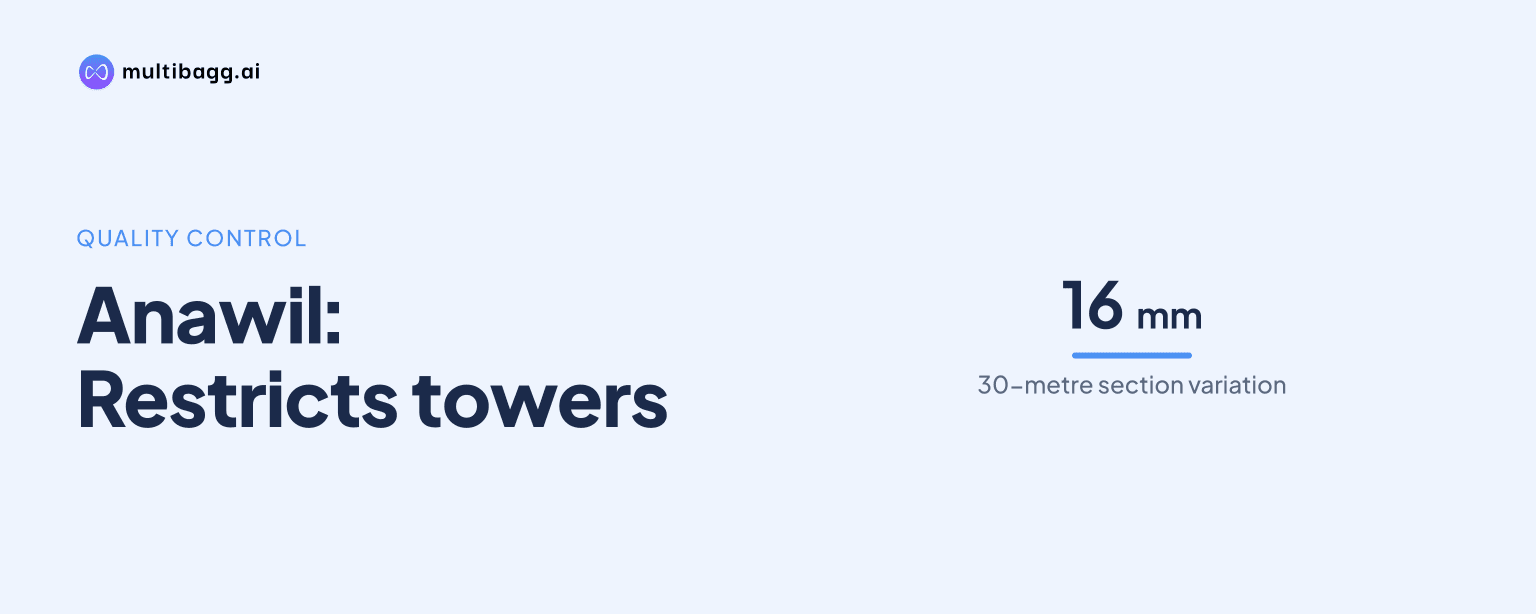
Anawil says wind-tower manufacturing is difficult to enter because a roughly 140-metre structure must meet 500-micron flange flatness while a new plant needs six to eight months of certification work after erection. Management also said Anawil has supplied about 650 towers without a complaint, which it presented as evidence of customer acceptance.
Know Anawil Wire and Engineering inside out
Results, valuation, peers and who's buying, in one view.
Why does Anawil say wind-tower fabrication is hard to enter?
Anawil says the principal entry barrier is precision fabrication, rather than simply installing factory capacity. Management described a tower of roughly 140 metres as a five-section structure, designated S1 through S5, assembled at site through flanges and nut-bolting. S1 is the lowest, or base, section, while each section is generally about 30 metres long, with dimensions varying by tower design.
The company said a 30,000-millimetre section can have only plus or minus 16 millimetres of length variation. Each section may contain about 10 welded plates, and rolling can expand horizontal and vertical plates by 1 to 1.5 millimetres. Management said a one-millimetre expansion across 10 plates can create 10 millimetres of cumulative movement before weld shrinkage and material pull are considered.
Anawil said this requires fabrication shops to deliver outcomes generally associated with machining, despite working with large steel structures. Management also said two or three plants have not been able to establish manufacturing because they could not achieve the required parameters. The transcript does not identify those plants or provide independent production data for them.
What dimensional tolerances does Anawil say its towers require?
Anawil says the top flange on a tower must achieve flatness of 500 microns. Management noted that one millimetre equals 1,000 microns, putting the stated flange requirement at half a millimetre. The flange connects tower sub-parts at the installation site, where sections of about 30 metres are bolted together.
The stated 500-micron flatness requirement works alongside the plus or minus 16-millimetre length limit across 30,000 millimetres. Anawil said welding both joins plates and shrinks material, requiring control of competing changes in dimensions. Management’s point was that a factory cannot necessarily make compliant towers as soon as it has installed rolling and welding equipment.
The physical scale also raises the importance of repeatability, according to management. Anawil said a 140-metre tower is comparable in height to a 50-storey building, and that the top can sway by up to one metre. Those statements explain why the company links precision at fabrication to performance after erection, although the transcript does not provide tower-specific engineering test results.
How long does Anawil say certification and approval take?
Anawil says a newly erected plant generally needs six to eight months for certification work before it is fully established with customers. Management said production must begin before certification can be completed, so the company initially requests one or two towers from customers to support the qualification process. It cited its Karnataka experience in 2023 as an example of the setup, production and approval timeline.
The sequence described by Anawil starts with ISO 9001, a quality-management standard, followed by ISO 3834, which management identified as a heavy-fabrication certification. It also cited ISO 14001 and ISO 45001 for environmental and occupational management systems. Management said each audit takes two days, followed by at least one month of evaluation.
Anawil said only certifications from two or three recognised firms are accepted, with documentation sent to Europe for review. It said an audit had concluded a month earlier and that it had received clearance by email, although the physical certificate had not yet arrived. Original equipment manufacturers then conduct audits and approve the plant, according to management.
Got a follow-up? Ask IRIS
What delivery record does Anawil cite for customer confidence?
Anawil says it has manufactured and supplied about 650 towers without a single complaint. This is a management claim rather than an independently audited quality metric, but Anawil presented it as proof of its fabrication and delivery record. Management said the company serves almost 11 clients, including three original equipment manufacturers and several independent power producers.
Management linked that record to the potential cost of a project-site failure. It said a 5-megawatt turbine costs around Rs 40 crore after erection and weighs at least 200 tonnes, while each blade weighs about 25 to 35 tonnes. Anawil said customers do not want to risk a supplier failing on quality or commitments because the wider project could be affected.
Anawil also said its customer base includes JSW, Evren, Ayana Power, ReNew Power, Avaada, Fourth Partner Energy, Senvion, Suzlon and Inox. Management described JSW as its top customer and said three customers are original equipment manufacturers. The transcript does not provide revenue contributions for each customer in this discussion.
How does Anawil plan to use this capability in FY28?
Anawil’s stated plan is to fully utilise its Karnataka and Kutch facilities in FY28, or financial year 2028, while bringing internal-component production into both sites. Management said trial production of internals had started in Karnataka and that Kutch would follow after Karnataka’s operation stabilised. Its first milestone is to produce more than 500 towers with internally manufactured components in FY28.
The company said internal integration can change the value of each order. Management compared a conversion order of around Rs 60 lakh with an order including internals of roughly Rs 1.10 crore to Rs 1.20 crore. It said making internals itself should increase turnover and earnings before interest, tax, depreciation and amortisation, or EBITDA, per tower.
Management’s initial target is to increase EBITDA by Rs 7 lakh to Rs 8 lakh per tower through internal manufacturing. It said the focus remains on full utilisation of Karnataka and Kutch rather than an immediate Rajasthan expansion. Rajasthan was described as a possible later location because of high-velocity wind areas and the introduction of 5-megawatt machines in India.
Conclusion
Anawil’s explanation of its competitive position rests on fabrication precision, customer qualification and a claimed execution record rather than factory capacity alone. The company cited 500-micron flange flatness, a plus or minus 16-millimetre allowance over 30 metres, and about 650 supplied towers without a complaint to explain why it believes new competitors may take time to establish themselves.
The next point to watch is execution of Anawil’s FY28 plan to fully utilise Karnataka and Kutch and produce more than 500 towers with internal components. Management said Rajasthan remains a future possibility tied to grid development and 5-megawatt-machine activity, but it has not committed to an FY29 target or expansion timetable.