










Anawil prioritises Rs 7 lakh-Rs 8 lakh tower EBITDA gain
Key highlights
- Anawil management targets an additional Rs 7 lakh to Rs 8 lakh of EBITDA per tower from in-house internals.
- Anawil said conversion-only orders are about Rs 60 lakh, versus Rs 1.10 crore to Rs 1.20 crore for orders including internals.
- Management targets full utilisation of Anawil's Karnataka and Kutch facilities in 2028 before considering Rajasthan.
- Anawil cited EBITDA of Rs 32.8 lakh per tower and said it expected at least Rs 35 lakh in H2.
powered by IRIS
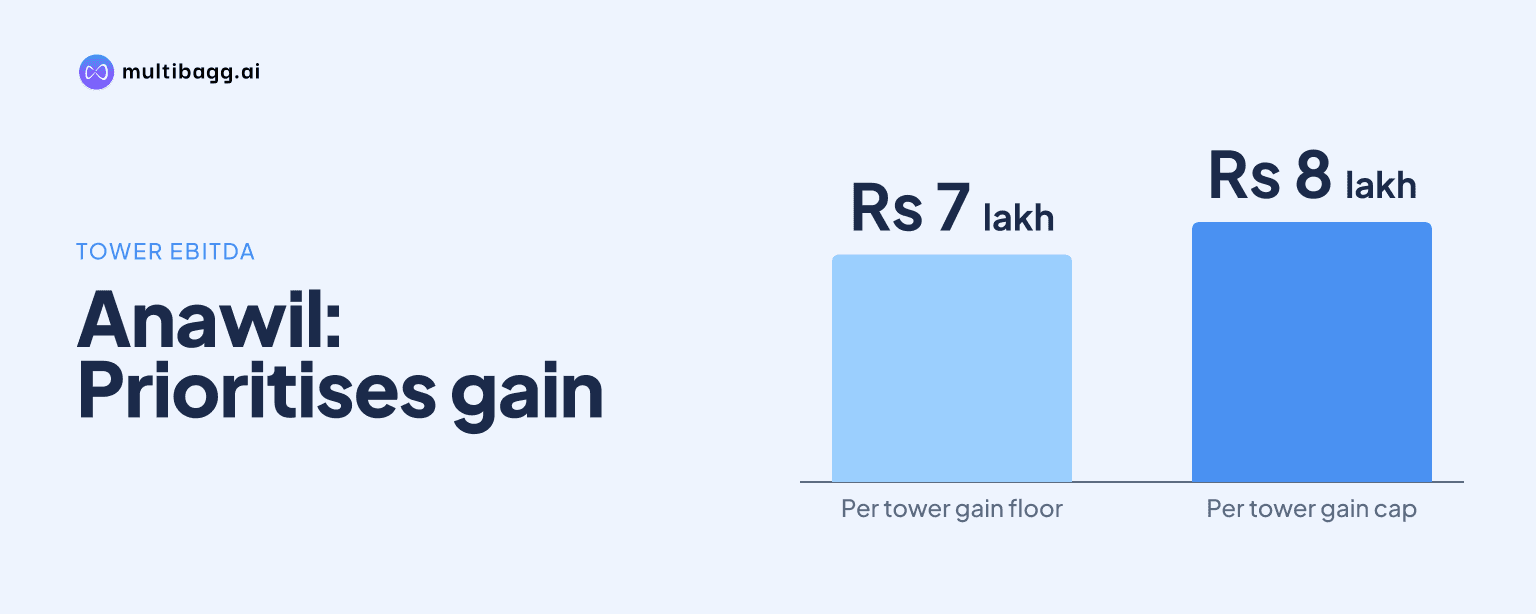
In its investor call, Anawil said manufacturing tower internals in-house could add Rs 7 lakh to Rs 8 lakh of earnings before interest, tax, depreciation and amortisation (EBITDA) per tower, with full utilisation of its Karnataka and Kutch facilities targeted in 2028 before a Rajasthan plant is considered.
Know Anawil Wire and Engineering inside out
Results, valuation, peers and who's buying, in one view.
What is Anawil's in-house internals plan?
Anawil plans to replace tower internals bought from outside suppliers with components manufactured at its Karnataka and Kutch facilities. Management said the internal-capacity plant had started in Karnataka and trial production would begin there, followed by the same activity at Kutch. It described internal manufacturing as the first operational priority ahead of another plant location.
The change would expand the value of orders handled by Anawil. Management said a conversion-only order is currently worth about Rs 60 lakh, while an order that includes internals is worth about Rs 1.10 crore to Rs 1.20 crore. Management expects this broader scope to lift turnover and EBITDA per tower, although it did not provide a date for achieving the full Rs 7 lakh to Rs 8 lakh increment.
The company distinguished conversion work from orders supplied with material. Management said conversion work has a higher EBITDA margin, whereas a material-included tower with a total cost of Rs 4 crore to Rs 5 crore would technically generate a margin of about 10%. Its stated objective is higher absolute EBITDA per tower through internal manufacturing rather than a specified percentage-margin target.
How could internals alter Anawil's per-tower EBITDA?
Anawil's management targets an additional Rs 7 lakh to Rs 8 lakh of EBITDA per tower from making internals itself. During the call, management cited EBITDA of Rs 32.8 lakh per tower and said it expected the measure to reach at least Rs 35 lakh in H2. The H2 expectation is management commentary, while the larger uplift depends on the internal-manufacturing plan.
Larger turbine specifications are a separate driver of tower economics. Management said towers had earlier served 2.7-megawatt (MW) to 3.3 MW machines, while 4 MW and 5 MW models are now being introduced. It estimated that tower weight has increased by about 30% to 40%, which can raise revenue and EBITDA per tower even if the number of towers does not rise at the same rate.
Heavier towers also require more fabrication time. Management said base plates for 5 MW towers can be 68 millimetres to 70 millimetres thick, increasing welding, rolling and re-rolling work. Anawil said it had ordered a higher-capacity machine expected to start running in November to reduce rolling time, making tonnage as well as tower count relevant to production planning.
Got a follow-up? Ask IRIS
Why is Anawil putting Rajasthan after existing plants?
Anawil said it will consider Rajasthan only after its Karnataka and Kutch facilities achieve full utilisation and both manufacture internals in-house. Management set 2028 as the target year for fully utilising the two existing plants and taking orders that include internals. Rajasthan is therefore a later conditional expansion option, not a committed plant project with a construction timetable.
Management identified Rajasthan as a high-velocity wind area in India, particularly relevant to 5 MW machines. It said the company would begin considering a Rajasthan facility as that market opens and 5 MW machines gain use in India. This sequencing places utilisation and vertical integration ahead of geographic growth.
The company also cited the lengthy setup process for a tower facility. Management said plant setup and certification can take five to seven months, followed by six to eight months of certification work after production starts. It referred to ISO 3834 for heavy fabrication, as well as ISO 9001, ISO 14001 and ISO 45001, and said an audit can take two days followed by at least one month of evaluation.
What operating and funding milestones has Anawil disclosed?
Anawil's main operating milestone is full use of its Karnataka and Kutch plants in 2028. Management said 107 towers had been manufactured so far and stated that more than 300 towers was its H2 target. An analyst suggested an H2 range of 200 to 220 towers, but management did not expressly confirm that range in its response.
Management said Karnataka had manufactured almost 120 towers in the preceding four months and 21 towers in November. It estimated combined Karnataka production at 135 to 140 towers, with the remaining 70 to 80 towers to be produced according to customer requirements. Management also said monthly tonnage was 7,650 tonnes and expected it to reach 10,000 tonnes from the following December.
Anawil said it does not intend to raise additional debt or equity for internal integration. Management said the required Karnataka machine had already been ordered, capex repayment was complete, and further internal-integration spending would be funded through internal accruals and reserves. It added that working-capital requirements for higher growth would be covered through letter-of-credit facilities.
Conclusion
Anawil's disclosed strategy is to increase value captured from each tower before adding a new geography. The planned shift from Rs 60 lakh conversion-only orders to Rs 1.10 crore to Rs 1.20 crore orders that include internals underpins management's Rs 7 lakh to Rs 8 lakh per-tower EBITDA target, while heavier 4 MW and 5 MW towers could also increase fabrication intensity and rupee contribution per tower.
The next items to watch are trial production of internals in Karnataka and Kutch, the path toward full utilisation of both plants in 2028, and execution against management's H2 tower target of more than 300. Rajasthan remains unresolved: management said it would evaluate a facility there only after existing plants are fully utilised and the 5 MW market develops further.