










Anawil H1 revenue hits Rs 153.97 crore, exceeding FY26 sales
Key highlights
- Anawil reported H1 FY27 revenue from operations of Rs 153.97 crore, above FY26 revenue of Rs 143.27 crore.
- H1 FY27 tower completions increased about 73% year on year to 107 from 62.
- Integrated-supply contracts accounted for about 64% of H1 FY27 revenue.
- Absolute EBITDA per tower increased about 105% year on year to Rs 32.82 lakh from Rs 16.03 lakh.
powered by IRIS
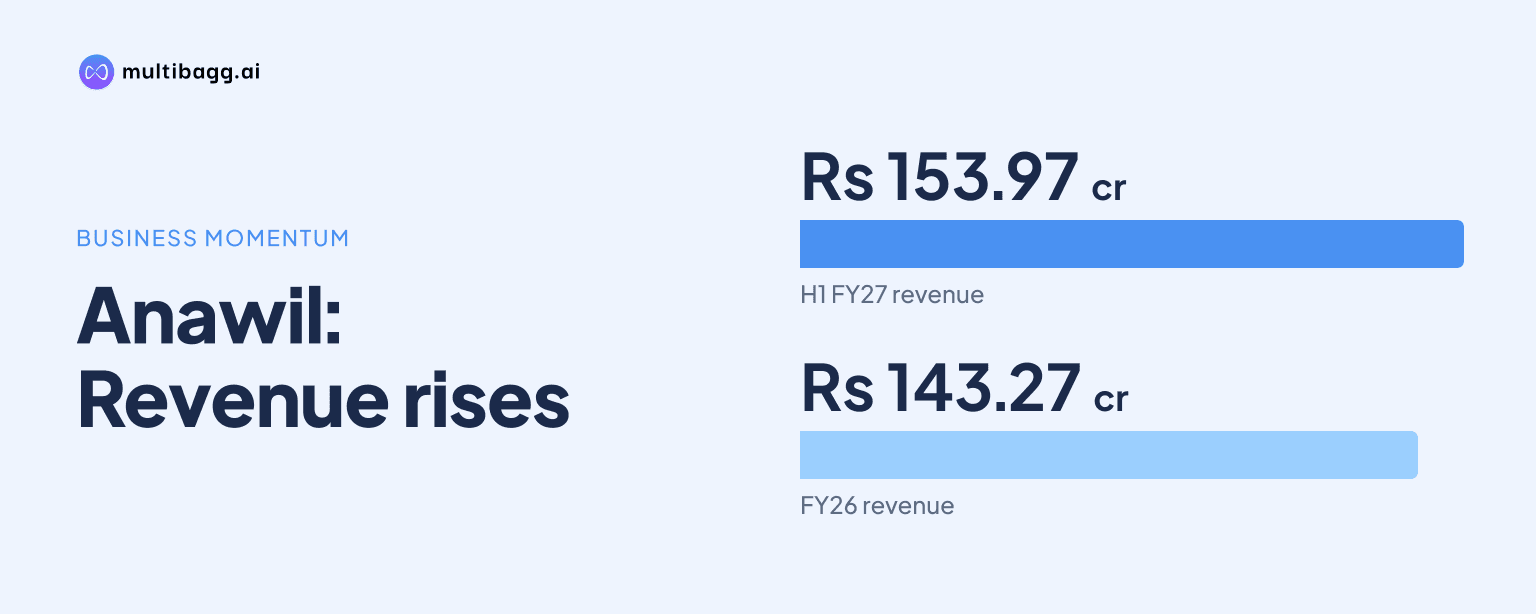
Anawil Wire and Engineering Limited reported Rs 153.97 crore of revenue from operations in H1 FY27, exceeding its Rs 143.27 crore revenue for all of FY26, as tower completions rose to 107 and integrated-supply contracts accounted for about 64% of half-year sales. Revenue was 272% higher year on year for the half year ended September 30, 2026.
Know Anawil Wire and Engineering inside out
Results, valuation, peers and who's buying, in one view.
Why did Anawil’s H1 FY27 revenue exceed FY26 revenue?
Anawil’s H1 FY27 revenue exceeded FY26 revenue because tower output increased and a larger share of contracts included customer materials in the sale value. Revenue from operations reached Rs 153.97 crore in H1 FY27, compared with Rs 143.27 crore for FY26, while tower production increased about 73% year on year to 107 towers from 62 in H1 FY26.
The H1 outcome came during what management described as the seasonally slower part of its financial year. Management said H2 has historically generated around 70% to 80% of annual revenue because monsoon conditions can restrict site accessibility and erection activity in H1. That timing places the Rs 153.97 crore H1 FY27 revenue ahead of the company’s traditional higher-execution period.
Integrated-supply contracts made up about 64% of H1 FY27 revenue. Under this model, Anawil supplies steel, flanges, internals and paint as well as fabricating the tower, so raw-material costs are included in reported revenue. This raises reported sales per tower compared with conversion-only work, where the customer provides the materials.
How did integrated supply affect Anawil’s margins?
Integrated supply reduced Anawil’s reported percentage margin while increasing absolute earnings per tower, according to management. Earnings before interest, tax, depreciation and amortisation, or EBITDA, increased about 256% year on year to Rs 36 crore in H1 FY27, while the EBITDA margin was 23.4%, compared with 24.5% in FY26. Profit after tax, or PAT, rose about 539% to Rs 14.39 crore.
Management described pure conversion as a model with revenue of about Rs 50 lakh to Rs 60 lakh per tower, EBITDA of about Rs 25 lakh to Rs 30 lakh, and an EBITDA margin of around 44% to 50%. Customers supply steel, flanges, paint and internals in this model, meaning Anawil’s revenue largely reflects its fabrication and conversion work.
In conversion-plus-internals work, management said revenue is normally Rs 1 crore to Rs 1.10 crore per tower, EBITDA is about Rs 35 lakh to Rs 40 lakh, and margins are around 33% to 37%. In the integrated model, revenue is normally Rs 3 crore to Rs 3.5 crore and EBITDA about Rs 40 lakh to Rs 50 lakh per tower, but the margin is around 14% to 16% because material costs are recorded in sales.
Management said absolute EBITDA per tower should be assessed alongside percentage margin, working capital and cash flow. Absolute EBITDA per tower increased about 105% to Rs 32.82 lakh in H1 FY27 from Rs 16.03 lakh in H1 FY26, which management attributed to higher value addition and the business-mix shift.
Got a follow-up? Ask IRIS
What could determine Anawil’s H2 FY27 execution?
Anawil’s H2 FY27 execution will partly depend on customer approvals and utilisation at its Kutch, Gujarat facility. Management described annual capacity of 612 towers across Koppal, Karnataka, with 420 towers, and Kutch, with 190 towers. Kutch trial runs and approvals were ongoing, with management expecting parts of the approval process to advance by late November and before December 15, 2026.
Management said ISO 14001 and ISO 45001 certifications were expected by the end of November, after which it planned to seek plant approvals from customers. It named Envision, Senvion, Suzlon and Inox in relation to customer discussions or approvals, and expected Kutch to contribute from December through March, subject to approval completion and customer schedules.
Kutch operating expenses have begun while capacity is still being ramped up, management said, affecting cost absorption in H1 FY27. Management also said it planned to start internal-manufacturing trials in December and use its own internals during January and February, a step it expects to support margins.
What do Anawil’s orders and targets indicate for FY27 and FY28?
Anawil reported a confirmed order book of Rs 395 crore covering 320 towers as of October 13, 2026, plus letters of intent worth Rs 44 crore for 44 towers. Management said the confirmed order book supported upcoming execution and indicated an aim to execute it by Q1 FY28, subject to customer schedules and project readiness.
For FY27, management targeted more than 300 towers, compared with 107 completed in H1 FY27. It also said it expected EBITDA per tower to rise from the current Rs 32 lakh to Rs 33 lakh range to at least Rs 35 lakh to Rs 36 lakh, while citing an expectation of about Rs 35 lakh to Rs 40 lakh per tower under its operating plan.
For FY28, management targeted more than 500 towers if Kutch is fully operational. It said a new machine was intended to handle plates up to 70 millimetres thick, compared with a previous maximum of about 55 millimetres, while a planned re-rolling machine at Kutch is intended to increase productivity for heavier towers.
Conclusion
Anawil’s H1 FY27 performance combined higher production with a greater contribution from integrated supply. The shift lifted revenue to Rs 153.97 crore, above FY26 revenue of Rs 143.27 crore in six months, and increased absolute EBITDA per tower to Rs 32.82 lakh from Rs 16.03 lakh, even as the EBITDA margin moved to 23.4% from 24.5% in FY26.
The next disclosed milestones are Kutch customer approvals, which management expected to progress from late November through mid-December 2026, and the facility’s contribution from December to March. Execution against the Rs 395 crore confirmed order book, the more-than-300-tower FY27 target and management’s more-than-500-tower FY28 target will also be important to monitor.