










Anawil says Kutch underuse depressed first-half profitability
Key highlights
- Anawil reported Rs 12.9 crore of depreciation in H1 and estimated approximately Rs 22 crore for the full financial year.
- Anawil said Rs 54 crore of short-term advances included Rs 25 crore of GST and machinery-related payments.
- Management expected Kutch certification work to finish by December 1, followed by potential OEM approval.
- Anawil said October dispatches were around 20 towers and targeted more than 30 towers a month after ramp-up.
powered by IRIS
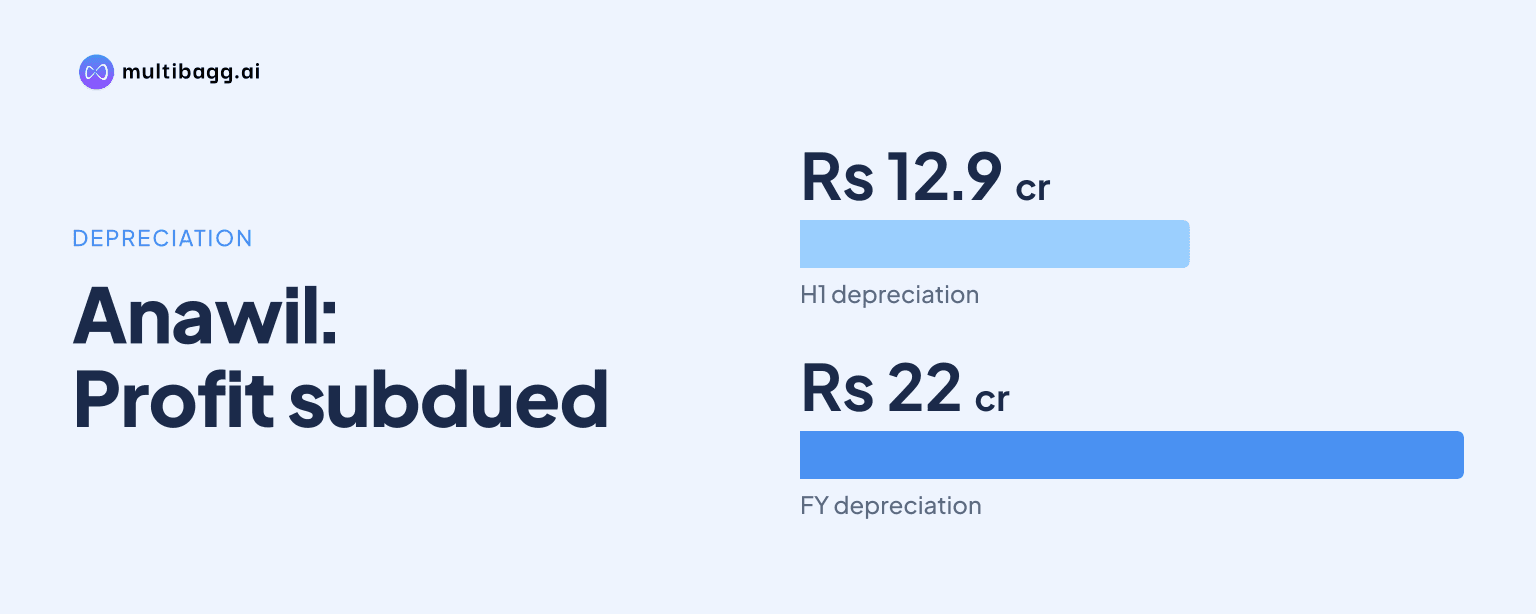
Anawil Wire and Engineering Limited said low Kutch plant utilisation depressed first-half profitability as depreciation reached Rs 12.9 crore in H1, before the facility had begun the production ramp management expects after certification work targeted for December 1. Management estimated depreciation of approximately Rs 22 crore for the full financial year.
Know Anawil Wire and Engineering inside out
Results, valuation, peers and who's buying, in one view.
Why did Kutch underutilisation affect Anawil's first-half profitability?
Anawil said the Kutch plant was not sufficiently utilised in H1, meaning its depreciation charge weighed on profitability before the facility generated the intended production volume. In response to an analyst's question on depreciation, management said Anawil had been affected in the first half because Kutch utilisation was not high enough relative to the plant's depreciation.
The company did not attribute the H1 effect to a change in its depreciation policy. Management said Anawil uses the written-down value, or WDV, method and estimated full-year depreciation at approximately Rs 22 crore. The Rs 12.9 crore recognised in H1 was therefore more than half of the management estimate before Kutch had reached the utilisation level management expects in the second half.
Management said the H1 issue should not recur in the second half, conditional on the expected ramp-up at Kutch. It did not disclose H1 revenue, operating profit, a separate Kutch loss, or the portion of total depreciation directly attributable to that plant. The call therefore establishes the mechanism, underutilised assets carrying depreciation, but not a precise profit impact.
Kutch was part of a broader plan to increase tower output. Management said October dispatches were around 20 towers, although it cautioned the precise number could have been 19 or 21 because its office was closed during the call. It aims to move from a monthly target of 20 to 22 towers to more than 30 towers as Karnataka capacity rises and Kutch begins contributing.
What were the machinery advances behind Anawil's balance-sheet movement?
Anawil said Rs 54 crore of short-term loans and advances included a Rs 25 crore Goods and Services Tax, or GST, balance and machinery-related payments. An analyst noted that the March balance was Rs 50 crore. Management said the Rs 50 crore March amount was not continuing in the same form because Kutch equipment had arrived and some facilities had started.
Management gave a partial breakdown of the current movement, identifying Rs 25 crore of GST and Rs 10 crore related to a DAVI machine. It said the DAVI machine had been paid for when delivery was not yet planned, while billing for an India Techno machine had been completed during the quarter. No full reconciliation between the Rs 50 crore March balance and the Rs 54 crore figure was provided.
The company also said its blasting booth and painting booth had been constructed, with payments made partly in advance. Management described a process in which Anawil makes a 50% payment during construction and does not accept the final bill until the machinery is commissioned and running. This links part of the advances balance to equipment installation rather than to a disclosed recurring working-capital requirement.
Management said machinery capital expenditure exceeded Rs 110 crore, which would generate GST at 18%. It did not identify the commissioning date for every machine or say when all related advances would be capitalised. The disclosed sequence is that machinery arrives or is constructed, commissioning occurs, and final billing is accepted after the equipment runs.
Got a follow-up? Ask IRIS
How does Anawil expect to use its GST credits?
Anawil expects GST credits to be utilised gradually as billing and productivity rise at Kutch rather than through an immediate cash recovery. Management separately said GST balances at Kutch and Karnataka were each in the Rs 7 crore to Rs 8 crore range, while identifying Rs 25 crore of GST in its short-term-advances explanation. The call does not reconcile whether these figures refer to separate classifications, sites or dates.
Management said Karnataka had sufficient GST utilisation and no issue, while Kutch credits should be used progressively as output rises. It linked this to higher billing and to conversion work involving internal purchases, which can generate input credit. Management did not provide a monthly utilisation amount or a quarter in which the Kutch GST balance would be exhausted.
The company also referred to a possible government amendment that could allow service-related claims. Management said it was waiting for the amendment and that it had not yet been introduced. Accordingly, normal use through Kutch billing is the disclosed route for existing credits, while claims related to services remain dependent on an amendment that was not in place at the time of the call.
When does Anawil expect Kutch production to ramp up?
Anawil said Kutch utilisation would start by Q4, with certification work expected to finish by December 1 and potential original equipment manufacturer, or OEM, approval thereafter. Asked directly whether Kutch utilisation would start by Q4, management answered that it would. That is a management expectation rather than a confirmed production approval date.
Karnataka is also part of the output plan. Management said a machine was expected to reach the Karnataka plant around November 17 after arriving at Mumbai port on November 13, and that erection and commissioning would take four to five days, with completion expected by the end of November. It said immediate production would begin following commissioning.
The new Karnataka machine can roll 80-millimetre plate, compared with 70-millimetre capability cited for the earlier equipment. Management expects the machine to add seven to eight towers of production. Together with Kutch utilisation, that capacity addition underpins management's target of more than 30 towers a month, compared with October dispatches of around 20 towers.
Management said tower dispatches are not the sole trigger for billing. Once a tower is manufactured and a client's quality-control representative issues an MDCC, described by management as a material dispatch certificate, Anawil can release the bill on the same day. This means that higher production and certification approval could affect both physical output and the pace at which GST credits are used.
What longer-term production target has Anawil disclosed?
Anawil's stated FY28 milestone is production of more than 500 towers with internal components across its facilities. Management said it wants both Kutch and Karnataka fully functional and internal production established before setting FY29 goals. It declined to commit to FY29 numbers during the call.
The product mix is also intended to change. Management said it manufactured around 30 to 32 towers with material in the preceding six months and expects to produce around 80 to 85 such towers in the current financial year through FY27. It said conversion work and internally produced components would increase, alongside some orders that include raw material.
Management described using letters of credit, or LC facilities, for working capital on steel purchases. It said steel is booked with suppliers on the same day an order is booked and treated as a pass-through to customers rather than a price-speculation position. That process is management's stated approach to supporting orders that include raw material while it pursues higher tower volumes.
Conclusion
Anawil's first-half profitability was affected by a timing mismatch between Kutch's depreciation and its utilisation. The company reported Rs 12.9 crore of H1 depreciation under the WDV method while Kutch remained below expected output, alongside machinery advances and GST balances associated with a capital programme exceeding Rs 110 crore.
The next disclosed milestones are certification work targeted for December 1, potential OEM approval at Kutch, and the expected Karnataka machine commissioning by the end of November. Management's plan calls for monthly tower output to rise from around 20 toward more than 30, while its longer-term FY28 target is more than 500 towers with internal components.