










Anawil shifts capacity economics toward heavier wind towers
Key highlights
- Anawil cited Rs 69 lakh of conversion revenue for a 400-tonne tower, versus about Rs 58 lakh for an earlier 3.5 MW tower.
- New 4 MW and 5 MW towers exceed 400 tonnes, and some 5 MW towers may weigh 450 tonnes.
- Plate thickness has increased from a previous maximum of 55 mm to 68 mm to 70 mm, increasing processing time.
- Management targets more than 500 towers in FY28, including at least 200 at Kutch and more than 300 in Karnataka.
powered by IRIS
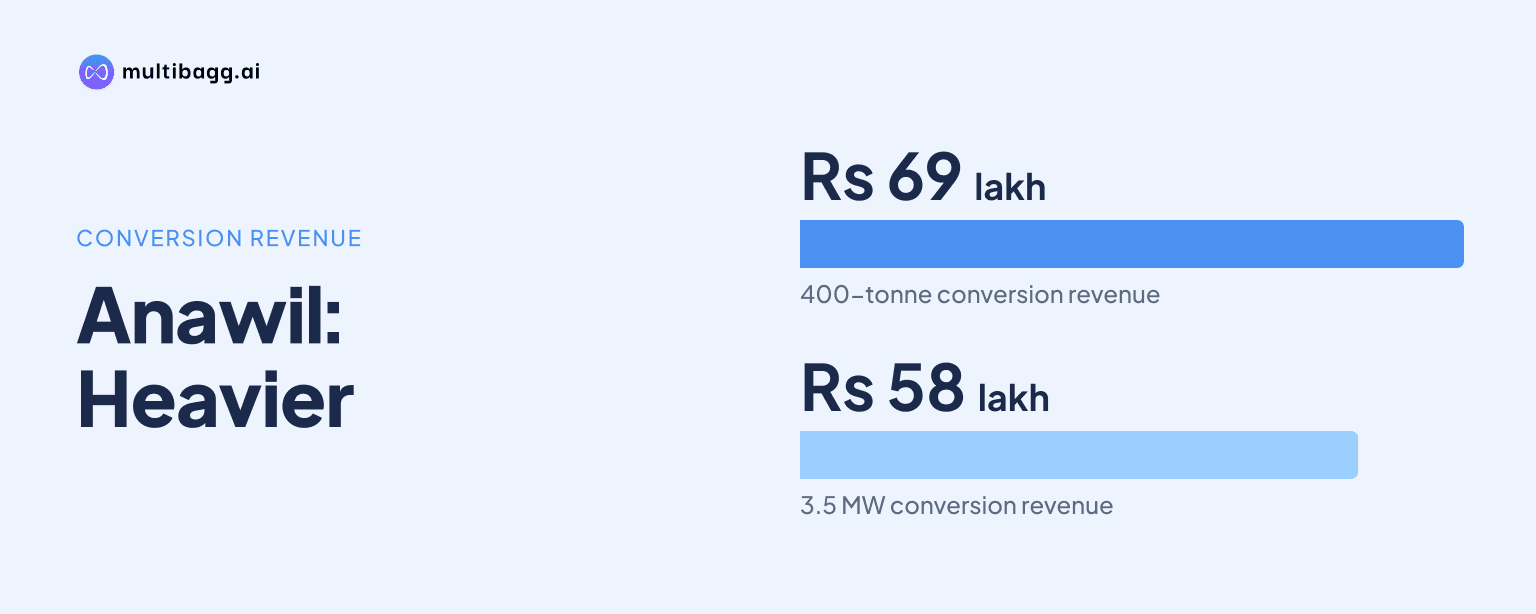
Anawil says heavier 4 megawatt (MW) and 5 MW wind towers are shifting its operating measure from tower count to tonnage, with a cited 400-tonne tower generating Rs 69 lakh of conversion revenue versus about Rs 58 lakh for an earlier 3.5 MW Envision tower. The larger structures require plates up to 70 millimetres thick, extending fabrication time.
Know Anawil Wire and Engineering inside out
Results, valuation, peers and who's buying, in one view.
Why is Anawil measuring capacity by tonnage rather than tower count?
Anawil says tonnage is becoming more relevant than tower count because turbine models have become larger and need heavier support structures. Management said towers produced when its newer unit began operations weighed roughly 250 tonnes to 350 tonnes, whereas current towers weigh almost or above 400 tonnes. Some 5 MW towers may weigh 450 tonnes.
The product transition spans several customers and turbine ratings. Management cited a 235-tonne Senvion 2.7 MW tower previously made in Karnataka, while saying it is now fabricating Senvion 4 MW models. It also identified Envision’s 5 MW offering and Vayona’s planned 5 MW market entry, and said fabrication tonnage has increased by about 30% to 35%.
Management’s explanation is that a move from 3.5 MW to 5 MW can raise generating capacity without necessarily changing the right of way, electricity-line requirement or land requirement. That makes larger turbine models commercially relevant for customers, while requiring Anawil to process more steel for each tower.
How do heavier towers change Anawil’s factory utilisation?
Heavier towers reduce units completed in a period because the thicker steel requires more time for rolling, welding and re-rolling. Management said the earlier maximum plate thickness was about 55 mm, compared with 68 mm to 70 mm for current higher-capacity towers. It said a comparison based only on 20 or 22 towers can therefore misstate actual production activity.
In the month cited during the call, Anawil reported 7,650 tonnes of output and said it expected tonnage to reach 10,000 tonnes from the following December. When asked about utilisation, management said Karnataka could be considered at 70%, while the analyst suggested a 47% combined calculation including Kutch. The two figures cover different facility scopes and are not like-for-like measures.
In H1 FY27, management said Karnataka manufactured 100 towers and Gujarat made about 10 towers. It said the Gujarat total did not fully capture work on Suzlon’s hybrid tower model, in which roughly 70% is lattice construction and the remaining portion is tubular. This product design is another reason that simple tower counts do not capture comparable work across customers.
What equipment is Anawil adding for thicker plates?
Anawil is adding machinery to process higher-thickness plates faster and increase both tower output and tonnage. Management said a newly ordered machine was expected to arrive in Bombay on the 13th and begin production by the end of that month. For Karnataka, it said the machine could add productivity equivalent to 7 to 8 towers a month.
Management said capital work in progress of Rs 30.69 crore included this equipment, two smaller machines ordered from Europe, and Kutch-related welding machines and extendable column booms. One European machine was expected to be dispatched the following week, with another to follow. Management said this capex would be completed by March 31, 2027 and was being funded through internal accruals.
Kutch is also planned to receive a re-rolling machine, allowing rolling and re-rolling to be handled separately. Management said the machine would be dispatched the following week and could be erected by January 1 after transport from Europe. The plan is intended to raise production after Kutch completes certification work.
Got a follow-up? Ask IRIS
How much more can heavier towers earn per unit?
Anawil says heavier towers can lift conversion revenue per tower even when unit output does not increase at the same rate. Management compared approximately Rs 58 lakh of conversion revenue on an earlier 3.5 MW Envision tower with Rs 69 lakh on a 400-tonne tower for the same company and independent power producer, or IPP. The cited difference reflects higher processed tonnage.
Management told an analyst that earnings before interest, tax, depreciation and amortisation, or EBITDA, per tower could reach at least Rs 35 lakh in H2, against Rs 32.8 lakh cited by the analyst for the earlier period. This was management’s expectation rather than reported guidance. It also said internal manufacture of tower internals could add Rs 7 lakh to Rs 8 lakh of EBITDA per tower.
The scope of an order also affects per-tower economics. Management said conversion-only orders currently bring around Rs 60 lakh per tower, while orders including internals can be worth about Rs 1.10 crore to Rs 1.20 crore. Its plan is to start trial production of internals in Karnataka and then establish a similar internal operation at Kutch.
What does the tonnage shift mean for Anawil’s FY28 plan?
Anawil’s target for FY28 is to manufacture more than 500 towers, with at least 200 at Kutch and more than 300 in Karnataka. Management compared this plan with current capacity of 612 towers a year and said 500 towers would represent full use of the two-facility network under its assumptions. Heavier tower weights mean revenue growth may not move in line with unit growth.
Management said Karnataka was fully booked and customers were beginning to discuss the next financial year to reserve capacity. It also said original equipment manufacturers, including Envision and Senvion, were expected to provide approvals in Kutch. The FY28 plan depends on Kutch certification, machinery installation and customer approvals, all of which management identified during the call.
Management’s priority for 2028 is to fully utilise Karnataka and Kutch and manufacture internals at both locations. It said a Rajasthan plant remains a later consideration because Rajasthan is a high-velocity wind area and 5 MW machines have entered India. No timing or committed investment for a Rajasthan facility was disclosed.
Conclusion
Anawil’s shift toward 4 MW and 5 MW towers changes the operating lens from the number of towers completed to tonnes processed, revenue per tower and manufacturing scope. Its cited movement from Rs 58 lakh to Rs 69 lakh in conversion revenue per tower, combined with a 30% to 35% increase in fabrication tonnage, explains why tower-count utilisation may not reflect the heavier product mix.
The next points to watch are completion of the Karnataka and Kutch equipment plans, Kutch certification and progress toward management’s FY28 target of more than 500 towers. Management also plans to manufacture tower internals in-house at both sites and expects that integration to add Rs 7 lakh to Rs 8 lakh of EBITDA per tower.