










ARCIL says unusually high H1 write-backs will moderate
Key highlights
- ARCIL said Q1 FY27 included Rs 125 crore of write-backs and H2 write-backs should be lower than the bulky H1 level.
- ARCIL's total income rose 48% year on year to Rs 516 crore in H1 FY27, while profit after tax rose 54% to Rs 290 crore.
- ARCIL's fee and other income increased 82% to Rs 227 crore as AUM rose 21% to Rs 20,274 crore.
- ARCIL acquired Rs 1,707 crore of assets in H1 FY27, including Rs 1,354 crore in Q2.
powered by IRIS
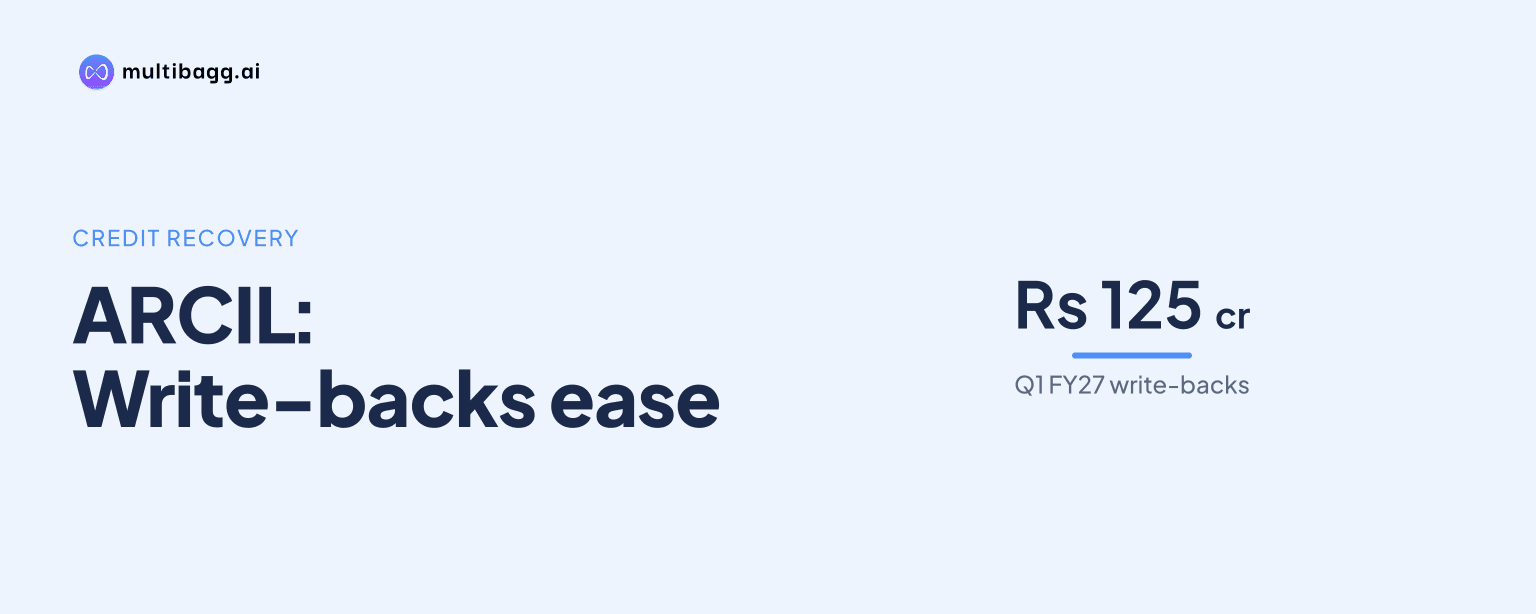
Asset Reconstruction Company (India) Limited said unusually high H1 FY27 write-backs will moderate in H2, after Rs 125 crore was recognised in Q1 alone, according to management on October 30, 2026. ARCIL said write-backs remain a recurring revenue item, but their timing depends on recoveries from assets, fees and expenses previously written off.
Know Asset Reconstruction Company (India) inside out
Results, valuation, peers and who's buying, in one view.
How large was ARCIL's H1 write-back contribution?
ARCIL reported Rs 129 crore of write-backs in its H1 FY27 financial review, up from Rs 37 crore in H1 FY26. The company defined these as recoveries of security receipts, fees and expenses written off in earlier years. In the question-and-answer session, Chief Financial Officer Pramod Gupta cited Rs 140 crore of H1 write-backs, including Rs 125 crore in Q1, creating a difference between the financial-review figure and management's call description.
The higher write-back contribution accompanied a 48% year-on-year increase in total income to Rs 516 crore in H1 FY27. Revenue from operations rose to Rs 512 crore from Rs 337 crore, while profit after tax rose 54% to Rs 290 crore from Rs 189 crore. The figures show that write-backs were a meaningful contributor to first-half income, alongside higher fees and investment upside.
The revenue mix changed across these lines in H1 FY27. Fee and other income increased by Rs 102 crore and investment upside increased by Rs 35 crore, while write-backs increased by Rs 92 crore. In contrast, net unrealised mark-to-market gains declined by Rs 46 crore, meaning the 48% total-income increase was generated by several components rather than a uniform increase across all revenue items.
Why will ARCIL's H2 write-backs moderate?
ARCIL expects H2 FY27 write-backs to be below the bulky H1 level because Rs 125 crore was recognised in Q1, Gupta said. He added that write-backs would continue as part of the revenue stream because the company can recover value after regulatory stipulations require it to write off assets that have not been realised within a prescribed period.
The company did not provide an H2 write-back target or a full-year forecast. ARCIL's explanation is that recognition depends on when recoveries occur from earlier written-off positions, making the line variable by quarter. This differs from fee income, which management links to assets under management, or AUM, and to collections, and from investment upside associated with cash acquisitions.
ARCIL separately described expected credit loss, or ECL, provisioning as a quarter-to-quarter accounting movement. The company made an ECL provision in Q1 FY27 as receivables rose and partly reversed it in Q2. Management said annual ECL under Reserve Bank of India regulations is typically about Rs 15 crore to Rs 20 crore, distinguishing this provision movement from the larger H1 write-back contribution.
Which ARCIL income streams have operating support?
ARCIL said fee and other income rose 82% to Rs 227 crore in H1 FY27 from Rs 125 crore a year earlier, supported by AUM growth and collections. AUM increased 21% to Rs 20,274 crore at September 30, 2026, while recoveries rose 21% to Rs 2,135 crore. Management said fees include income connected to both AUM and collection activity.
Gupta said quarterly fee income had stabilised at about Rs 115 crore to Rs 120 crore. Management also described an annual management-fee run rate of Rs 450 crore. The 82% increase in the first-half fee line exceeded the 21% AUM increase because collection fees are also part of the revenue stream, according to management.
Other operating income, which ARCIL described mainly as investment upside, increased to Rs 122 crore in H1 FY27 from Rs 87 crore in H1 FY26. Gupta said investment upside had been above Rs 200 crore annually for the preceding two to three years. He linked that outcome to investment in assets acquired entirely for cash, where value is realised through subsequent recoveries.
Management said cash acquisitions generally begin producing upside in the second or third year, whereas other AUM and collections principally generate management fees. ARCIL invested Rs 718 crore of its own capital in H1 FY27 acquisitions, an investment ratio of 42%. Management said the growing cash-investment portfolio should support investment upside, but gave no numerical outlook for this income line.
Got a follow-up? Ask IRIS
How does ARCIL's portfolio shape revenue timing?
ARCIL said its corporate book can make recoveries and related income lumpy because individual resolutions can be large. Corporate assets represented about 66% of Rs 20,274 crore of AUM at September 30, 2026, compared with 69% a year earlier. Retail accounted for 25%, up from 24%, and small and medium enterprises, or SME, accounted for 9%, up from 8%.
Management put the corporate book at about Rs 13,000 crore of AUM and said one or two large resolutions can occur regularly without being predictable in individual quarters. Q2 FY27 recoveries were Rs 1,069 crore, compared with Rs 1,339 crore in Q2 FY26, when large corporate resolutions occurred. Yet H1 recoveries increased to Rs 2,135 crore from Rs 1,765 crore, which management said makes half-year comparisons more meaningful.
Acquisition timing follows a different seasonal pattern. ARCIL acquired Rs 1,707 crore of assets in H1 FY27, up 18% from Rs 1,445 crore, including Rs 353 crore in Q1 and Rs 1,354 crore in Q2. Management said about 60% of the previous year's acquisitions occurred in the second half as lenders reviewed asset quality before their year-end.
Corporate acquisitions were about Rs 700 crore in H1 FY27, with retail and SME accounting for about Rs 1,000 crore. ARCIL said it intends to grow corporate, retail and SME activity while evaluating stressed microfinance portfolios selectively. It did not provide an AUM or acquisition target for FY27, instead pointing to its historical growth trajectory and available pipeline.
What could change ARCIL's H2 revenue mix?
ARCIL said it enters H2 FY27, its seasonally stronger acquisition period, with a healthy pipeline and plans to scale collection-as-a-service pilots with banks and non-banking financial companies. The company had started pilots with a couple of lenders by September 30, 2026. It expects to scale the service through H2 but disclosed no revenue target or client-acquisition target.
Balance-sheet capacity is part of management's plan to fund acquisitions. At September 30, 2026, ARCIL had net worth of Rs 3,337 crore, borrowings of Rs 1,224 crore and debt-to-equity of 0.37 times. Capital adequacy was 70.5%, and management said these resources leave it positioned to fund acquisitions during the second half.
First-half profitability reflected the combined effect of the income lines rather than write-backs alone. Profit before tax rose 54% to Rs 390 crore and profit after tax rose 54% to Rs 290 crore, while the profit-after-tax margin increased to about 56% from 54% in H1 FY26. The outcome included Rs 227 crore of fee and other income, Rs 122 crore of investment upsides and lower mark-to-market gains.
Conclusion
ARCIL's H1 FY27 results included an unusually large write-back contribution, particularly the Rs 125 crore recorded in Q1 that management highlighted on the earnings call. The company nevertheless reported growth in operating-linked measures, with AUM up 21% to Rs 20,274 crore, recoveries up 21% to Rs 2,135 crore and fee and other income up 82% to Rs 227 crore.
The next disclosed markers are H2 acquisition conversion, the scaling of collection-as-a-service pilots and the mix of fee income, investment upside and recoveries. Management has not provided AUM, acquisition or write-back guidance, but has said H2 write-backs should not be as high as the bulky H1 contribution and that the second half is typically stronger for acquisitions.