










Steelcast sees Q3 margin pressure before Q4 pass-through
Key highlights
- Steelcast said Q2 FY27 raw-material costs were Rs 2 crore higher than Q1 FY27, with the increase starting in early September.
- Steelcast expects Q3 FY27 margins to face a pass-through lag, with recovery of September cost increases expected to begin in Q4.
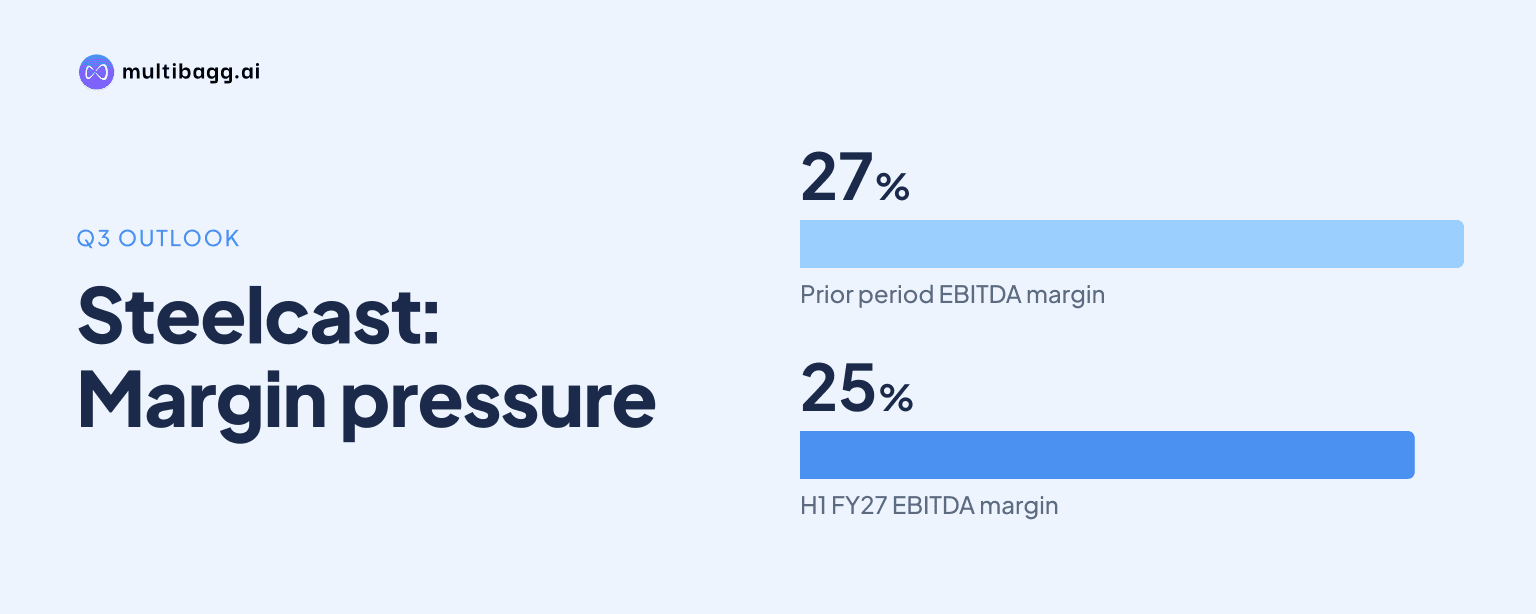
- H1 FY27 revenue rose 23.2% to Rs 262.8 crore, while EBITDA margin declined to 25% from 27%.
- Steelcast raised FY27 revenue-growth guidance to about 30% and reported an executable order book of about Rs 145 crore.
powered by IRIS
Steelcast Limited expects Q3 FY27 margins to remain under pressure because customer price reductions for July-August input declines will overlap with unrecovered September cost increases, including Rs 2 crore of higher Q2 raw-material costs. Steelcast expects recovery of the September raw-material and fuel-cost increases to begin through customer price revisions in Q4 FY27.
Know Steelcast inside out
Results, valuation, peers and who's buying, in one view.
Why will Steelcast’s Q3 FY27 margins remain under pressure?
Steelcast’s Q3 FY27 margins face a timing mismatch in its pass-through mechanism rather than a stated change in its commercial model. Management said input costs declined in July and August, requiring lower customer prices in Q3, but costs began rising again in the first week of September. The company absorbed the September increase initially and expects the related customer price revision in Q4.
The formula compares input costs between the preceding quarter and the current quarter to determine whether customer prices rise or fall. Steelcast said the mechanism is the same for domestic and export customers, although exports accounted for 52% of Q2 FY27 revenue and domestic sales made up 48%. Management did not quantify the final Q3 margin effect because the full-quarter input-cost outcome was not yet known.
Natural-gas costs add another timing issue. Management said natural-gas prices had almost doubled compared with February levels, with the sudden increase occurring in the third month of a quarter. Steelcast said it must wait until Q3 ends to seek the relevant customer correction and expects the fuel-cost recovery through price revisions in Q4.
How large was Steelcast’s Q2 FY27 raw-material timing impact?
Steelcast said raw-material cost was Rs 2 crore higher in Q2 FY27 than in Q1 FY27, with the increase beginning in the first week of September. This was management’s clearest quantification of the timing effect: the company absorbed the cost before the corresponding customer price revision could be applied under its quarterly comparison formula.
The Q2 FY27 margin outcome also reflected costs separate from raw materials. Steelcast spent about Rs 1 crore more on new-product development than in Q1, covering trials, experiments and rework. It also recruited and trained employees for the planned foundry expansion, though management did not provide the incremental employee-cost amount.
Profit after tax, or PAT, was Rs 23.4 crore in Q2 FY27, compared with Rs 23.7 crore in Q1 FY27 and Rs 23.2 crore in Q2 FY26. PAT margin fell to 16.9% from 19.0% sequentially and 21.8% year on year, even as Q2 sales volume rose 8% from Q1 to 4,370 tons and increased 28% from Q2 FY26.
What does Steelcast expect for FY27 margins and revenue?
Steelcast maintained a broad FY27 earnings before interest, tax, depreciation and amortisation, or EBITDA, margin outlook of 26% to 27% in its prepared remarks. In the question session, management described 25% to 26% as its current-year expectation. Both comments were framed as full-year views rather than quarter-specific assurances, with quarterly margins dependent on raw-material movements and price-revision timing.
Management raised its FY27 revenue-growth guidance to about 30% from the 25% guidance provided on the Q1 FY27 call. It attributed the revised target to improved expected volumes in Q3 and Q4, adequate order visibility, product development and demand in mining and earthmoving. Management also said the second half has historically been better than the first half, despite limited overall seasonality.
For H1 FY27, revenue from operations increased 23.2% to Rs 262.8 crore from Rs 213.3 crore in H1 FY26. EBITDA excluding other income rose 14.3% to Rs 65.8 crore, while EBITDA margin declined to 25% from 27%. PAT increased 10.1% to Rs 47.4 crore, but PAT margin declined to 18% from 20.2%.
Got a follow-up? Ask IRIS
Can higher volumes offset Steelcast’s near-term cost pressure?
Steelcast said higher volume should create operating leverage, but management cautioned that unpassed input-cost increases, additional employee costs and product-development expenditure could offset part of that benefit. Existing capacity is 29,000 tons a year, and management expects utilisation to be broadly around 60% in FY27, compared with 57% in Q2 FY27 and 66% in Q1 FY27.
The Q2 utilisation decline did not indicate lower dispatches. Steelcast built inventory in Q1 FY27 to support expected dispatches and liquidated it in Q2, meaning Q2 sales volume exceeded production volume. This resulted in 4,370 tons of Q2 dispatches alongside 57% reported utilisation, which management said should be assessed over a longer period.
The executable order book stood at about Rs 145 crore, equal to roughly three months of sales. Steelcast said physical purchase orders usually cover three to four months, while customers provide rolling 12-month forecasts. Its FY27 revenue outlook therefore rests on both near-term purchase orders and customers’ ongoing production forecasts rather than multi-year physical orders.
What could support Steelcast’s margins after Q3 FY27?
Steelcast expects Q4 FY27 to begin recovering the September raw-material increase and the recent natural-gas increase through customer price corrections. Management also expects Q3 and Q4 volumes to exceed those of Q1 and Q2, supporting operating leverage. These are management expectations, and the recovery timing depends on the Q3 cost comparison and customer price revisions.
Renewable power is a disclosed operating-efficiency initiative. Steelcast has commissioned 9.5 megawatts of renewable capacity and has 2.4 megawatts of hybrid power and 1.4 megawatts of solar power under commissioning, taking the planned portfolio to 13.3 megawatts. Management targets commissioning of the pending 3.8 megawatts by 31 December 2026 and estimates annual power-cost savings of about Rs 4.5 crore.
The company is also preparing for longer-term volume growth. Its board approved 11,750 tons of additional capacity, taking total capacity from 29,000 tons to 40,750 tons, with estimated investment of Rs 151 crore. Management is targeting new-foundry commissioning around 1 April 2028 and expects to invest about Rs 60 crore by 31 March 2027.
Conclusion
Steelcast’s Q2 FY27 figures show that higher dispatches did not fully offset cost timing and expansion-related spending: sales volume increased 28% year on year to 4,370 tons, while PAT margin declined to 16.9% from 21.8%. The reported pressure reflects the lag between input-cost movements and customer price revisions, alongside Rs 1 crore of additional product-development expenditure and hiring ahead of capacity expansion.
The next developments to watch are Q4 FY27 price corrections for September raw-material and natural-gas costs, progress toward management’s approximately 30% FY27 revenue-growth target, and commissioning of 3.8 megawatts of renewable capacity by 31 December 2026. Management also plans about Rs 60 crore of expansion investment by 31 March 2027 as part of the Rs 151 crore project targeted for commissioning around 1 April 2028.