










Steelcast raises FY27 revenue growth outlook to 30% on volumes
Key highlights
- Steelcast raised FY27 revenue-growth guidance to 30% from 25%, citing better expected Q3 and Q4 volumes.
- H1 FY27 revenue from operations rose 23.2% to Rs 262.8 crore from Rs 213.3 crore in H1 FY26.
- Steelcast reported an executable order book of approximately Rs 145 crore, equal to around three months of sales.
- Steelcast plans Rs 151 crore of investment to add 11,750 tonnes of annual capacity by around 1 April 2028.
powered by IRIS
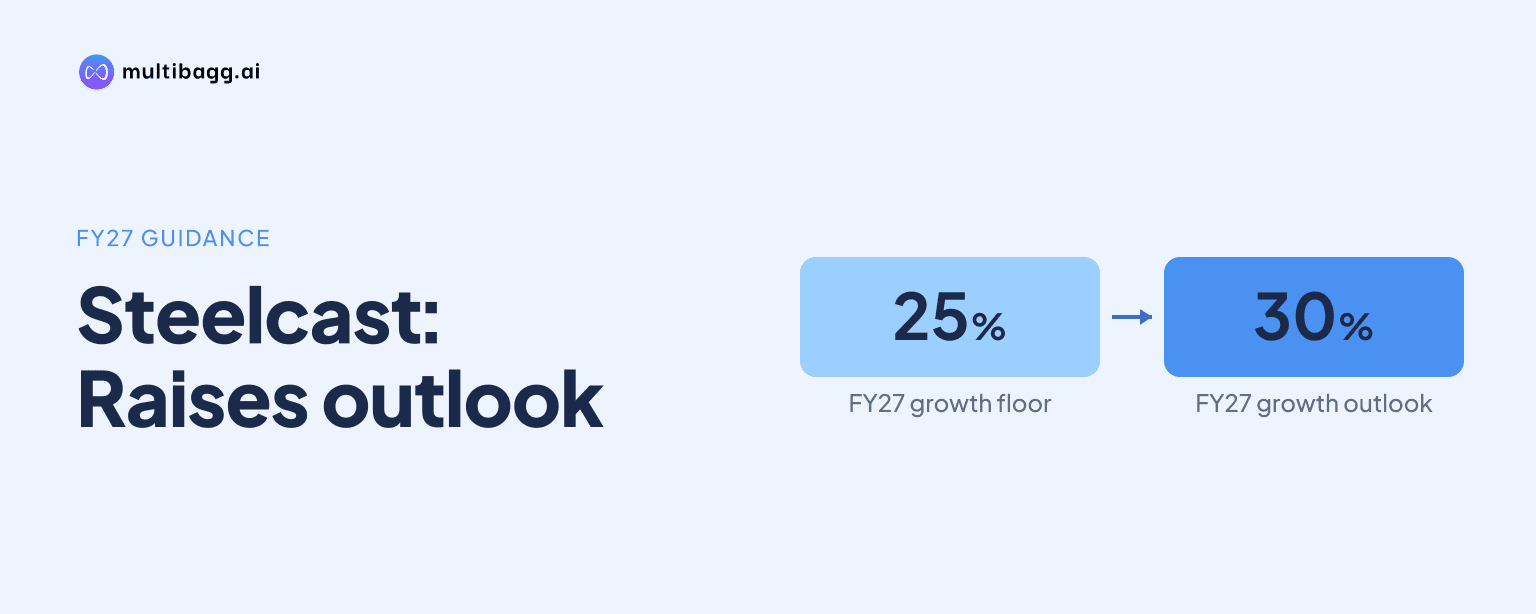
Steelcast raised its FY27 revenue-growth outlook to 30% from 25%, with management expecting improved Q3 and Q4 volumes and citing an executable order book of about Rs 145 crore, equal to roughly three months of sales. H1 FY27 revenue had already increased 23.2% year on year to Rs 262.8 crore.
Know Steelcast inside out
Results, valuation, peers and who's buying, in one view.
Why did Steelcast raise its FY27 revenue-growth outlook?
Steelcast raised its FY27 revenue-growth guidance because management expects Q3 and Q4 volumes to exceed those in Q1 and Q2. Management had issued 25% FY27 revenue-growth guidance in the Q1 FY27 investor call, but said in the current call that growth should reach 30% versus FY26. It clarified that the 30% figure is revenue guidance, not volume guidance.
The Rs 145 crore executable order book is a near-term support for that outlook, as management equated it to around three months of sales. Physical purchase orders generally provide 3 to 4 months of coverage, while customers also supply rolling 12-month forecasts. Management additionally cited bookings in serviceable segments, product development and opportunities in mining and earthmoving.
Steelcast said there is not much seasonality in its business, but its second half has historically been better than its first half. H1 FY27 revenue from operations rose 23.2% to Rs 262.8 crore from Rs 213.3 crore in H1 FY26. The revised 30% full-year projection therefore depends on the anticipated improvement in second-half dispatches and revenue.
How did Steelcast's volumes and revenue mix change in Q2 FY27?
Steelcast reported Q2 FY27 sales volume of 4,370 tonnes, up 8% from 4,036 tonnes in Q1 FY27 and 28% from 3,411 tonnes in Q2 FY26. H1 FY27 sales volume was 8,406 tonnes. Management said Q2 dispatches included inventory built during Q1 and liquidated in Q2, meaning sales volume exceeded production volume during the quarter.
Capacity utilisation at the existing 29,000-tonnes-per-annum facility fell to 57% in Q2 FY27 from approximately 66% in Q1 FY27, despite higher dispatch volume. Management attributed the decline to the inventory cycle, under which Q1 production built inventory for expected dispatches. It expects utilisation of the existing facility to be broadly around 60% during FY27.
Steelcast's Q2 FY27 revenue mix moved toward domestic sales, with exports contributing 52% and domestic business 48%. In Q2 FY26, exports represented 64% and domestic sales 36%. For H1 FY27, exports accounted for 57% of revenue and domestic sales 43%, compared with 59% and 41%, respectively, in H1 FY26.
Earthmoving was Steelcast's largest H1 FY27 end market at 51% of revenue, followed by mining at 21% and construction at 18%. These three sectors together represented approximately 90% of H1 FY27 revenue, while locomotive, railways and other applications accounted for the remaining 10%. Management expects mining and earthmoving to remain key FY27 sectors.
Got a follow-up? Ask IRIS
Why are Steelcast's margins facing near-term pressure?
Steelcast expects Q3 FY27 margin pressure from the timing of its raw-material pass-through mechanism. Input costs declined during July and August, requiring a related price reduction to customers in Q3, while input prices began rising again from the first week of September. Management expects the price revision to recover that September increase to be reflected in Q4.
Management said raw-material cost was Rs 2 crore higher in Q2 FY27 than in Q1 FY27, with the increase occurring from the first week of September. It also incurred approximately Rs 1 crore of quarterly expenditure on new-product development, including trials, experiments and rework. Employee costs increased as Steelcast recruited and trained workers before the new foundry begins operating.
H1 FY27 earnings before interest, tax, depreciation and amortisation, excluding other income, rose 14.3% to Rs 65.8 crore from Rs 57.5 crore in H1 FY26. However, the corresponding margin declined to 25% from 27%. Profit after tax increased 10.1% to Rs 47.4 crore, while profit-after-tax margin fell to 18% from 20.2%.
Management discussed a broad FY27 margin range of 26% to 27% in its prepared remarks, but later said it expected current-year earnings before interest, tax, depreciation and amortisation margin of 25% to 26%. It attributed the expected improvement in Q4 to recovery of the September input-cost increase and to operating leverage from higher volumes. Those ranges are management outlooks, not quarter-specific assurances.
How will Steelcast's expansion change its product capability?
Steelcast plans to add 11,750 tonnes per year of capacity, taking total manufacturing capacity to 40,750 tonnes per year from 29,000 tonnes per year. The Rs 151 crore programme combines an approved 8,500-tonnes-per-year greenfield project costing approximately Rs 120 crore with an additional 3,250 tonnes per year approved at an estimated Rs 31 crore. Management is targeting commissioning of the new foundry around 1 April 2028.
The additional Rs 31 crore investment includes an electric arc furnace, which management said would extend Steelcast's piece-weight capability to approximately 3.5 tonnes from 2.5 tonnes. The greenfield expansion is intended to broaden production across steel castings weighing from 5 kilograms to 1,000 kilograms, while the heavier capability addresses construction, mining and earthmoving applications. Management said it has historically declined 400 to 500 tonnes of annual business for parts weighing more than 2.5 tonnes and below 3.5 tonnes.
Steelcast is pursuing a 111-part product-development programme over three years. During April to September 2026, 55 new parts were in sampling, tooling or customer qualification, while 32 parts had been developed and 15 commercialised during FY27. The process includes co-engineering with original equipment manufacturer customers, pilot orders, process validation and serial production.
The company also plans renewable-energy capacity of 13.3 megawatts, including 9.5 megawatts already commissioned, 2.4 megawatts of hybrid power and 1.4 megawatts of solar power under commissioning. The 3.8 megawatts under commissioning are targeted for completion by 31 December 2026 and are expected to generate annual power-cost savings of approximately Rs 4.5 crore.
Conclusion
Steelcast's revised 30% FY27 revenue-growth outlook reflects management's expectation of higher Q3 and Q4 volumes, supported by Rs 145 crore of executable orders and activity in its principal end markets. The outlook comes after H1 revenue rose 23.2%, but profitability margins moderated because of raw-material pass-through timing, product-development spending and advance hiring for new capacity.
The next disclosures to watch are Q3 volumes, progress in recovering September input-cost increases through Q4 price revisions, and the execution of the Rs 151 crore expansion across FY27 and FY28. Management targets the new foundry for around 1 April 2028, while its 3.8-megawatt renewable projects under commissioning are targeted for 31 December 2026.