










Steelcast FY29 plan keeps core markets at 83% of revenue
Key highlights
- Steelcast plans for mining, earthmoving and construction to account for 83% of FY29 revenue, versus about 90% currently.
- Steelcast targets GETs at about 6% of FY29 sales, up from roughly 1.5% currently.
- Steelcast expects railway revenue to reach 5% by FY29 from around 3% currently.
- Steelcast increased planned expansion investment to Rs 151 crore and expects commissioning by March 2028.
powered by IRIS
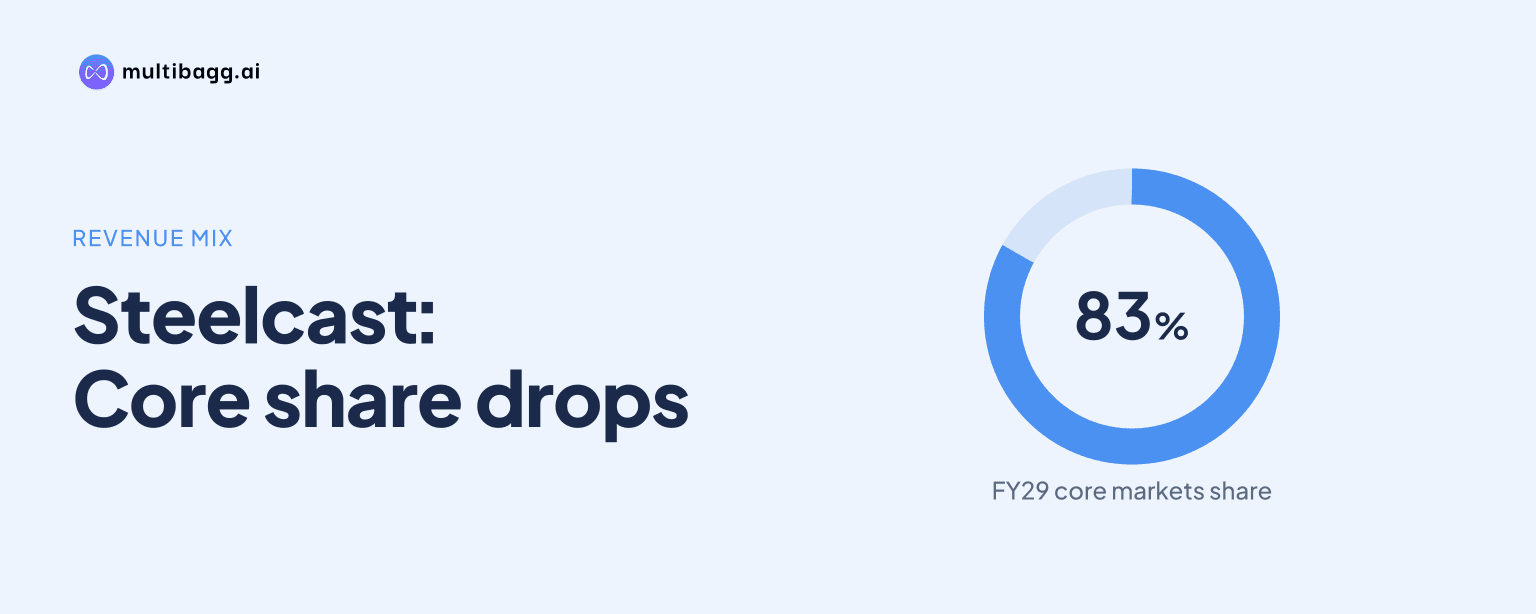
Steelcast Limited plans for mining, earthmoving and construction to represent 83% of revenue in FY29, compared with about 90% currently, according to management's stated end-market mix. The planned reduction rests mainly on growth in ground-engaging tools, railways and locomotives, while mining and earthmoving would still account for 71% of FY29 revenue combined.
Know Steelcast inside out
Results, valuation, peers and who's buying, in one view.
How will Steelcast change its FY29 revenue mix?
Steelcast plans to reduce the combined revenue share of mining, earthmoving and construction to 83% in FY29 from about 90% currently. Management's FY29 breakdown assigns 36% to earthmoving, 35% to mining and 12% to construction, leaving 17% for locomotives, transportation, railways, ground-engaging tools and other industries.
The planned mix represents diversification rather than a departure from Steelcast's established end markets. Mining and earthmoving alone would contribute 71% of FY29 revenue under the plan, while construction would remain a 12% segment. The three core markets would therefore still determine most demand for the company’s casting output through FY29.
Management also gave a broader objective that mining, construction and earthmoving could account for about 60% to 65% over a three- to five-year horizon, with other industries contributing 30% to 35%. That broader indication does not match the later FY29 breakdown, which totals 83% for the same three markets. Steelcast subsequently confirmed that the FY29 figures were a revenue breakup, and investors will need a future clarification on the timing and relationship between the two targets.
Which businesses are expected to drive Steelcast diversification?
Steelcast expects ground-engaging tools, or GETs, to rise to about 6% of FY29 sales from roughly 1.5% currently. That is the largest specifically quantified increase among its smaller disclosed businesses, representing an intended gain of about 4.5 percentage points in revenue mix over the period.
Railways are planned to reach 5% of FY29 revenue from around 3% currently, while locomotives are also targeted at 5%. Transportation is projected at 1.5%, and management listed cement, steel and defence at about 1% each, while noting that the figures were rounded. These categories form the 17% non-core share in the stated FY29 plan.
Steelcast said it does not supply Indian Railways because management considers pricing inadequate, so its railway target should not be interpreted as an entry plan for that customer base. In defence, management said Indian defence is no longer a focus area. For defence exports, Steelcast has developed prototypes and was informed that potential business could emerge over the next three to six months.
The company linked the plan to development work across four or five different industries, rather than to a disclosed multi-year contracted order book. Steelcast said physical purchase orders usually cover about 3.5 to four months of business, while customers provide rolling 12-month forecasts. The forecasts provide production visibility but do not establish that FY29 segment targets are confirmed sales.
Got a follow-up? Ask IRIS
What investment supports Steelcast's wider product range?
Steelcast has raised its planned capacity addition by 3,250 tonnes to 11,750 tonnes and increased the associated investment to Rs 151 crore from Rs 120 crore. Management expects to commission the full programme by March 2028 and said it may invest about Rs 60 crore by March 31, 2027.
The additional investment includes an electric arc furnace, which management said will broaden the product range beyond the existing induction-melting process. The furnace is expected to have capacity of about 6 to 6.5 tonnes and lift Steelcast's maximum piece-weight capability to 3.5 tonnes from 2.5 tonnes. Management said electric arc processing can further refine steel, whereas induction melting has limited refining capability.
Steelcast said it currently turns away or cannot serve about 400 to 500 tonnes of annual business involving parts weighing more than 2.5 tonnes but less than 3.5 tonnes. The new furnace is intended to address that range and expand the addressable market. The call did not specify how much of this additional capability will be used for GETs, railways, locomotives or any other FY29 target segment.
The company has also ordered about Rs 35 crore of computer numerical control, or CNC, machines, with deliveries scheduled from January 2027 to January 2028. Management said the equipment should provide machining capacity as production rises. Its long-range plan assumes about 90% capacity utilisation by FY29, although it did not provide a utilisation target by end market.
What could affect Steelcast's FY29 mix targets?
Steelcast's capacity decision reflects management's expectation that commodity prices will remain elevated and support investment in mining, earthmoving, construction and railroad industries. Management also cited China Plus One demand, overall demand growth and requests from existing customers to develop more parts. It said, however, that its business-to-business model does not normally involve purchase orders extending two to four years ahead.
The current sales base remains concentrated during the proposed transition. Management said exports have historically accounted for 50% to 60% of sales, with domestic revenue at 40% to 50%. It expects both export and domestic sales to remain near 50%, plus or minus 5%, over the longer term, and said exports could be somewhat higher in the second half of FY27.
Input-cost timing could affect margins while Steelcast funds development and capacity additions. Management said raw-material cost was Rs 2 crore higher than in Q1, with the increase arising from the first week of September. It also said natural-gas prices had almost doubled from February levels and expected related price corrections after Q3, potentially in Q4.
Steelcast spent Rs 1 crore more on new-product development in Q2 than in Q1 and is absorbing additional employee costs for the new facility. Management said higher volumes should create operating leverage, but delayed pass-through of raw-material, power and fuel increases can offset that benefit in a quarter. It maintained a current-year EBITDA, or earnings before interest, tax, depreciation and amortisation, margin expectation of 25% to 26%, and described 25% as sustainable over a two- to three-year horizon.
Conclusion
Steelcast's disclosed FY29 plan would lower the combined mining, earthmoving and construction share by about 7 percentage points to 83%, while building positions in GETs, railways, locomotives and other industries. The shift is meaningful in mix terms, but the planned 71% contribution from mining and earthmoving means the company would remain predominantly exposed to those two end markets.
The next disclosed milestones are a decision on an additional 6 megawatts of solar capacity within two to three months, an update at the next quarterly investor call, CNC-machine deliveries from January 2027 and commissioning of the Rs 151 crore expansion by March 2028. Steelcast also needs to clarify how its FY29 83% core-market mix aligns with its separate three- to five-year target of 60% to 65%.