










Steelcast lifts foundry plan to Rs 151 crore, 40,750 tonnes
Key highlights
- Steelcast raised planned foundry investment by Rs 31 crore to Rs 151 crore.
- The expanded project will increase annual capacity from 29,000 tonnes to 40,750 tonnes.
- The electric arc furnace is intended to lift Steelcast’s piece-weight capability from 2.5 tonnes to about 3.5 tonnes.
- Steelcast reported an executable order book of about Rs 145 crore, equal to around three months of sales.
powered by IRIS
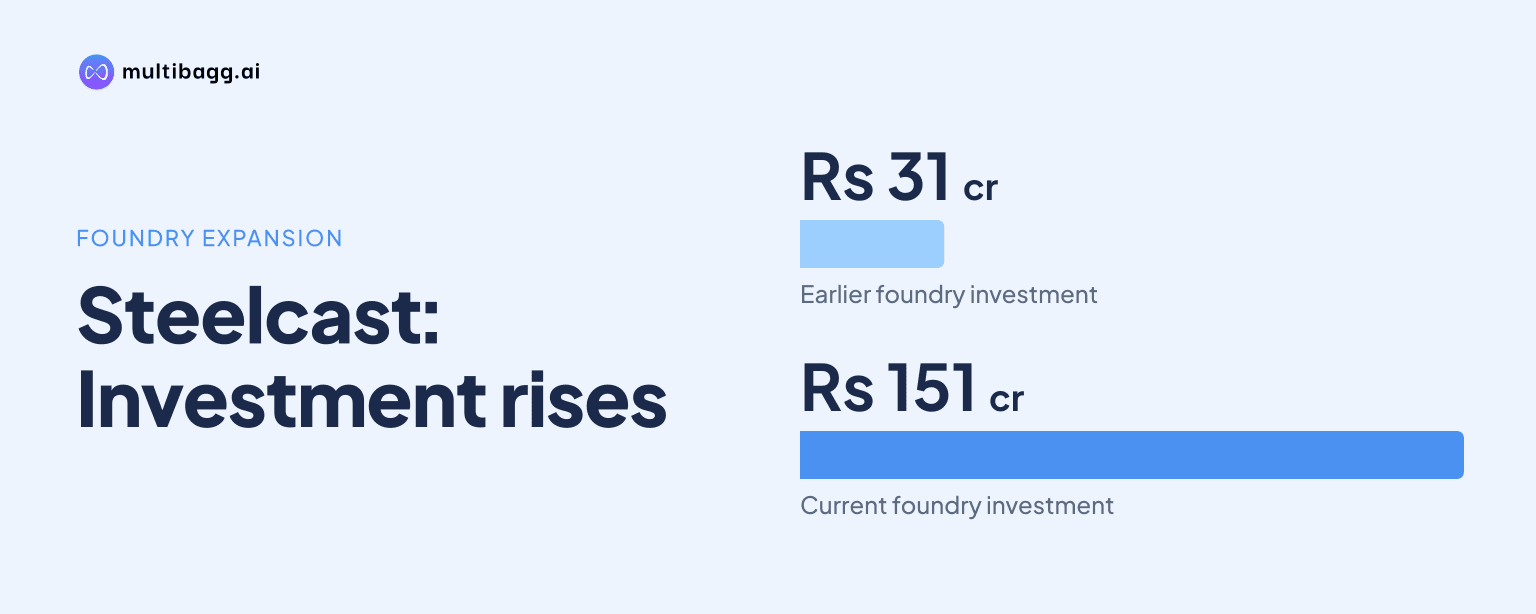
Steelcast Limited has increased its greenfield foundry project to Rs 151 crore, which will lift annual capacity to 40,750 tonnes from 29,000 tonnes. The additional Rs 31 crore investment adds 3,250 tonnes of capacity and an electric arc furnace, intended to raise Steelcast’s maximum casting weight to about 3.5 tonnes from 2.5 tonnes.
Know Steelcast inside out
Results, valuation, peers and who's buying, in one view.
Why did Steelcast increase its foundry investment?
Steelcast increased the project because management identified demand for heavier castings and steel requiring more refining than its existing induction-melting process provides. The Board had previously approved Rs 120 crore for 8,500 tonnes of greenfield capacity over two years, focused on components weighing between 5 kilograms and 1,000 kilograms. It subsequently approved a further Rs 31 crore and 3,250 tonnes of capacity.
Management said the incremental installation includes an electric arc furnace with capacity of about 6 to 6.5 tonnes. Steelcast currently uses induction melting, which management said allows limited refining. The arc furnace is intended to permit further steel refining, broaden the product range and provide more flexible manufacturing capability. The expansion is capability-led rather than linked to a disclosed multi-year purchase order.
The revised plan raises Steelcast’s capacity by 11,750 tonnes, from 29,000 tonnes per annum to 40,750 tonnes per annum. Management expects the Rs 31 crore addition to be phased alongside the original project during FY27 and FY28. It is targeting commissioning of the new foundry around 1 April 2028, while seeking to complete the work earlier if feasible.
What market can Steelcast serve with heavier castings?
Steelcast expects the project to extend its maximum casting weight to about 3.5 tonnes from 2.5 tonnes, addressing business it currently cannot serve. Management said customers buy castings weighing from 5 kilograms to 7.5 tonnes, although demand volumes generally decline as component weight rises. The company identified the 2.5-tonne to 3.5-tonne range as a gap in its existing offering.
Management said Steelcast turns away roughly 400 to 500 tonnes of annual business because required casting weights exceed 2.5 tonnes but are below 3.5 tonnes. Construction, mining and earthmoving are the principal opportunity areas identified for heavier products. These were already Steelcast’s largest end markets in H1 FY27: earthmoving contributed 51% of revenue, mining 21% and construction 18%, or about 90% combined.
The additional capacity expands Steelcast within its current core markets while adding a steel-refining capability. Management cited elevated commodity prices as a factor that could support investment in mining, earthmoving, construction and railroad industries. It also cited China Plus One demand and requests from existing customers to develop more parts, but described these as demand expectations rather than contracted multi-year orders.
Got a follow-up? Ask IRIS
How does the expansion fit Steelcast’s demand visibility?
Steelcast reported an executable order book of about Rs 145 crore, equal to roughly three months of sales, while management said physical purchase orders usually cover 3.5 to four months. Customers also provide rolling 12-month forecasts, according to management, but these forecasts are distinct from physical orders and are updated each month.
Demand supported sales-volume growth before the new facility’s expected commissioning in April 2028. Q2 FY27 sales volume rose to 4,370 tonnes from 3,411 tonnes in Q2 FY26, an increase of about 28%, and from 4,036 tonnes in Q1 FY27, an 8% sequential rise. H1 FY27 sales volume was 8,406 tonnes, with management attributing part of Q2 dispatch growth to inventory liquidated after it was built in Q1.
Capacity utilisation at the existing 29,000-tonne facility fell to 57% in Q2 FY27 from about 66% in Q1 FY27 despite higher sales volume. Management said Q2 dispatches exceeded production because the quarter drew on inventory, reducing reported utilisation. It expects utilisation of existing capacity to be broadly around 60% during FY27, meaning quarterly utilisation does not directly track shipment demand.
How does Steelcast plan to fund the larger project?
Steelcast said it has remained debt free for three consecutive years and held free reserves of about Rs 120 crore in bank fixed deposits, mutual funds and secured bonds. Management said this liquidity base and internal accruals support planned investments, including greenfield manufacturing capacity. Return on capital employed was 28.8% in H1 FY27, compared with 28.6% in FY26, while return on equity was 21.9%, compared with 22.0%.
Revenue from operations increased 23.2% to Rs 262.8 crore in H1 FY27 from Rs 213.3 crore in H1 FY26. Earnings before interest, tax, depreciation and amortisation, or EBITDA, excluding other income, rose 14.3% to Rs 65.8 crore, while the EBITDA margin declined to 25% from 27%. Profit after tax rose 10.1% to Rs 47.4 crore, but its margin declined to 18% from 20.2%.
Management linked the margin change to product-development spending, recruitment and training before the expansion, and a lag in the raw-material price pass-through mechanism. Q2 FY27 included approximately Rs 1 crore of additional new-product development expenditure, while raw-material cost was about Rs 2 crore higher than in Q1 FY27 after prices rose from the first week of September. Management said the September increase should begin to pass through in Q4, although Q3 would also reflect lower earlier input costs being passed to customers.
Management’s margin comments varied during the call. In the prepared remarks, it discussed a broad FY27 EBITDA margin range of 26% to 27%, while in the question-and-answer session it referred to 25% to 26% for FY27 and described 25% as sustainable over a two- to three-year period. Both comments were management outlooks, not reported results.
Conclusion
Steelcast’s Rs 151 crore project combines a larger capacity addition with broader production capability. The extra 3,250 tonnes will take annual capacity to 40,750 tonnes and allow castings of up to about 3.5 tonnes, addressing the 400-to-500-tonne annual business opportunity management says lies above the present 2.5-tonne limit. The investment is directed at end markets that generated about 90% of H1 FY27 revenue.
The next milestones are project spending through FY27 and FY28 and management’s target to commission the foundry around 1 April 2028. Investors will also watch Q3 and Q4 FY27 margin outcomes as raw-material, natural-gas and power-cost revisions move through the pass-through mechanism, as well as progress on 111 parts in Steelcast’s three-year product-development programme.