










Avadh Sugar & Energy Reports FY26 Revenue of Rs 2,694 Crore
Key highlights
- Avadh Sugar reported FY26 revenue of Rs 2,694 crore, compared with Rs 2,636 crore in FY25.
- FY26 EBITDA declined to Rs 226 crore from Rs 280 crore in FY25.
- Q4 FY26 revenue was Rs 671 crore and EBITDA was Rs 121 crore.
- Avadh Sugar has crushing capacity of 34,800 TCD and power capacity of 74 MW.
powered by IRIS
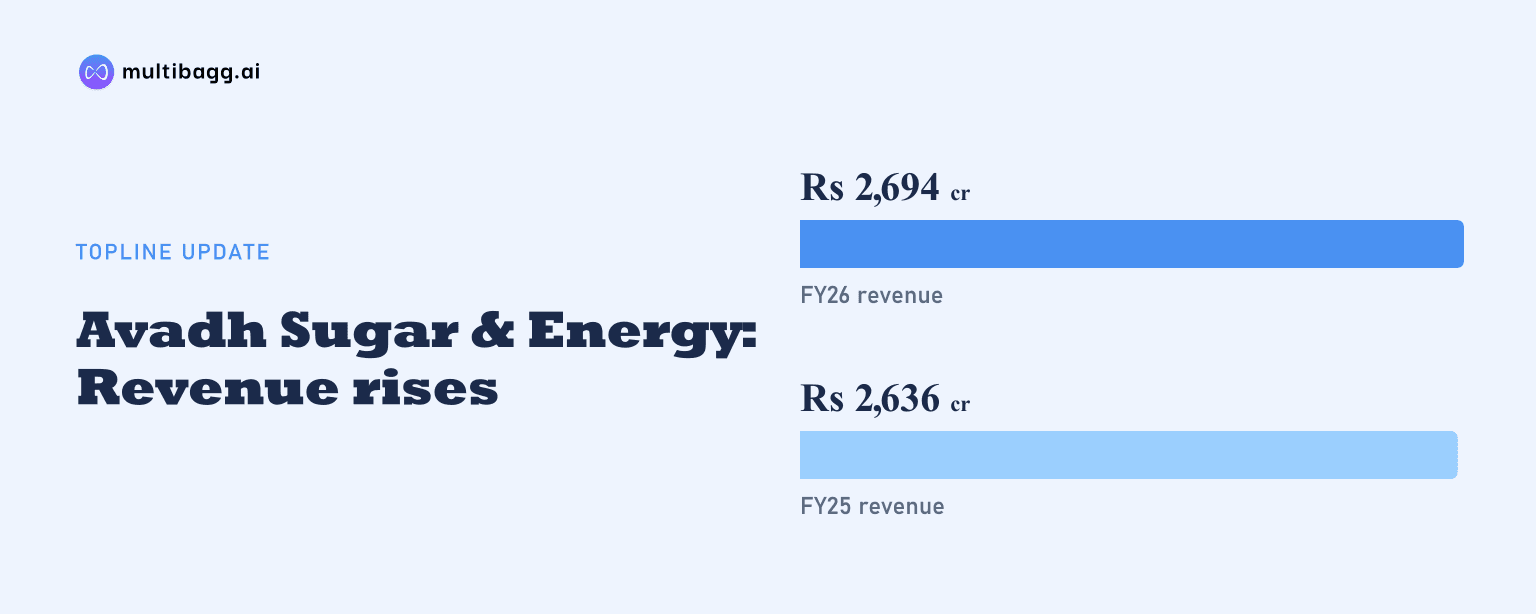
Avadh Sugar & Energy Limited reported FY26 revenue of Rs 2,694 crore, compared with Rs 2,636 crore in FY25, while EBITDA declined to Rs 226 crore from Rs 280 crore. The figures show modest annual revenue growth alongside lower operating earnings for the sugar, ethanol and power producer.
Know Avadh Sugar & Energy inside out
Results, valuation, peers and who's buying, in one view.
What did Avadh Sugar & Energy report for FY26?
Avadh Sugar & Energy reported revenue of Rs 2,694 crore for FY26, against Rs 2,636 crore in FY25. The year-on-year increase was Rs 58 crore. However, EBITDA fell to Rs 226 crore in FY26 from Rs 280 crore a year earlier, a decline of Rs 54 crore.
For the fourth quarter, revenue was Rs 671 crore in Q4 FY26, compared with Rs 679 crore in Q4 FY25. Quarterly EBITDA was Rs 121 crore, down from Rs 149 crore in the corresponding quarter of the previous year. The company said profitability in Q4 FY25 had increased 47%, driven by higher margins on sugar sales despite lower crushing volumes and reduced recovery.
The financial figures were included in Avadh Sugar's Q4 and FY26 investor presentation, filed on May 12, 2026. The company described the presentation as information material and stated that it did not constitute an offer or recommendation to buy or subscribe to securities.
How does Avadh Sugar's business model use sugarcane?
Avadh Sugar operates an integrated business in which sugarcane supports sugar, ethanol and power production. The cane is processed into sugar, molasses are used for ethanol, and bagasse, the fibrous residue left after crushing, is used to generate electricity.
This structure means the company's three operating areas are linked to the same agricultural raw material. Sugar remains the core business, while ethanol and power provide additional avenues to use by-products generated during the crushing process. Avadh Sugar describes itself as an agribusiness producing sugar, ethanol alcohol and power.
The company has a stated crushing capacity of 34,800 tonnes of cane per day, or TCD, and power capacity of 74 MW. Its operations are located in Uttar Pradesh, which the company identifies as India's largest sugar-producing state.
What do the latest quarterly figures show?
The latest quarterly data cited for Avadh Sugar show sales of Rs 779.25 crore, net income of Rs 0.23 crore and earnings per share of Rs 0.12. Revenue in the immediately preceding quarter was Rs 670.61 crore, indicating a sequential increase in sales based on the reported figures.
Net income, however, was Rs 55.61 crore in the preceding quarter before falling to Rs 0.23 crore in the latest quarter. The provided data do not specify the factors behind this change, so the figures should be read as reported rather than as evidence of a particular operational cause.
On a trailing 12-month basis, Avadh Sugar's net profit margin was 2.39% and its operating margin was 6.29%. The cited industry averages were 10.83% for net profit margin and 13.68% for operating margin, placing the company's reported margins below those reference levels.
Got a follow-up? Ask IRIS
How is Avadh Sugar valued relative to the cited industry data?
Avadh Sugar's reported trailing 12-month price-to-earnings ratio was 24.3 times, compared with a cited industry average of 36.19 times. This comparison places its reported valuation multiple below the stated industry benchmark.
The company reported trailing 12-month EPS of 33.16. Revenue per share for the latest quarter was reported at Rs 239.67. These measures provide additional context for investors assessing earnings and sales on a per-share basis, though they do not by themselves explain changes in revenue, profitability or market valuation.
The financial data also underline the importance of tracking operating margins alongside topline growth. FY26 revenue was higher than FY25 revenue, but annual EBITDA was lower. The latest-quarter data similarly show a large difference between sales and net income, reinforcing the need to distinguish revenue performance from profit performance.
Why do sugar volumes and margins matter to the company?
Sugar sales, crushing volumes and recovery rates remain important to Avadh Sugar because sugarcane is the common input across its sugar, ethanol and power activities. Crushing volumes determine the amount of cane processed, while recovery affects the output obtained from cane.
The company specifically cited lower crushing volumes and reduced recovery in its discussion of Q4 FY25, even as higher sugar-sale margins supported a 47% increase in profitability for that quarter. This illustrates how selling margins and operating volumes can move in different directions within the same period.
For investors, the reported FY26 figures show that a higher annual revenue base did not translate into higher EBITDA. The cited margin data also show that Avadh Sugar's trailing profitability ratios were below the referenced industry averages. Future disclosures on sugar sales, crushing conditions, ethanol operations and power generation will therefore remain relevant to evaluating operating performance.
Conclusion
Avadh Sugar's FY26 results show revenue of Rs 2,694 crore, modestly above FY25, alongside a decline in EBITDA to Rs 226 crore. Its integrated model continues to connect sugar production with ethanol and bagasse-based power, but the reported figures show that revenue growth and operating profitability did not move together during the year.
Investors should watch subsequent company disclosures for updates on crushing volumes, recovery, sugar-sale margins and the contribution from ethanol and power. These are the operating factors identified in the available material that can help clarify whether margins and earnings improve after FY26.