










Avadh Faces Zero-Diversion Shift to C-Heavy and Grain Ethanol
Key highlights
- Avadh’s H1FY27 ethanol production fell to 267 lakh litres from 457 lakh litres in H1FY26.
- The ESY 2026-27 tender excludes B-heavy molasses and cane juice while allowing C-heavy molasses and grain feedstocks.
- B-heavy molasses and juice represented 6.49 crore litres, or about 86%, of Avadh’s 7.54 crore litres of ESY 2025-26 orders.
- Avadh supplied 7.00 crore litres to OMCs by 31 October 2026 against 7.54 crore litres allocated or ordered.
powered by IRIS
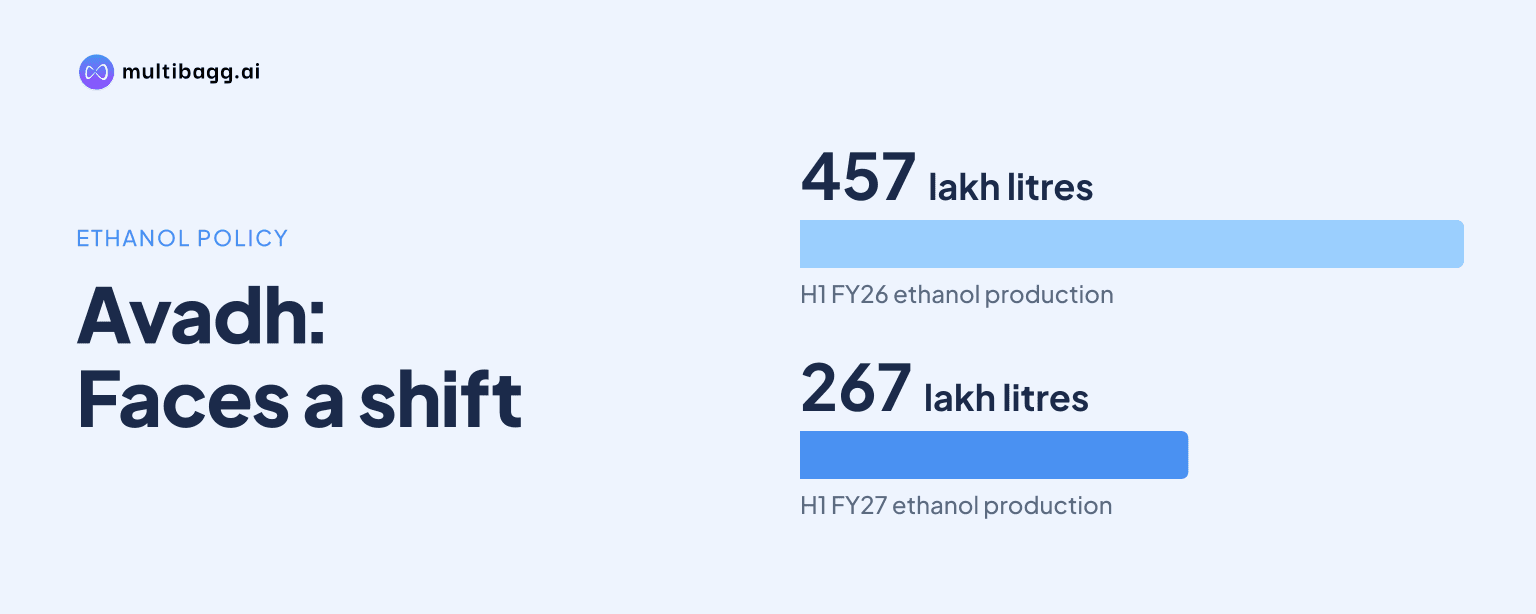
Avadh Sugar & Energy Ltd. enters ethanol supply year, or ESY, 2026-27 with B-heavy molasses and cane juice excluded from oil marketing company procurement, after ethanol production fell 42% to 267 lakh litres in H1FY27 from 457 lakh litres a year earlier. The new tender permits only C-heavy molasses and grain-based routes among the feedstocks shown.
Know Avadh Sugar & Energy inside out
Results, valuation, peers and who's buying, in one view.
What changed in Avadh’s ethanol operating environment?
Avadh now faces an ethanol procurement cycle with zero sugar diversion and no permitted use of B-heavy molasses, cane juice or sugar syrup. Oil marketing companies, or OMCs, issued a tender on 16 October 2026 for about 11 billion litres to be supplied from November 2026 through October 2027. The permitted feedstocks are maize, broken rice, Food Corporation of India, or FCI, surplus rice, and C-heavy molasses.
The policy differs from ESY 2025-26, when the industry diverted about 3 million tonnes of sugar to ethanol, compared with zero for ESY 2026-27. Government data cited in the presentation put grain’s ethanol share at about 90%, up from about 75% in the prior year. That shift removes two feedstocks that made up most of Avadh’s immediately preceding OMC order programme.
The tender also reduced the stated maize ethanol price to Rs 68.86 per litre from Rs 71.86 per litre and cut the maize incentive to Rs 2.79 per litre from Rs 5.79 per litre. The Indian Sugar & Bio-energy Manufacturers Association requested Rs 62.23 per litre for C-heavy molasses and pricing linked to the fair and remunerative price, or FRP, of cane. The presentation identifies those measures as industry requests, not approved policy changes.
How far did Avadh’s distillery volumes decline?
Avadh’s ethanol production fell by 190 lakh litres year on year to 267 lakh litres in H1FY27, while ethanol sold declined by 89 lakh litres to 375 lakh litres. Production in Q2FY27 was 46 lakh litres, down from 187 lakh litres in Q2FY26. Q2 ethanol sales declined to 117 lakh litres from 197 lakh litres over the same comparison.
Management attributed lower distillery earnings before interest and tax, or EBIT, to reduced ethanol production and lower feedstock availability. It linked the feedstock constraint to higher C-heavy molasses crushing during sugar season, or SS, 2025-26. Management also said the B-heavy molasses levy obligation for SS 2025-26 rose to 20% from 18% during the current quarter.
Power sold to the grid also decreased, to 32 lakh units in H1FY27 from 37 lakh units in H1FY26, with Q2 volume falling to 6 lakh units from 19 lakh units. However, management said power EBIT cannot be compared directly with the prior year because the earlier period included one-time income from a power tariff differential relating to previous years.
Got a follow-up? Ask IRIS
How dependent was Avadh on the excluded feedstocks?
Avadh had 6.49 crore litres of ESY 2025-26 orders in the two feedstocks now excluded from the new tender: 4.78 crore litres from B-heavy molasses and 1.71 crore litres from juice. Together, they represented about 86% of its 7.54 crore litres allocated or ordered. C-heavy molasses accounted for the remaining 1.05 crore litres.
Avadh supplied 7.00 crore litres against 7.54 crore litres allocated or ordered by 31 October 2026. The supplied volume comprised 4.32 crore litres from B-heavy molasses, 1.69 crore litres from juice and 0.99 crore litres from C-heavy molasses. The preceding programme therefore used the feedstocks that are no longer available under the ESY 2026-27 tender.
At the industry level, OMCs allocated 1,197 crore litres against tenders of 1,776 crore litres for ESY 2025-26, with 987 crore litres supplied as of 30 September 2026. Maize represented the largest allocated feedstock at 614 crore litres, followed by FCI rice at 233 crore litres. The presentation notes an industry concern that priority for dedicated grain plants with long-term offtake could leave distilleries idle; it does not present this as a disclosed outcome for Avadh.
What do blending and sugar trends mean for Avadh?
National average ethanol blending reached 19.09% in ESY 2025-26, and monthly blending reached 20% in September 2026, according to the presentation. The OMC contracting trend rose from 457 crore litres in 2021-22 to 1,197 crore litres in 2025-26. Higher aggregate demand therefore coincides with a procurement framework that excludes the two sugar-based feedstocks central to Avadh’s previous orders.
Management expects distillery operation exclusively on C-heavy molasses to increase sugar availability and raise sugar inventory. India’s opening sugar stock was about 3.66 million tonnes on 1 October 2026, compared with about 5 million tonnes a year earlier, while the Indian Sugar & Bio-energy Manufacturers Association forecast sugar production of about 26 million tonnes for SS 2026-27. These sector figures provide the context for management’s expected inventory build-up.
Avadh reported Q2FY27 total income of Rs 655 crore, compared with Rs 670 crore in Q2FY26, while EBITDA rose to Rs 42 crore from Rs 20 crore. Management attributed margin improvement to higher sugar realisations and lower cost of inventory sold, but separately said lower ethanol sales hurt revenue and profitability. It quantified the Q2FY27 adverse profitability effect of the higher molasses levy obligation at about Rs 9.50 crore.
Conclusion
Avadh’s operating environment has moved from a feedstock mix led by B-heavy molasses and juice to a new procurement cycle limited to C-heavy molasses and grain routes. The change follows a 190 lakh-litre decline in H1FY27 ethanol output and excludes feedstocks representing 6.49 crore litres, or about 86%, of Avadh’s ESY 2025-26 orders.
The next factors to watch are execution under the ESY 2026-27 procurement period beginning in November 2026, any policy decision on C-heavy molasses pricing or support for idle distilleries, and management’s expected working-capital debt rebuild from November as sugar crushing begins. Management also expects C-heavy-only distillery operations to add to sugar availability and inventory.