










Avadh sees tighter sugar backdrop as Indian stocks fall
Key highlights
- India’s opening sugar stock was about 3.66 MMT on 1 October 2026, versus about 5 MT a year earlier.
- The presentation cites about 26 MT of Indian sugar production for SS 2026-27, compared with about 27.95 MT in SS 2025-26.
- Avadh’s H1FY27 sugar realisation rose 8% year on year to rupees 4,321 per quintal.
- Global 2026-27 sugar deficit forecasts cited by Avadh ranged from 0.2 MT to 6.28 MT.
powered by IRIS
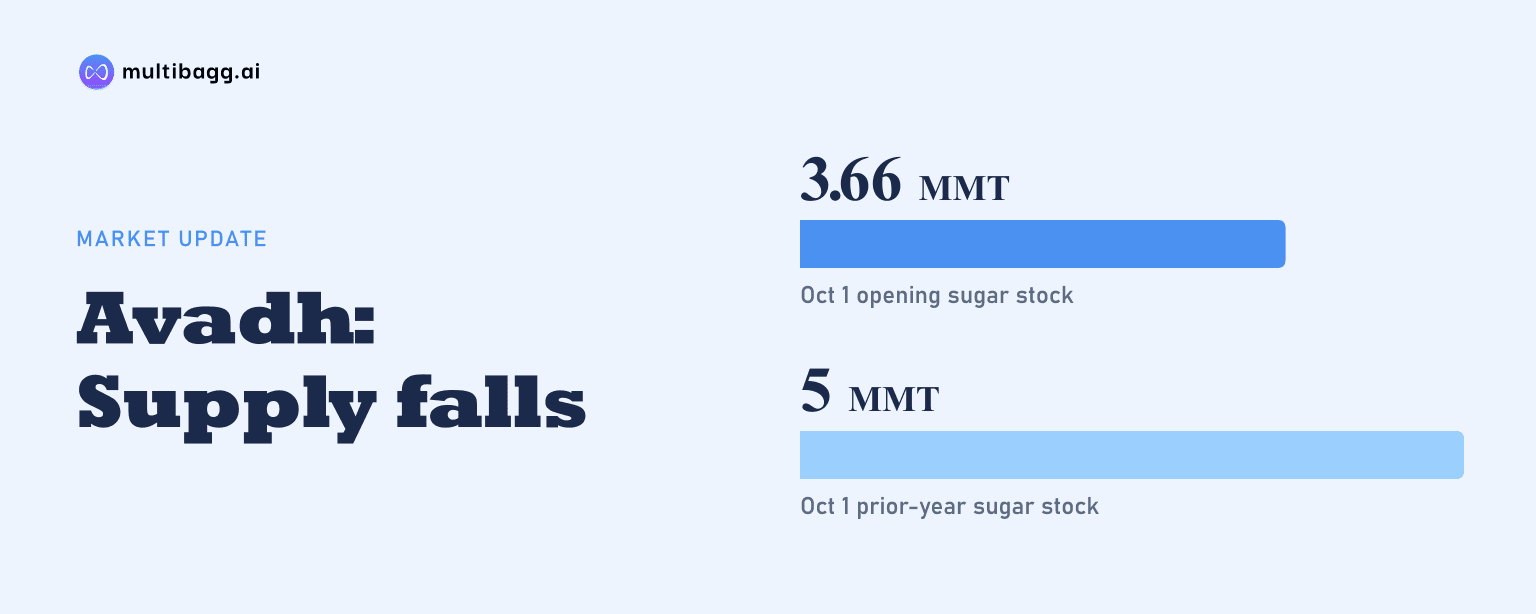
Avadh Sugar & Energy Ltd. enters SS 2026-27 against an Indian opening sugar stock of about 3.66 million metric tonnes (MMT) on 1 October 2026, roughly 1.34 million tonnes (MT) below the prior year’s level of about 5 MT. The presentation also cites global 2026-27 deficit forecasts ranging from 0.2 MT to 6.28 MT.
Know Avadh Sugar & Energy inside out
Results, valuation, peers and who's buying, in one view.
Why are Indian sugar stocks tighter entering SS 2026-27?
India begins SS 2026-27 with about 3.66 MMT of opening sugar stock, which Avadh describes as among the lowest levels in a decade. The position was about 5 MT a year earlier, a reduction of roughly 1.34 MT. The October sale quota was 3 MT, comprising 1.4 MT and 1.6 MT, which kept domestic supplies moving at the start of the season.
New-season sugar arrivals were slow when the presentation was prepared. About 123 Maharashtra mills had started, Karnataka’s season was delayed by farmer agitation, and Uttar Pradesh crushing was expected to reach full pace only after 10 November. The timing is material for Avadh because sugar generated revenue of Rs 1,257 crore, including inter-segment revenue, in H1FY27, compared with Rs 230 crore for distillery and Rs 20 crore for co-generation and other operations.
The presentation’s supply outlook also indicates lower production than in the prior season. Its ISMA forecast puts SS 2026-27 Indian sugar production at about 26 MT, compared with about 27.95 MT, net of diversion, in SS 2025-26. The 1.95 MT decline in forecast production, together with the lower opening stock, is the market backdrop presented by Avadh rather than a forecast of its own output.
How could the deficient monsoon affect Indian sugar production?
The presentation says the 2026 monsoon brought 759.4 millimetres of rainfall, 12.6% below normal, making it India’s first deficient monsoon since 2015. It cites a National Oceanic and Atmospheric Administration estimate of more than 90% probability of a very strong El Niño through winter 2026-27. Maharashtra and Karnataka were identified as the most affected areas because dry spells reduced cane weight and sucrose.
The presentation cites an expected sugar recovery of only 8.6% in the affected regions, referring to the proportion of sugar obtained from crushed cane. Avadh’s H1FY27 average recovery was 11.18%, marginally below 11.23% in H1FY26. Its cane crushing fell to 6.19 lakh quintals in H1FY27 from 14.44 lakh quintals a year earlier, while sugar production declined to 0.86 lakh quintals from 1.81 lakh quintals.
Uttar Pradesh is presented as relatively insulated because west Uttar Pradesh cane is largely irrigated. Northwest India, which includes Uttar Pradesh, recorded rainfall only 6% below normal, according to the presentation. This regional difference may matter to Avadh’s cane availability, although the source does not provide a company-specific SS 2026-27 crushing or production forecast.
Got a follow-up? Ask IRIS
Which policies could limit Avadh’s pricing benefit?
The Fair and Remunerative Price, or FRP, for cane in 2026-27 is rupees 365 per quintal at 10.25% recovery, up 10 rupees per quintal. Avadh identifies the increase as a higher cost floor. Uttar Pradesh’s State Advised Price, or SAP, had not been announced at the time of the presentation; the prior-year rates were rupees 400 per quintal for early variety and rupees 390 per quintal for general variety.
The sugar minimum selling price has remained rupees 31 per kilogram since 2019 and was under committee review. Management said a higher floor would de-risk the second half, but the presentation gives neither a proposed level nor a decision date. Sugar exports remained restricted, while the 1 MT duty-free import quota was extended to 31 December; Avadh said little sugar had entered so far, but the quota could cap domestic prices.
Supply controls were also in place, including a 15-day bulk-stock limit and an October quota of 30 lakh tonnes during the festive period. Against that policy setting, Avadh’s H1FY27 average sugar realisation increased 8% year on year to rupees 4,321 per quintal from rupees 3,994 per quintal. Sugar segment earnings before interest and tax, or EBIT, turned to Rs 45 crore from a Rs 3 crore loss, which the presentation primarily attributes to improved realisations rather than a change in the minimum selling price.
Why do global deficit forecasts matter to Avadh?
The global outlook cited by Avadh points to deficits, but the estimates differ substantially. The International Sugar Organization forecast a 0.2 MT deficit in September, Covrig forecast 0.3 MT in August, StoneX forecast 0.9 MT in September, and Green Pool forecast 6.28 MT in October. The presentation also says India is seen 1.33 MT short, its widest gap in three years.
International raw sugar reached a 19-month high of 21.3 US cents per pound in mid-October and stood at 20.24 US cents per pound on 23 October, about 35% above a year earlier. The presentation does not state that this international price movement will flow directly into Avadh’s realisations, particularly because Indian exports are restricted and domestic sales are regulated through quotas and stock rules.
The global supply reductions identified in the presentation extend across major producing regions. European Union output for 2026-27 was forecast to fall 19% to 13.4 MT, Thailand’s output was forecast to fall 17% to 10 MT, and Brazil Centre-South cumulative output was 14% below the prior year. These reductions support the deficit case, while the range from 0.2 MT to 6.28 MT leaves the scale of the final global shortfall unresolved.
Conclusion
Avadh’s SS 2026-27 pricing backdrop combines lower Indian opening stocks, a 26 MT production forecast versus about 27.95 MT in SS 2025-26, and weather pressure in Maharashtra and Karnataka. These market conditions accompanied an 8% rise in Avadh’s H1FY27 sugar realisation to rupees 4,321 per quintal and a shift in sugar EBIT to Rs 45 crore from a Rs 3 crore loss a year earlier.
The next disclosures to watch are Uttar Pradesh’s 2026-27 SAP decision, the committee review of the rupees 31-per-kilogram minimum selling price, and the production effect of delayed crushing after 10 November. Avadh also disclosed that cane juice and B-heavy molasses are barred from ethanol supply in ESY 2026-27, leaving C-heavy molasses or grain as permitted feedstocks while requested distillery support remains pending.