










Bajaj AMC income rose 71% as AUM reached Rs 35,768 crore
Key highlights
- Bajaj AMC reported total AUM of Rs 35,768 crore in Q2 FY2027, up Rs 4,324 crore from Q1 FY2027.
- Bajaj AMC H1 FY2027 total income rose 71% year on year to Rs 49.4 crore.
- Bajaj AMC H1 FY2027 loss after tax narrowed to Rs 86.3 crore from Rs 107.8 crore a year earlier.
- Bajaj AMC had 52,996 distributors in Q2 FY2027, with a reported two-year CAGR of 16%.
powered by IRIS
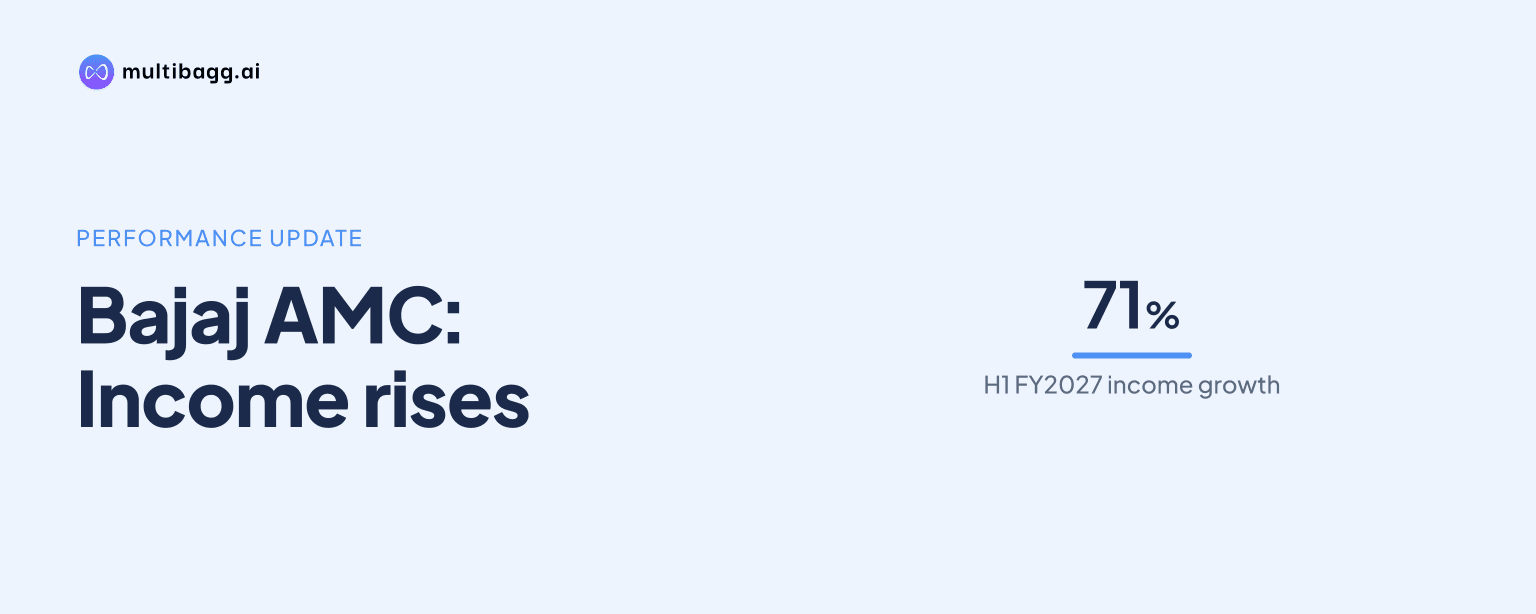
Bajaj Asset Management Ltd. remained loss-making in H1 FY2027, reporting a Rs 86.3 crore loss even as total income rose 71% year on year to Rs 49.4 crore and total assets under management reached Rs 35,768 crore in Q2 FY2027. The figures show expanding revenue and distribution scale alongside a smaller, but continuing, loss.
Know Bajaj Finserv inside out
Results, valuation, peers and who's buying, in one view.
Why did Bajaj AMC remain loss-making in H1 FY2027?
Bajaj AMC remained loss-making because its H1 FY2027 profit after tax was negative Rs 86.3 crore, although the loss narrowed from negative Rs 107.8 crore in H1 FY2026. In Q2 FY2027, the loss was negative Rs 45.1 crore, compared with negative Rs 55.7 crore a year earlier. Thus, the quarterly loss narrowed by Rs 10.6 crore and the half-year loss by Rs 21.5 crore, based on the reported figures.
The presentation does not disclose an expense breakdown, fee yield or a date for reaching profitability, so it does not identify the specific cost items behind the loss. It does show Rs 900 crore of capital infused as of September 30, 2026, including Rs 125 crore infused during the year, and net worth of Rs 137 crore at that date. Those disclosures establish the reported funding and balance-sheet position, but do not establish an earnings target.
How fast did Bajaj AMC's income and AUM grow?
Bajaj AMC’s total income increased 72% in Q2 FY2027 and 71% in H1 FY2027 from the corresponding prior-year periods, calculated from the reported values. Q2 income rose to Rs 24.2 crore from Rs 14.1 crore, while H1 income rose to Rs 49.4 crore from Rs 28.9 crore. The improvement occurred alongside a narrower loss in both periods, but income remained below the Rs 86.3 crore H1 loss after tax.
Total AUM rose to Rs 35,768 crore in Q2 FY2027 from Rs 31,444 crore in Q1 FY2027, an increase of Rs 4,324 crore in one quarter. Compared with Rs 28,814 crore in Q2 FY2026, AUM was higher by Rs 6,954 crore. Bajaj AMC reports a two-year compound annual growth rate, or CAGR, of 48% for AUM, while the income table gives only the current and comparable financial periods rather than an AUM-linked revenue measure.
The quarterly AUM record was not a straight line: it fell by Rs 3,431 crore from Rs 30,250 crore in Q3 FY2026 to Rs 26,819 crore in Q4 FY2026 before rising in the next two quarters. The Q2 FY2027 amount was the highest in the eight-quarter series provided. This period-to-period movement matters because the source’s 48% two-year CAGR describes the overall trajectory, whereas the quarterly data shows that asset levels can fluctuate.
Got a follow-up? Ask IRIS
Which fund categories make up Bajaj AMC's AUM?
Equity funds accounted for the largest disclosed pool of Bajaj AMC AUM at Rs 21,379 crore in Q2 FY2027, ahead of debt at Rs 13,053 crore and passives at Rs 1,337 crore. Equity represented about 60% of the reported Rs 35,768 crore total, while debt, which includes arbitrage according to the presentation, represented about 36%. Passive funds were the smallest of the three reported categories.
Bajaj AMC sets out differentiated strategies for seven equity or equity-oriented categories, but the presentation does not provide separate AUM for each scheme. The examples include megatrends for Flexi Cap, moat investing for Large and Mid, high conviction for Large Cap and over- and under-reaction for Multi Cap. For fixed income, the stated approach is high-credit-quality investments to seek safety and mitigate risk, while passive products may be launched where the firm sees appropriate investor opportunities.
How is Bajaj AMC building distribution and product reach?
Bajaj AMC had 52,996 distributors in Q2 FY2027, up from 51,886 in Q1 FY2027 and 47,937 in Q2 FY2026. That is an addition of 1,110 distributors quarter on quarter and 5,059 from a year earlier. The presentation reports a 16% two-year CAGR for distributor growth, compared with the higher 48% two-year CAGR reported for AUM.
The stated distribution model includes streamlined digital touchpoints for investor and distributor empanelment and transactions, supported by data and technology platforms. Bajaj AMC also describes its investment philosophy as INQUBE, comprising informational, quantitative and behavioral edges. These mechanisms are part of the firm’s stated strategy; the presentation does not quantify their direct effect on the Rs 49.4 crore H1 FY2027 income or the Rs 86.3 crore H1 loss.
The broader industry material in the presentation frames the addressable opportunity through 2026 figures: Indian retail mutual-fund penetration is cited at about 4.0%, with total industry AUM of Rs 7,373 lakh crore and monthly systematic investment plan, or SIP, inflows of Rs 32,087 crore. It also cites 6.0 crore retail investors and an AUM-to-deposit ratio of 20.6% in 2026. These are industry indicators rather than Bajaj AMC operating results.
Conclusion
Bajaj AMC’s Q2 and H1 FY2027 disclosures show a scale-up with two contrasting outcomes. AUM reached Rs 35,768 crore, distributor count reached 52,996 and H1 income increased to Rs 49.4 crore, while the H1 loss after tax narrowed to Rs 86.3 crore rather than turning positive. Equity was the largest AUM category at Rs 21,379 crore, giving the firm its biggest disclosed asset base within the three reported categories.
The next issue to watch is whether the stated product differentiation, digital distributor processes and expansion in passive products convert rising AUM and distributor reach into further loss reduction. The presentation provides no profitability deadline, cost breakdown or earnings target, so subsequent disclosures will be needed to show whether income growth continues to outpace the loss trajectory reported in H1 FY2027.