










Bajaj Life shifts agency mix as term sales climb 54% in Q2
Key highlights
- Bajaj Life's agency protection sales increased 54% from the same quarter last year in Q2.
- Bajaj Life's proprietary and face-to-face institutional term sales rose 49% and 62%, respectively.
- Bajaj Life reported non-par product mix of 19.7%, compared with 17.1% last year.
- Bajaj Life said annuity mix moved from about 5% to about 10% over two quarters.
powered by IRIS
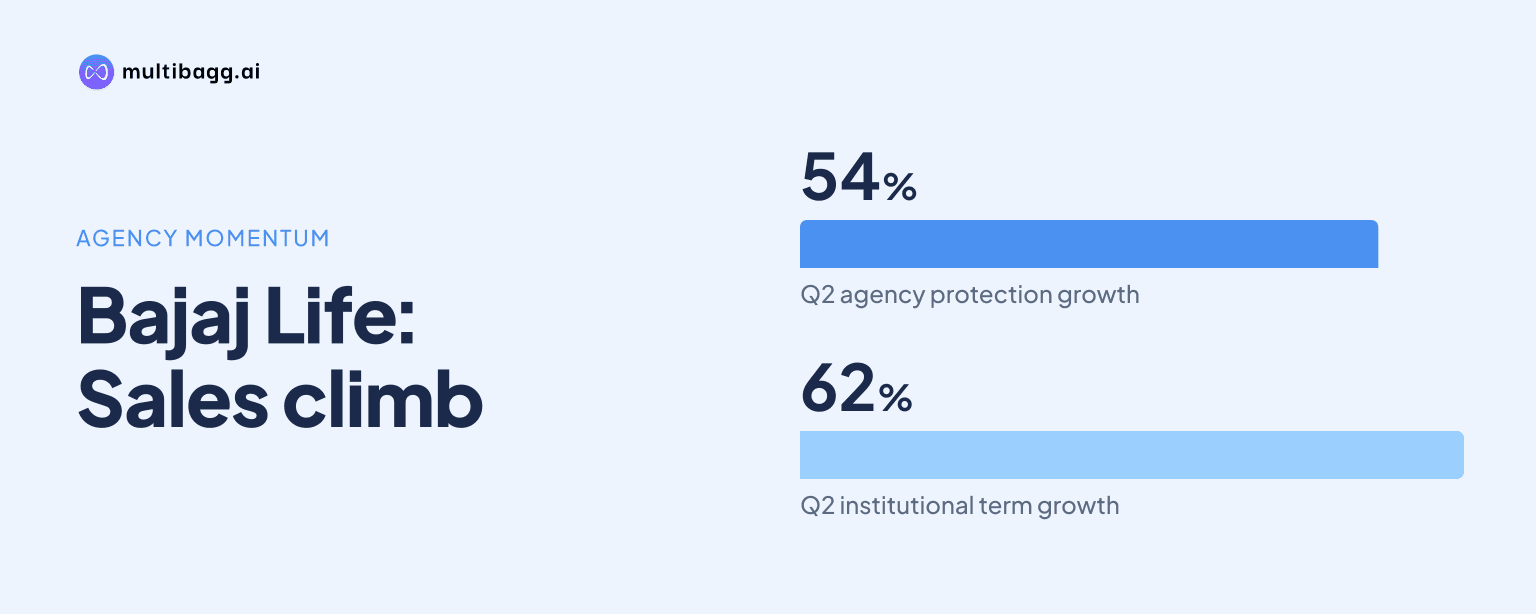
Bajaj Life deliberately moderated agency growth in Q2 to change its protection mix, and agency term business increased 54% from the same quarter last year. Management said it began the shift six months earlier after seeing regulatory emphasis on protection, while proprietary and face-to-face institutional term sales rose 49% and 62%, respectively.
Know Bajaj Finserv inside out
Results, valuation, peers and who's buying, in one view.
Why did Bajaj Life's agency growth slow?
Bajaj Life's agency growth slowed because management prioritised changing the channel's product mix rather than maximising near-term growth. Tarun Chugh said agency growth looked slow because Bajaj Life had focused largely on streamlining protection sales through the agency force. The resulting 54% year-on-year increase in protection sold by agency was management's evidence that the shift was taking hold.
The decision reflected management's reading that the regulator's focus was moving towards protection, rather than a disclosed reduction in agency capacity or reach. Chugh said Bajaj Life had made the move over the previous six months and intended to follow the same route for another quarter. Management expects that additional period to help establish a sustained product mix in agency distribution.
How much did Bajaj Life increase protection sales?
Bajaj Life increased term sales across face-to-face channels, not only through agency. Agency protection sales increased 54% from the same quarter last year, proprietary-sales term business rose 49%, and face-to-face institutional term business rose 62%. The three growth rates show that the protection initiative covered directly controlled and institutional customer-facing channels.
Management said the objective was to build a distribution culture focused on risk products. Chugh said Bajaj Life's face-to-face channels, including agency, had the highest percentage focus on risk products in the sector at the time of the call. He limited the comparison to face-to-face distribution and contrasted it with models that depend on aggregators and brokers.
Bajaj Life did not disclose term premium, policy count or the protection share of total new business in the discussion. The reported 54%, 49% and 62% rates therefore show the direction of product emphasis by channel, but not the absolute size of each channel. Management nevertheless said term growth had remained consistently high after the protection shift began six months earlier.
Has Bajaj Life moved from non-par to annuities?
Bajaj Life has not described its approach as a complete move away from non-par products because management said both non-par and annuity business grew. It said annuity growth picked up after Bajaj Life saw significant pricing pressure and intensity in non-par products from Q2 of the previous year. Management then introduced different annuity products and said the revised mix had held for almost a year.
Bajaj Life cited the following mix progression when explaining the shift in product opportunities:
The reported mix shows annuity rising from about 5% to about 10% over two quarters, while non-par declined from about 18% to about 13%. Management said that profile had broadly persisted for almost a year. It did not provide a current annuity-mix percentage during the discussion, so the transcript does not support a later calculation of the mix movement.
Management also distinguished the current non-par sales mix from the prior year's mix. It said non-par product mix was 19.7%, compared with 17.1% last year, and attributed the earlier mix largely to a short-pay product carrying a benefit. Management described the current mix as regular non-pay product mix, with benefits going directly to customers, and did not disclose a numerical margin comparison with annuities.
Got a follow-up? Ask IRIS
What does Bajaj Life expect from annuities and retail term?
Bajaj Life sees the annuity opportunity as sustainable while retaining flexibility to change its product mix if pricing changes. Management said it moved towards annuities after observing pricing intensity in non-par products and said the annuity products introduced from Q2 of the previous year had continued to hold up. Vipin Bansal said Bajaj Life would continue exercising flexibility rather than comparing margins product by product.
Bajaj Life's retail-term focus also forms part of its response to potential changes in credit-life distribution. Management said Bajaj Life is large in credit life but has diversified over the past couple of years across loan types and distribution relationships. It cited microfinance institutions, non-microfinance lenders and other distribution types while identifying opportunities in bulk covers and retail term life.
The regulatory issue remained unresolved at the time of the call because management said the proposed reforms were drafts subject to further iteration. Bajaj Life said there could be an effect on overall credit life, while lenders could still seek coverage against non-payment after a customer's death. Its stated response was to keep building retail life business, particularly retail term, rather than depend on a single credit-life route.
How does Bajaj Life's strategy combine protection and annuities?
Bajaj Life's strategy combines a protection-led redesign of agency with selective annuity expansion rather than concentrating on one product category. The 54% agency term increase and 62% face-to-face institutional term increase indicate a greater focus on risk protection. The shift from about 5% to about 10% annuity mix also shows Bajaj Life using annuities where management saw opportunity amid non-par pricing pressure.
The approach separates channel growth from product-mix growth. Agency growth was intentionally moderated during the six-month transition, while term sales in the three disclosed face-to-face channels increased between 49% and 62%. Management's account indicates that the near-term trade-off was intended to establish a sustained protection orientation, although it did not quantify the effect on total retail premium growth or profitability.
Conclusion
Bajaj Life used Q2 to prioritise protection penetration over faster agency expansion, producing 54% growth in agency term business and 49% and 62% increases in proprietary and face-to-face institutional term sales. At the same time, management retained non-par offerings and developed annuity business after pricing pressure changed the reported mix from about 18% non-par and 5% annuity to about 13% and 10%, respectively, over two quarters.
The next point to watch is whether Bajaj Life follows its stated plan to continue the agency-mix initiative for another quarter and then reaches a sustained product profile. Management also identified two unresolved variables: the final form of commission-related reforms affecting credit life, and whether annuity opportunities remain durable as Bajaj Life responds to non-par pricing conditions.