










Bajaj Markets income grew 37% as lending reached Rs 2,535 crore
Key highlights
- Bajaj Markets reported Q2 FY2027 total income of Rs 123 crore, up 37% from Rs 90 crore in Q2 FY2026.
- Bajaj Markets' Q2 FY2027 loss after tax narrowed to Rs 28 crore from Rs 45 crore a year earlier.
- Bajaj Markets mobilised Rs 2,535 crore of lending volume in Q2 FY2027, compared with Rs 2,269 crore in Q1 FY2027.
- Bajaj Markets listed 106 unique partners, 34 financial products and more than 140 offerings.
powered by IRIS
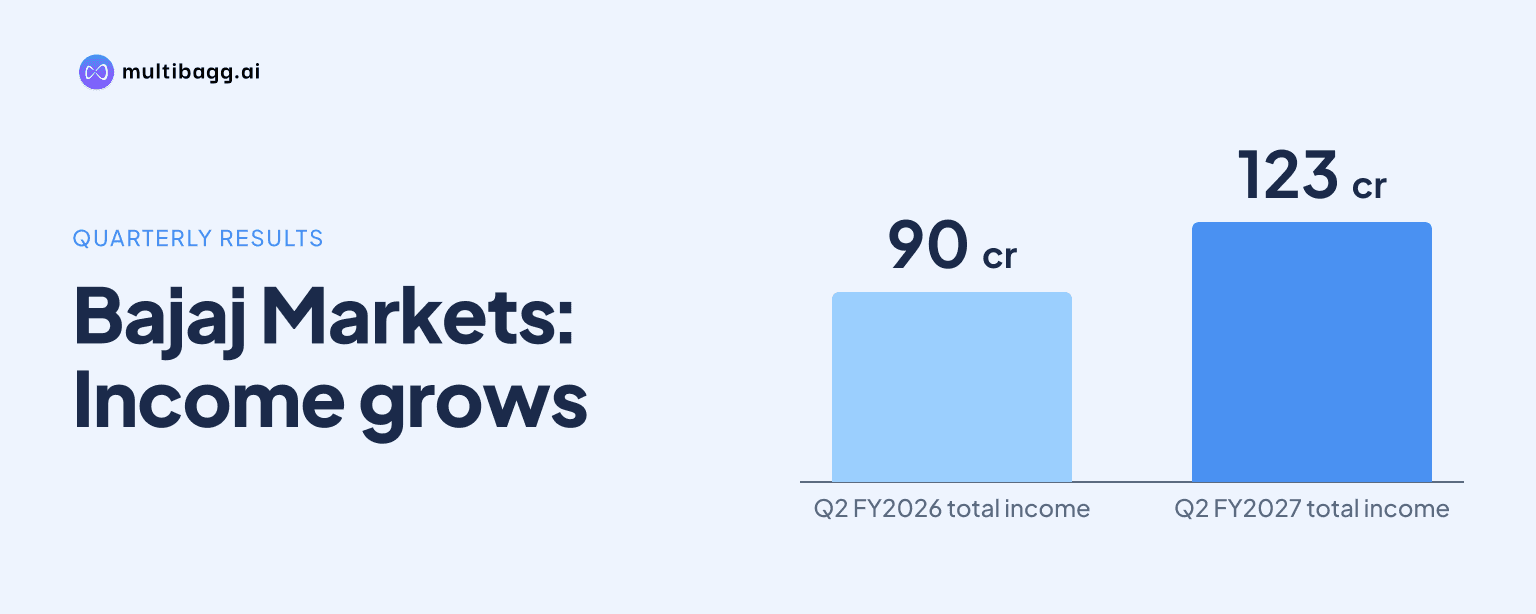
Bajaj Finserv Direct Ltd. (Bajaj Markets) reported total income of Rs 123 crore in Q2 FY2027, 37% higher than Rs 90 crore a year earlier, while lending volume reached Rs 2,535 crore and loss after tax narrowed to Rs 28 crore from Rs 45 crore. Organic traffic was unchanged sequentially at 47 lakh.
Know Bajaj Finserv inside out
Results, valuation, peers and who's buying, in one view.
How did Bajaj Markets' income and loss change in Q2 FY2027?
Bajaj Markets increased total income by Rs 33 crore in Q2 FY2027, from Rs 90 crore in Q2 FY2026 to Rs 123 crore. For H1 FY2027, total income was Rs 234 crore, compared with Rs 182 crore in H1 FY2026, a Rs 52 crore increase. Q2 FY2027 income was also about one-third of the Rs 375 crore reported for the full FY2026.
Bajaj Markets reduced its quarterly loss after tax by Rs 17 crore, to Rs 28 crore from Rs 45 crore a year earlier. Its H1 FY2027 loss was Rs 65 crore, lower by Rs 30 crore than the Rs 95 crore loss in H1 FY2026. The presentation does not provide a full-year FY2027 income, profit or breakeven forecast.
The improvement occurred in both periods reported for comparison. Income rose year on year in Q2 and H1 FY2027, while losses declined in each period. Bajaj Markets describes itself as an open-architecture marketplace for loans, cards, insurance, investments and payments, with products supplied through industry partners rather than a single-product model.
How much did Bajaj Markets' lending volume and traffic change?
Bajaj Markets mobilised lending volume of Rs 2,535 crore in Q2 FY2027, up Rs 986 crore from Rs 1,549 crore in Q2 FY2026. The quarterly sequence shown in the presentation rose from Rs 1,800 crore in Q3 FY2026 to Rs 2,046 crore in Q4 FY2026, then Rs 2,269 crore in Q1 FY2027 and Rs 2,535 crore in Q2 FY2027.
Bajaj Markets' lending volume rose Rs 266 crore quarter on quarter, even as organic traffic remained at 47 lakh in both Q1 FY2027 and Q2 FY2027. Compared with Q2 FY2026, organic traffic increased by 19 lakh from 28 lakh. The presentation reports the two measures but does not disclose loan approvals, average loan values, conversion rates or product-level lending volumes.
Bajaj Markets also reported more than 90,000 transacting customers in Q2, around 2.0 million monthly active users and more than 221 million traffic. Those measures place the Rs 2,535 crore lending volume within a broader consumer base, although the presentation does not state how much of the traffic is attributable to lending, cards, insurance, investments or payments.
Got a follow-up? Ask IRIS
How broad is Bajaj Markets' marketplace network?
Bajaj Markets reported 106 unique partners, 34 financial products and more than 140 offerings. Lending was the largest vertical by partner count, with 58 partners, followed by insurance with 19, securities with 11, cards with seven, value-added services with six, investments with four and the Open Network for Digital Commerce with one.
By partner category, Bajaj Markets listed 29 fintechs, 20 non-banking financial companies, 19 insurance companies, 11 brokers, 10 banks, 10 housing finance companies, six value-added-service providers and one Open Network for Digital Commerce partner. The presentation separately says the platform offers choice from more than 55 lenders, consistent with lending being its largest partner vertical.
Bajaj Markets describes the marketplace as using real-time offers, a dynamic rule engine and best-match logic. Its web and app journeys are described as AI-driven omnichannel experiences, while its data-science and machine-learning tools are intended to provide personalised recommendations and increase cross-selling. The source does not quantify the impact of those mechanisms on revenue, customer acquisition cost or loan conversion.
What is Bajaj Markets' stated strategy and what remains unquantified?
Bajaj Markets says it aims to become a profitable, artificial-intelligence-first platform connecting Indian consumers with a wide choice of banking, financial services and insurance products. The stated plan includes artificial-intelligence use cases across businesses and functions for revenue growth, operating-expense optimisation and productivity improvement, but management provides no savings target, rollout timetable or profitability milestone.
The platform's demand-side data include more than 48 million app installs, about 2.0 million monthly active users and 47 lakh organic traffic in Q2 FY2027. On the supply side, it has 106 partners across lending, cards, insurance, investments, securities and other offerings. The reported Q2 figures show higher income and lending volume, but the presentation does not split income by product line or partner category.
Management's market-opportunity material says the mix of digital and traditional lending is slated to be 50:50 by FY2030 and identifies a digital-lending opportunity exceeding Rs 11,310 crore by FY2030. These are market and strategic statements rather than Bajaj Markets forecasts. The disclosed operating baseline is Rs 123 crore of Q2 FY2027 income, Rs 2,535 crore of lending volume and a Rs 28 crore loss after tax.
Conclusion
Bajaj Markets' Q2 FY2027 data show higher reported income, a narrower loss and continued lending-volume growth. Total income rose from Rs 90 crore to Rs 123 crore year on year, loss after tax fell from Rs 45 crore to Rs 28 crore, and lending volume increased from Rs 1,549 crore to Rs 2,535 crore. Organic traffic, however, was flat at 47 lakh compared with Q1 FY2027.
The next results will show whether the Rs 266 crore quarter-on-quarter lending-volume increase can continue while income rises beyond Rs 123 crore and the H1 FY2027 loss of Rs 65 crore declines further. Management's disclosed plan centres on artificial-intelligence use cases, real-time matching and cross-selling across 106 partners, while its FY2030 material points to a 50:50 mix of digital and traditional lending without setting a dated earnings target.