










Bajaj Finserv Q2 PAT Rises 25% to ₹5,952 Crore
Key highlights
- Bajaj Finserv's Q2 FY27 consolidated PAT rose 25.4% to ₹5,952 crore.
- Consolidated total income increased 16.7% to ₹43,416 crore in Q2 FY27.
- Profit attributable to owners grew 22.9% to ₹2,758 crore from ₹2,244 crore a year earlier.
- Bajaj General's gross written premium grew 10% to about ₹7,556 crore, below industry growth of about 12%.
powered by IRIS
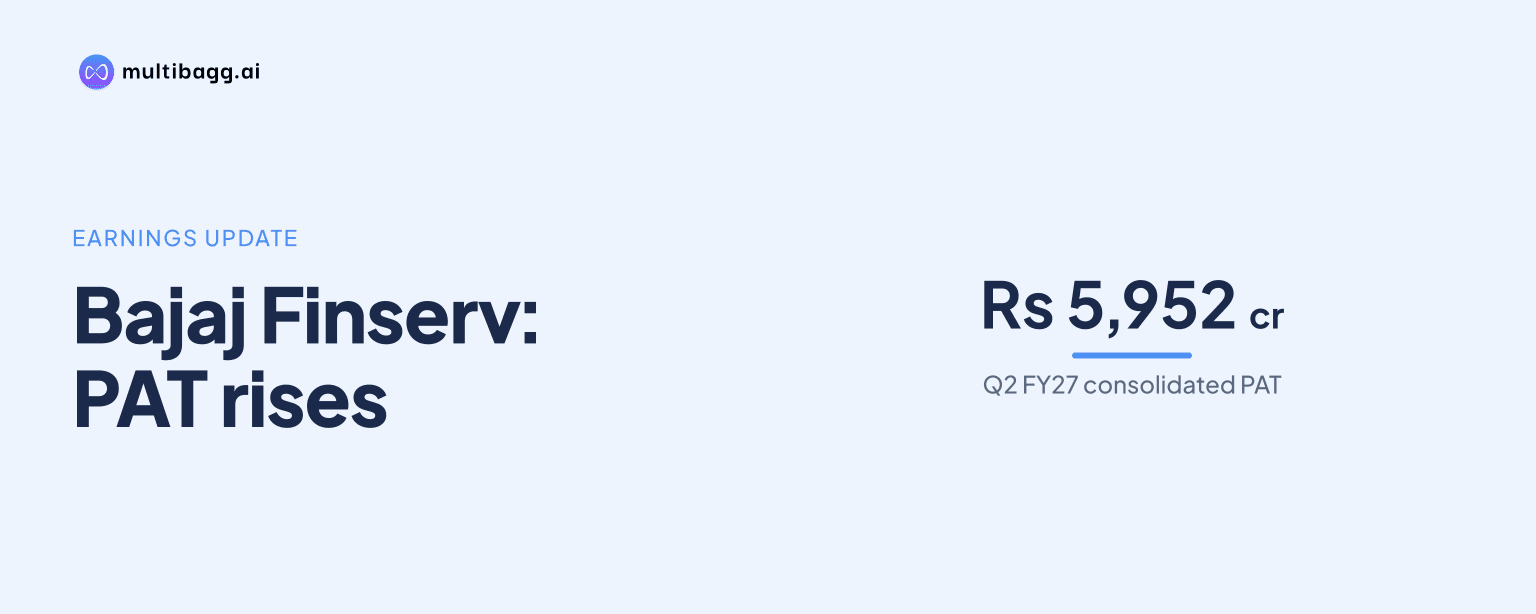
Bajaj Finserv Limited reported consolidated profit after tax of ₹5,952 crore for Q2 FY27, up 25.4% year on year, while consolidated total income increased 16.7% to ₹43,416 crore. The quarter reflected growth in lending and life insurance, although general insurance faced catastrophe claims, lower investment gains and elevated claims ratios.
Know Bajaj Finserv inside out
Results, valuation, peers and who's buying, in one view.
How did Bajaj Finserv perform in Q2 FY27?
Bajaj Finserv Limited recorded a 16.7% year-on-year increase in consolidated total income to ₹43,416 crore in the September 2026 quarter. Consolidated profit after tax rose 25.4% to ₹5,952 crore, while profit attributable to owners increased 22.9% to ₹2,758 crore from ₹2,244 crore in the corresponding quarter a year earlier.
Profit before exceptional items and tax was ₹8,604 crore. This included a ₹379 crore charge related to the New Labour Codes. Basic earnings per share stood at ₹17.22 and diluted earnings per share at ₹17.12 for the quarter.
For the first half of FY27, consolidated total income grew 17.8% to ₹85,453 crore. Consolidated profit after tax increased 21.6% to ₹12,249 crore, and profit attributable to owners rose 17.0% to ₹5,890 crore.
Which businesses drove Bajaj Finserv's quarterly growth?
Lending and life insurance were the principal contributors to Bajaj Finserv's reported quarterly growth. The company said lending growth and improved life insurance value of new business supported the consolidated outcome.
Bajaj Finance, a key lending business within the group, reported net total income growth of 23% to ₹15,974 crore and profit after tax growth of 29% to about ₹6,267 crore. It booked 1.34 crore new loans during the quarter, an 11% increase year on year.
Bajaj Finance's assets under management grew 26.5% to ₹5,84,624 crore, with net AUM addition of close to ₹38,000 crore during the quarter. It added 45 lakh new customers, taking its customer franchise to just under 12.9 crore customers.
The lender reported a quarterly return on assets of 4.6% and return on equity of 20.6%. Its loan loss to average assets under finance improved to 1.56% from 1.88% a year earlier, while gross and net non-performing assets stood at 1.06% and 0.42%, respectively.
What held back the general insurance business?
Bajaj General's gross written premium grew 10% year on year to about ₹7,556 crore, below the industry growth of about 12% cited by management. The general insurance business was affected by catastrophe claims, lower investment gains and higher claims ratios during the quarter.
These factors matter because general insurers earn from underwriting premiums as well as income on invested funds. A higher claims ratio can reduce underwriting profitability, while lower investment gains can limit the contribution from the investment portfolio.
Management also identified regulatory proposals as an uncertainty. The company said its insurance businesses had provided feedback to the Insurance Regulatory and Development Authority of India as part of the regulator's outreach on its paper. The transcript did not provide a financial estimate of the potential effect of these proposals.
The company also referred to changes in its health partnership arrangements as an area of uncertainty. Bajaj Finserv's emerging businesses include Bajaj Finserv Health, Bajaj Finserv Direct and Bajaj Finserv Asset Management Company, whose performance was described as mixed in the earnings summary.
Got a follow-up? Ask IRIS
What does the quarter mean for Bajaj Finserv investors?
The quarter shows that Bajaj Finserv's consolidated earnings continued to benefit from the scale and growth of its lending operations, alongside an improvement in life insurance value of new business. The 25.4% increase in consolidated profit after tax exceeded the 16.7% increase in total income, indicating stronger profit growth than income growth in the reported period.
For investors, the lending business remains relevant because Bajaj Finance's AUM, customer additions and loan bookings all expanded in the quarter. The lender's management raised its FY27 AUM growth guidance to 26%-27%, from its earlier 23%-25% range, citing first-half performance and early festival-season momentum.
However, the insurance businesses require separate attention. Bajaj General's premium growth trailed the industry pace cited by management, and catastrophe claims and claims-ratio pressure affected its operating environment. Regulatory consultation and health partnership changes are additional disclosed variables, with no quantified impact provided in the call.
Bajaj Finance also recognised a ₹337 crore macroeconomic overlay as a prudential measure. Its cost of funds declined sequentially by 9 basis points to 7.87%, while its liquidity buffer remained just under ₹20,000 crore, according to its separate Q2 FY27 earnings call.
How are market conditions shaping the group's businesses?
Bajaj Finserv operates across lending, general insurance, life insurance and newer financial-services platforms, so its quarterly outcome reflects conditions in more than one market. Loan demand, credit costs, insurance claims, investment income and regulatory policy can each affect the group differently.
In the lending business, the reported AUM expansion and rise in customer additions came alongside improving loan-loss metrics. But Bajaj Finance also noted competitive intensity in segments including gold loans and said it had made provision for potential macroeconomic stress.
In general insurance, catastrophe claims can affect profitability even when premium collections continue to grow. The disclosed 10% premium growth at Bajaj General was lower than the roughly 12% industry growth cited by management, highlighting the need to assess both premium expansion and claims experience.
For the parent company, the result combines these distinct operating trends. Strong lending and life insurance growth supported the quarter, while the general insurance and regulatory factors remain relevant to how investors assess future operating performance.
Conclusion
Bajaj Finserv delivered higher consolidated income and profit in Q2 FY27, with total income reaching ₹43,416 crore and profit after tax rising to ₹5,952 crore. Lending growth and improved life insurance value of new business were the stated supports, while general insurance faced catastrophe claims, lower investment gains and elevated claims ratios.
Investors will watch Bajaj Finance's ability to deliver its revised FY27 AUM growth guidance of 26%-27%, as well as developments in insurance claims, regulatory proposals and health partnership changes. Bajaj Finserv has not quantified the financial effect of these disclosed uncertainties.