










Bajaj Finserv Ltd. Q2 profit rose 23% as finance led gains
Key highlights
- Bajaj Finserv’s Q2 FY2027 consolidated profit rose 23% to Rs 2,758 crore.
- Bajaj Finance’s Q2 FY2027 profit component rose 29% to Rs 3,218 crore.
- General Insurance’s Q2 FY2027 profit component fell 37% to Rs 170 crore despite 8% revenue growth.
- Bajaj Finserv’s H1 FY2027 consolidated revenue increased 18% to Rs 85,453 crore.
powered by IRIS
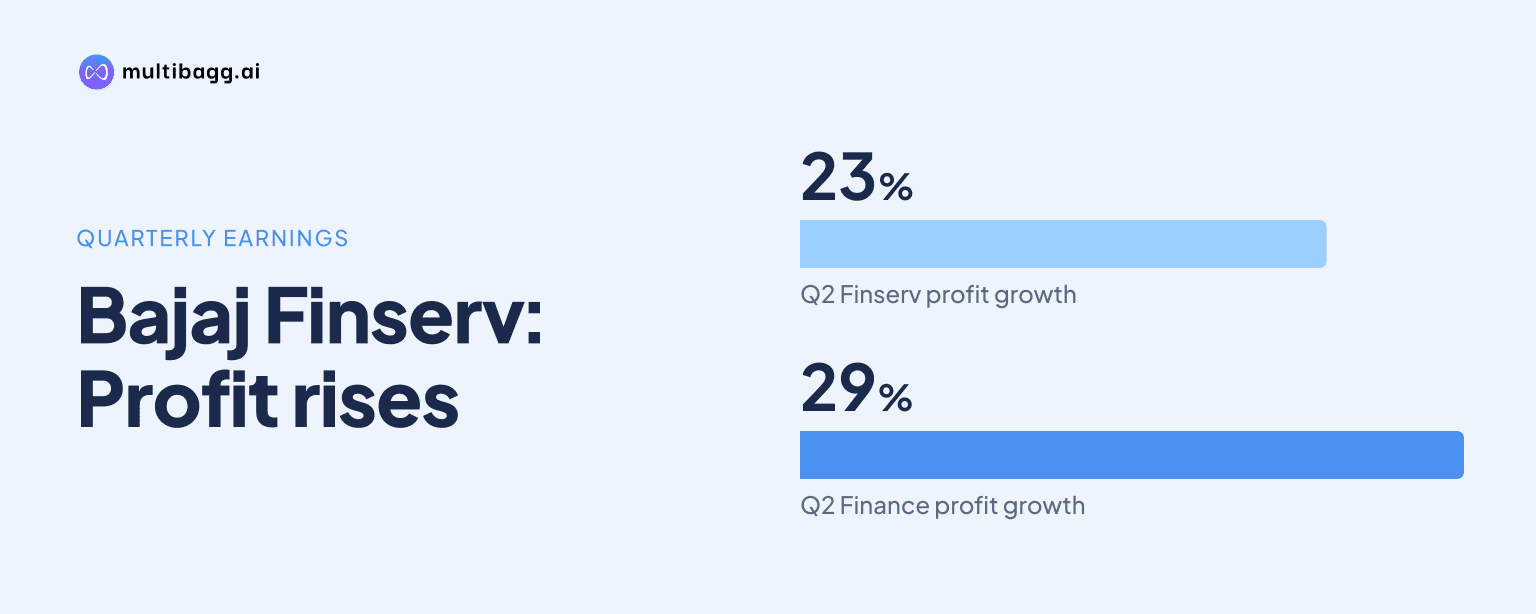
Bajaj Finserv reported Q2 FY2027 consolidated profit of Rs 2,758 crore, up 23% year on year, led by Bajaj Finance’s Rs 714 crore rise in its profit component to Rs 3,218 crore, while the General Insurance component fell by Rs 100 crore to Rs 170 crore.
Know Bajaj Finserv inside out
Results, valuation, peers and who's buying, in one view.
What drove Bajaj Finserv's Q2 FY2027 profit growth?
Bajaj Finserv’s Q2 FY2027 profit growth was principally driven by Bajaj Finance, whose profit component increased 29% to Rs 3,218 crore from Rs 2,504 crore a year earlier. Its Rs 714 crore increase exceeded the group’s Rs 514 crore increase in consolidated profit, from Rs 2,244 crore in Q2 FY2026 to Rs 2,758 crore. The presentation states that these components are measured after Bajaj Finserv’s stake in the respective companies.
Bajaj Finserv standalone also added to the increase, with its profit component rising 34% to Rs 1,458 crore from Rs 1,085 crore. Life Insurance narrowed its loss to Rs 17 crore from Rs 88 crore, an improvement of Rs 71 crore. These movements were partly offset as negative intercompany adjustments widened by Rs 538 crore to Rs 1,929 crore.
The wider eliminations matter because the consolidated result is not a simple addition of the operating components. Bajaj Finserv reported 23% consolidated profit growth, while growth excluding insurance companies’ mark-to-market, or MTM, gains and losses was 22%. In Q2 FY2026, the corresponding reported and MTM-excluded growth rates were 8% and 12%, respectively.
Why did General Insurance contribute less to Bajaj Finserv profit?
General Insurance contributed less because its Q2 FY2027 profit component fell 37% to Rs 170 crore from Rs 270 crore, even as its revenue increased 8% to Rs 9,991 crore from Rs 9,248 crore. The component therefore moved in the opposite direction to the segment’s revenue during the quarter. Bajaj Finserv’s consolidated-component disclosure does not specify the reasons for that profit decline.
The separately reported Bajaj General financial highlights also show lower earnings and higher underwriting losses. Bajaj General’s Q2 FY2027 profit after tax was Rs 420 crore, down 18.8% from Rs 517 crore, while its underwriting loss increased to Rs 115 crore from Rs 92 crore. Its combined ratio, a measure incorporating claims and expenses relative to premium, was 104.5%, compared with 102.3% in Q2 FY2026.
The first-half figures show the same earnings direction. General Insurance’s H1 FY2027 profit component declined 20% to Rs 575 crore from Rs 715 crore, although revenue rose 7% to Rs 18,983 crore from Rs 17,810 crore. In contrast, Bajaj Finance’s H1 profit component rose 28% to Rs 6,289 crore, making it materially larger than the insurance contribution.
Got a follow-up? Ask IRIS
How did Bajaj Finserv's Q2 revenue composition change?
Bajaj Finserv’s Q2 FY2027 consolidated revenue rose 17% to Rs 43,416 crore from Rs 37,215 crore, with Bajaj Finance providing the largest reported component at Rs 24,576 crore. Bajaj Finance revenue increased 23%, or Rs 4,584 crore, from Rs 19,992 crore. The presentation assigns Bajaj Finance 57% of the Q2 revenue mix, ahead of General Insurance at 23% and Life Insurance at 21%.
Life Insurance recorded faster revenue growth than General Insurance during the quarter. Its revenue increased 16% to Rs 9,302 crore from Rs 8,047 crore, whereas General Insurance grew 8% to Rs 9,991 crore. Bajaj Finserv standalone revenue rose 38% to Rs 2,047 crore, while the Others category declined to Rs 356 crore from Rs 389 crore.
Intercompany adjustments in revenue became more negative, moving to Rs 2,856 crore from Rs 1,943 crore. This means the Rs 43,416 crore consolidated total includes the removal of intragroup revenue alongside the stated business components. In H1 FY2027, consolidated revenue increased 18% to Rs 85,453 crore, compared with 12% growth to Rs 72,515 crore in H1 FY2026.
What does the H1 FY2027 profit comparison show?
Bajaj Finserv’s H1 FY2027 consolidated profit increased 17% to Rs 5,890 crore from Rs 5,033 crore, with Bajaj Finance supplying the largest component at Rs 6,289 crore. That was an increase of Rs 1,369 crore from Rs 4,920 crore in H1 FY2026. The group’s reported H1 profit growth of 17% was below the 19% growth reported for H1 FY2026.
Other positive movements included Bajaj Finserv standalone, where the H1 profit component rose 82% to Rs 2,576 crore from Rs 1,415 crore. Life Insurance profit increased to Rs 116 crore from Rs 21 crore, a 452% increase from the lower prior-year base. These gains occurred alongside a Rs 1,633 crore widening in negative intercompany adjustments, to Rs 3,393 crore.
Other businesses remained loss-making in aggregate, though their H1 loss narrowed to Rs 273 crore from Rs 278 crore. The H1 FY2027 figure included losses of Rs 102 crore at Bajaj Finserv Health, Rs 86 crore at BFS AMC, Rs 59 crore at Bajaj Finserv Direct, Rs 19 crore at Bajaj Finserv ALTs and Rs 5 crore at BFS Ventures. In Q2, the same aggregate category recorded a Rs 142 crore loss, against Rs 136 crore a year earlier.
Conclusion
Bajaj Finserv’s Q2 and H1 results show that Bajaj Finance was the principal source of profit growth, with its Q2 profit component up Rs 714 crore and its H1 component up Rs 1,369 crore. General Insurance recorded revenue growth in both periods but lower profit components, while losses in other businesses and larger negative intercompany adjustments reduced the impact of gains in lending, Life Insurance and the standalone business.
The next benchmark is management’s long-range strategy, presented in December 2025, which sets a 2030 consolidated profit-after-tax aspiration of Rs 21,000 crore to Rs 24,000 crore, compared with Rs 9,000 crore for 2025. Management states that these 2025-30 estimates are not an assurance or indication of future performance; subsequent results can show whether Bajaj Finance growth, insurance profitability and other-business losses develop in line with that aspiration.