










Bajaj Life lifts Q2 margin to 21.6% despite retail lag
Key highlights
- Bajaj Life's Q2 FY2027 VNB rose 39.6% year on year to Rs 512 crore.
- Bajaj Life's Q2 FY2027 NBM increased to 21.6% from 17.1%.
- Bajaj Life's Q2 FY2027 RWRP grew 5%, versus 10% for private life insurers.
- Bajaj Life's H1 FY2027 group protection new business rose 87.8% to Rs 2,723 crore.
powered by IRIS
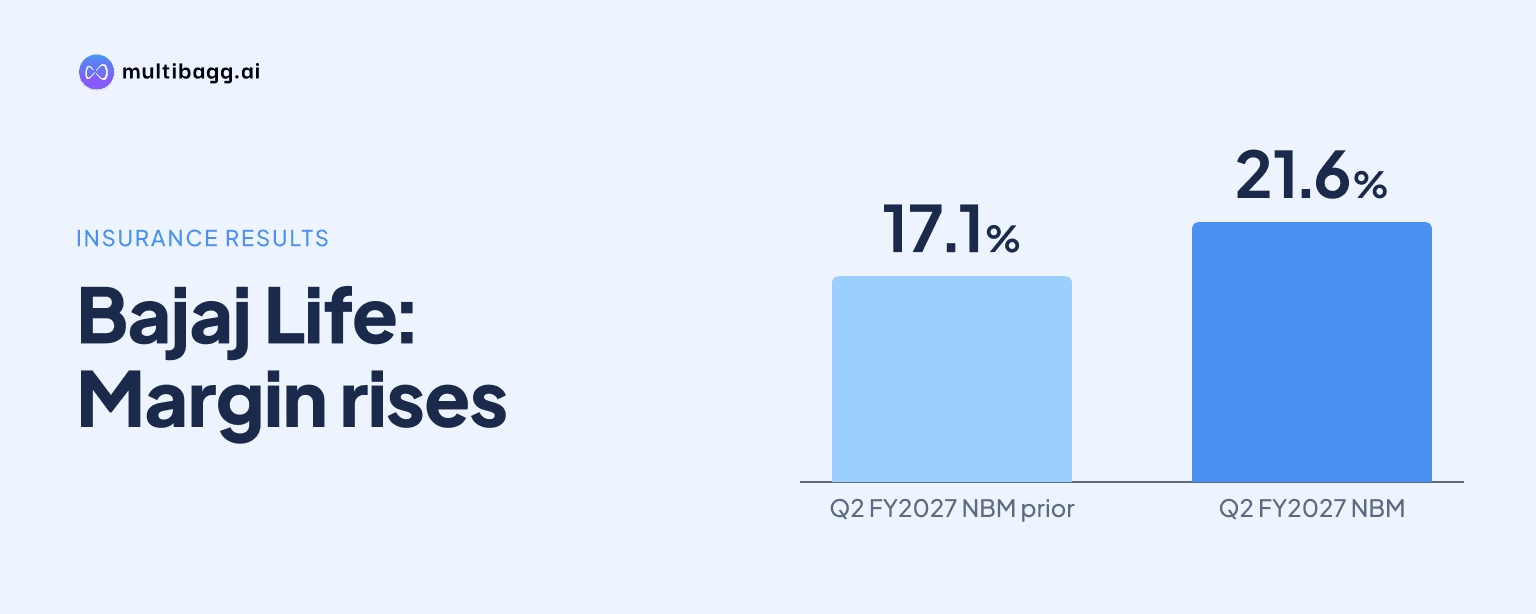
Bajaj Life Insurance Ltd. lifted its new-business margin to 21.6% in Q2 FY2027 from 17.1% a year earlier, with value of new business rising 39.6% to Rs 512 crore even as retail weighted received premium grew 5%, versus 10% for private life insurers.
Know Bajaj Finserv inside out
Results, valuation, peers and who's buying, in one view.
How did Bajaj Life lift its Q2 new-business margin?
Bajaj Life lifted its Q2 FY2027 new-business margin, or NBM, by 4.5 percentage points to 21.6% as annualized premium, or ANP, rose 10.0% to Rs 2,364 crore and value of new business, or VNB, increased 39.6% to Rs 512 crore. VNB was Rs 367 crore in Q2 FY2026, while ANP was Rs 2,149 crore.
Management attributed the VNB increase to high retail and group growth, product restructuring, a higher term-product mix, yield-curve benefit and expense savings. It said GST on retail business partly offset these factors. The presentation defines VNB as the discounted present value of expected net cash flows from new business written and ANP as regular premium at 100% plus single premium at 10%.
The H1 FY2027 NBM was 19.2%, up 4.4 percentage points from 14.8% in H1 FY2026, while VNB rose 52.9% to Rs 783 crore. Bajaj Life's H1 VNB walk shows Rs 878 crore before a Rs 95 crore GST impact, which reduced reported VNB to Rs 783 crore; the before-GST NBM was shown as 21.6%.
Why did Bajaj Life's retail premium growth trail private insurers?
Bajaj Life's retail weighted received premium, or RWRP, grew 5% year on year to Rs 1,942 crore in Q2 FY2027, below 10% growth for private life insurers and 11% for the overall industry. Its RWRP market share, measured against the whole industry, declined to 5.6% from 5.9% in Q2 FY2026.
The relative gap continued in H1 FY2027. Bajaj Life's RWRP rose 10% to Rs 3,416 crore, compared with 12% growth for private life insurers to Rs 43,058 crore and 13% growth for the industry to Rs 60,856 crore. Bajaj Life's H1 market share moved to 5.6% from 5.8% a year earlier.
RWRP comprises 100% of first-year premium and 10% of single premium, excluding group products. That measure differs from gross written premium, which increased 22.8% to Rs 10,277 crore in Q2 FY2027, while renewal premium rose 17.3% to Rs 5,106 crore. The difference is relevant because Bajaj Life reported faster group-protection growth than retail RWRP growth.
Got a follow-up? Ask IRIS
Which business-mix changes supported Bajaj Life's VNB growth?
Bajaj Life increased the protection and annuity portions of retail RWRP in H1 FY2027 while reducing non-participating savings. Individual non-participating protection rose to 12% from 8% in H1 FY2026, and individual annuity rose to 11% from 7%; non-participating savings fell to 13% from 19%.
Q2 FY2027 showed a similar mix shift. Protection accounted for 11% of RWRP against 8% in Q2 FY2026, and annuity accounted for 12% against 9%, while non-participating savings declined to 14% from 20%. Unit-linked business fell to 41% from 43%, while participating business was unchanged at 21%.
Retail protection new business rose 50.7% to Rs 217 crore in Q2 FY2027 and 54.7% to Rs 393 crore in H1 FY2027. Group protection new business grew more quickly, rising 80.9% to Rs 1,357 crore in the quarter and 87.8% to Rs 2,723 crore in the half year. Management cited higher term mix among the drivers of Q2 VNB growth.
What changed in Bajaj Life's channels, capital and embedded value?
Bajaj Life's institutional business was the fastest-growing disclosed channel in H1 FY2027, with RWRP up 13% to Rs 1,796 crore from Rs 1,596 crore. Agency RWRP rose 10% to Rs 1,211 crore, while Bajaj Life Direct grew 2% to Rs 409 crore. In Q2 FY2027, institutional business grew 9%, agency grew 1% and Bajaj Life Direct declined 1%.
Assets under management, or AUM, reached Rs 146,322 crore at 30 September 2026, up 10.8% from Rs 132,060 crore a year earlier. Non-unit-linked AUM increased to Rs 90,325 crore from Rs 80,347 crore, while unit-linked AUM rose to Rs 55,997 crore from Rs 51,713 crore. Bajaj Life said 96.4% of its debt portfolio was in AAA-rated or sovereign securities.
Net worth was Rs 9,774 crore at H1 FY2027, compared with Rs 10,928 crore a year earlier, after a Rs 1,200 crore equity-share buyback in Q4 FY2026 that affected net worth and AUM. The solvency ratio was 255%, above the 150% regulatory requirement but below 346% a year earlier. MCEV rose to Rs 26,774 crore at 30 September 2026 from Rs 25,300 crore at 31 March 2026, supported by Rs 783 crore of VNB.
Conclusion
Bajaj Life's Q2 FY2027 figures show that margin expansion and retail-market growth diverged: NBM rose 4.5 percentage points to 21.6% and VNB increased Rs 145 crore, while RWRP market share declined 0.3 percentage points to 5.6%. The disclosed shift toward protection and annuities, together with group-protection growth of 80.9%, coincided with higher VNB.
The next disclosed operational milestones are DIGI 2.0, planned for go-live by November 2026, and onboarding of 100% of products and riders to the core-system transformation platform by December 2026. Investors can also watch whether Bajaj Life's RWRP growth closes the gap with the 10% Q2 growth reported by private life insurers and whether the reported H1 NBM of 19.2% changes after the Rs 95 crore GST effect.