










Bajaj Finserv says Rs 4,700 crore can fund expansion over 18 months
Key highlights
- Bajaj Finserv expects less than Rs 2,000 crore of investments over the next 18 months.
- Bajaj Finserv reported about Rs 4,700 crore of surplus capital.
- The ALTs business may require about Rs 1,100 crore of sponsor capital in another year.
- The asset management company requires another Rs 300 crore and may break even in FY2029.
powered by IRIS
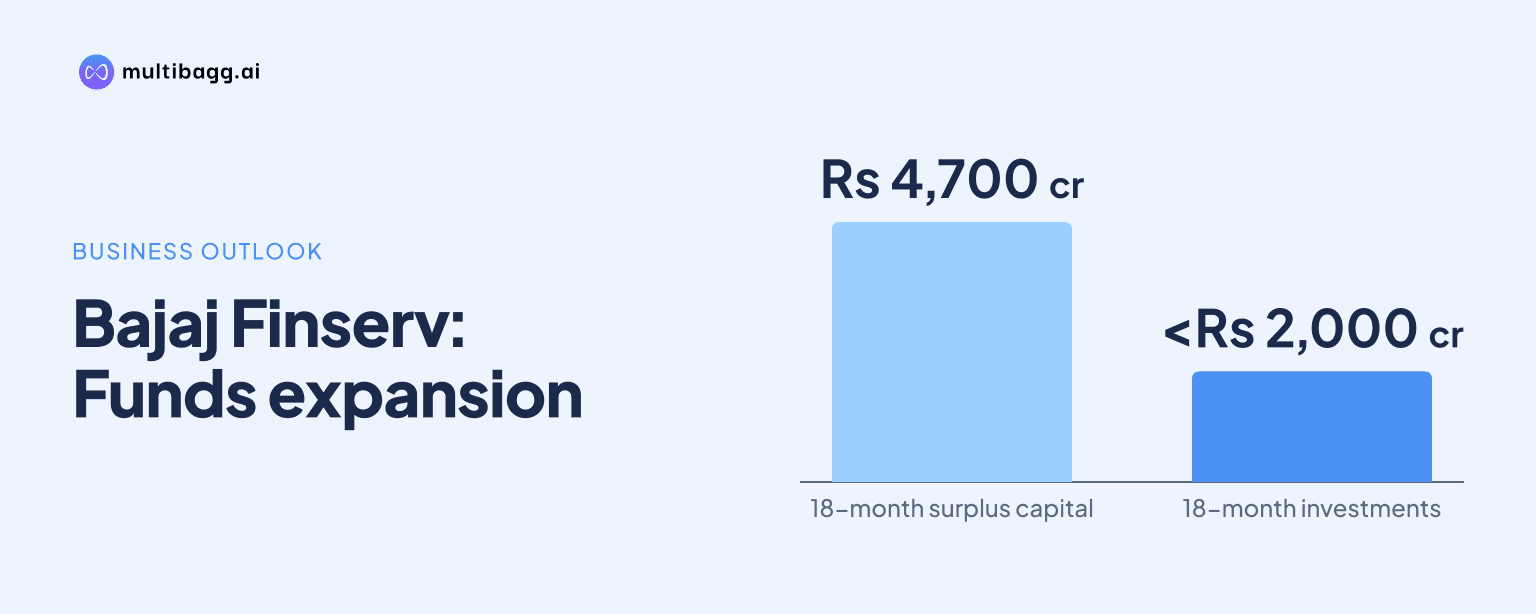
Bajaj Finserv said its Rs 4,700 crore capital surplus, together with dividends from material subsidiaries, should fund less than Rs 2,000 crore of investments over the next 18 months, including about Rs 1,100 crore of sponsor capital for the alternatives, or ALTs, business.
Know Bajaj Finserv inside out
Results, valuation, peers and who's buying, in one view.
How much capital does Bajaj Finserv expect to require?
Bajaj Finserv expects to require less than Rs 2,000 crore for the businesses it identified over the next 18 months. Ramandeep Singh Sahni said the estimate includes about Rs 800 crore to Rs 900 crore for emerging businesses and about Rs 1,100 crore of ALTs sponsor capital expected in another year.
The ALTs allocation is the largest single identified requirement at about Rs 1,100 crore. Management described it as sponsor capital rather than capital to be consumed as the business grows, distinguishing it from the funding needs of businesses that remain on a path to break-even.
Management also said that 25% of other investments it had previously called out must happen now, with the balance occurring over 18 months. It did not provide a separate rupee amount for those other investments or explain how they were split among individual businesses.
Which Bajaj Finserv businesses need funding?
Bajaj Finserv said Bajaj Health will consume less than Rs 200 crore this year, with a substantially lower requirement next year. Management hopes Bajaj Health will break even on a quarterly basis in the last quarter of next year and on a full-year basis in the year after that.
The asset management company requires another Rs 300 crore until break-even, which management said would probably occur in FY2029. Its break-even timing depends on market conditions because management expects to reach that point at assets under management, or AUM, of Rs 90,000 crore to Rs 1 lakh crore.
Bajaj Finserv's reinsurance venture may need about Rs 500 crore over the next two to three years. Management included health, asset management and reinsurance in its aggregate estimate of Rs 800 crore to Rs 900 crore for emerging businesses, meaning the disclosed total spans different business timetables.
Bajaj Finserv Direct has not been taking capital and is not expected to need material capital going forward, according to management. It hopes to break even on a quarterly basis in this year's last quarter and on a full-year basis next year while expanding from a lending marketplace into insurance and later investment marketplaces.
How will Bajaj Finserv fund the expansion plan?
Bajaj Finserv said its Rs 4,700 crore surplus capital and dividends from material subsidiaries should be sufficient to fund the identified investments. Management specifically cited dividends from Bajaj Finance and the insurance companies when outlining the funding pool.
The disclosed Rs 4,700 crore surplus exceeds the less-than-Rs 2,000 crore investment estimate for the next 18 months, before any future subsidiary dividends. That comparison is limited to the stated 18-month plan because management did not quantify dividend receipts, future capital needs or investment spending after that period.
Management said it would welcome additional surplus and identified the insurance transition to Indian Accounting Standards, or Ind AS, as a possible buffer. Sahni said discounting and reserve adjustments at the one-time migration could provide a sizeable relief, but the amount, timing and ability to reinvest any surplus remain undecided.
Bajaj Finserv also said it had presented other funding options to its Board when it agreed to subscribe to warrants. Management did not disclose the alternatives, their potential value or whether they would be used, leaving the current plan based on existing surplus capital and subsidiary dividends.
Got a follow-up? Ask IRIS
When could Ind AS affect Bajaj Finserv's capital position?
Bajaj Finserv said its two insurance companies were working towards 1 April for Ind AS implementation. Sahni said there was no clarity on any possible delay, but that the Insurance Regulatory and Development Authority of India's engagement indicated that 1 April remained the implementation date being pursued.
Tarun Chugh said the regulator had maintained that position and had appointed a member actuary whose first task concerned Ind AS implementation. He added that management was confident that Ind AS and risk-based capital, or RBC, would both take effect on 1 April.
The timing matters because management sees potential capital relief from the change in discounting and reserves. However, Bajaj Finserv did not assign a rupee value to that possible relief and said it must wait for the regulator's decision on whether it can be ploughed back into the business.
The potential Ind AS outcome is therefore not part of the stated Rs 4,700 crore surplus currently available for investment. Management described it as an additional buffer while saying the surplus and dividends should already be adequate for the less-than-Rs 2,000 crore requirement over 18 months.
What does Bajaj Finserv's plan show about capital allocation?
Bajaj Finserv's plan directs the biggest identified amount, about Rs 1,100 crore, to ALTs sponsor capital, while emerging businesses together require Rs 800 crore to Rs 900 crore. The allocation combines a platform funding need in ALTs with support for operations that have separate expected break-even dates.
The break-even schedule differs across the portfolio. Bajaj Finserv Direct is targeted for full-year break-even next year, Bajaj Health for full-year break-even in the following year, and the asset management company probably in FY2029 at AUM of Rs 90,000 crore to Rs 1 lakh crore.
Reinsurance has the longest explicitly stated funding period after asset management, with about Rs 500 crore expected over two to three years. Management's less-than-Rs 2,000 crore total therefore brings together spending that may occur this year, in another year and over a longer two-to-three-year period.
Conclusion
Bajaj Finserv's disclosed funding plan rests on a Rs 4,700 crore surplus, expected subsidiary dividends and an investment requirement of less than Rs 2,000 crore over 18 months. The largest allocation is about Rs 1,100 crore for ALTs, while Bajaj Health, asset management and reinsurance account for the remaining Rs 800 crore to Rs 900 crore emerging-business estimate.
The next milestones are Bajaj Finserv Direct's quarterly break-even target in this year's last quarter, Bajaj Health's lower capital requirement next year, and the asset management company's FY2029 break-even objective. Investors will also watch the planned 1 April Ind AS and RBC implementation and the unresolved regulatory decision on whether any migration-related insurance surplus can be reinvested.