










Bajel Projects keeps customer arbitration balances unadjusted
Key highlights
- Bajel Projects disclosed arbitration proceedings with three customers for recovery of outstanding balances.
- Bajel Projects made no further standalone adjustment as of September 30, 2026 because the arbitration outcome could not presently be determined.
- Bajel Projects reported total trade receivables of Rs 1,241.6521 crore at September 30, 2026, versus Rs 1,849.0476 crore at March 31, 2026.
- Bajel Projects reported standalone profit after tax of Rs 5.7979 crore for the quarter ended September 30, 2026.
powered by IRIS
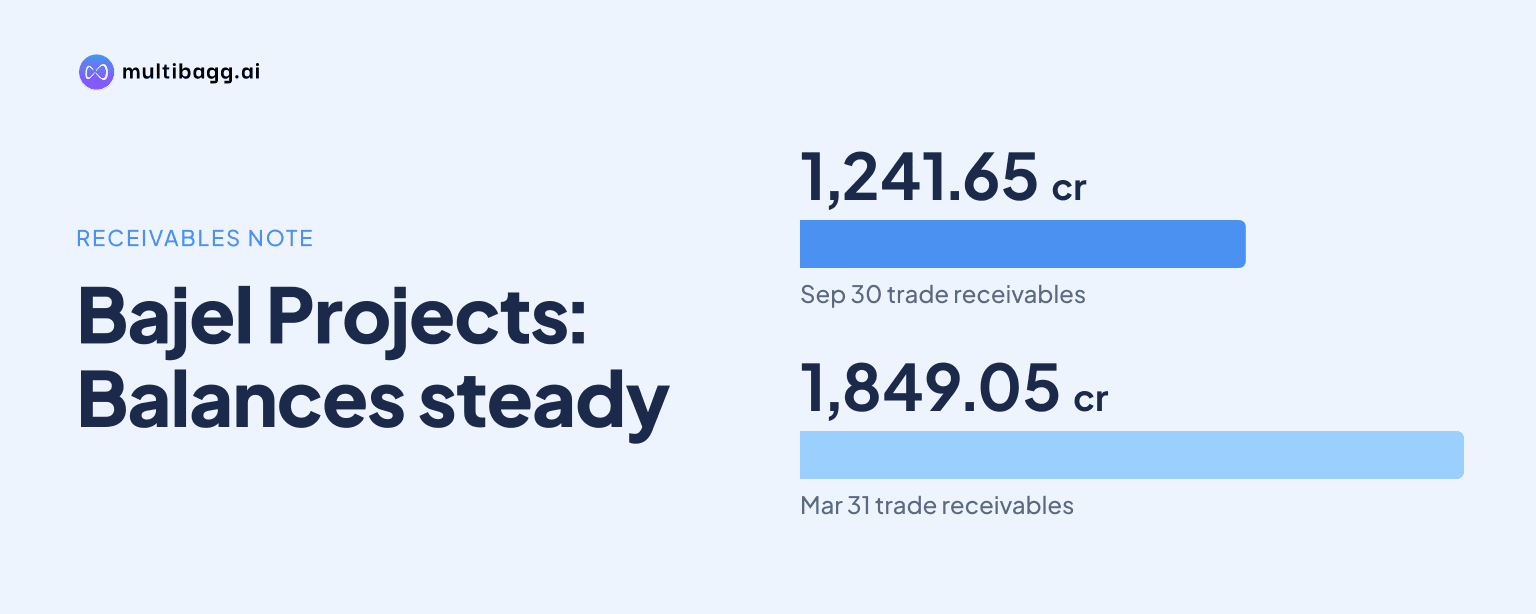
Bajel Projects Limited made no further adjustment to its standalone results for the six months ended September 30, 2026, because arbitration to recover balances from three customers had an outcome that could not presently be determined. Its reported total trade receivables at that date were Rs 1,241.6521 crore.
Know Bajel Projects inside out
Results, valuation, peers and who's buying, in one view.
What did Bajel Projects disclose about the customer arbitration?
Bajel Projects disclosed that it had invoked or was continuing arbitration proceedings with three customers for recovery of outstanding balances. The disclosure was made in the independent auditor's review report dated November 6, 2026, which covered Bajel Projects' unaudited standalone financial results for the quarter ended September 30, 2026 and the period from April 1, 2026 to September 30, 2026.
The auditor drew attention to note 2 of the standalone results and said management considered no further adjustment necessary because the arbitration outcome could not presently be determined. The supplied filing does not reproduce note 2, identify the three customers, state a claim amount or support a disputed-balance figure of Rs 85.9 crore.
Did Bajel Projects' auditor modify its conclusion over arbitration?
No, Bajel Projects' auditor did not modify its conclusion in relation to the arbitration matter. S R B C & CO LLP stated that its conclusion was not modified, while drawing attention to the recovery proceedings involving three customers in its November 6, 2026 review report.
S R B C & CO LLP performed its review under Standard on Review Engagements 2410, which it said provides moderate assurance and is substantially less extensive than an audit. For the quarter and six months ended September 30, 2026, the auditor said nothing had come to its attention to suggest that the standalone statement contained a material misstatement or omitted required disclosures.
How much did Bajel Projects report in trade receivables?
Bajel Projects reported total current and non-current trade receivables of Rs 1,241.6521 crore at September 30, 2026, compared with Rs 1,849.0476 crore at March 31, 2026. The balance therefore declined by Rs 607.3955 crore, but the filing does not identify the amount attributable to customers in arbitration.
Current trade receivables fell more sharply than non-current receivables between the two reporting dates. Current receivables were Rs 1,042.2459 crore at September 30, 2026 against Rs 1,633.7755 crore at March 31, 2026, while non-current receivables decreased to Rs 199.4062 crore from Rs 215.2721 crore.
Bajel Projects' cash-flow statement recorded a Rs 607.5858 crore decrease in current and non-current trade receivables during the six months ended September 30, 2026. This compared with a Rs 48.6969 crore decrease in the corresponding six months ended September 30, 2025, although the filing does not link either movement to collections, settlements or recoveries from the three arbitration customers.
Got a follow-up? Ask IRIS
What were Bajel Projects' September 2026 standalone results?
Bajel Projects reported standalone profit after tax of Rs 5.7979 crore for the quarter ended September 30, 2026, compared with Rs 5.9422 crore for the quarter ended September 30, 2025. Total income declined to Rs 520.7781 crore from Rs 620.8077 crore, while total expenses decreased to Rs 512.9738 crore from Rs 612.8311 crore.
For the six months ended September 30, 2026, Bajel Projects' standalone profit after tax rose to Rs 10.3457 crore from Rs 9.2573 crore a year earlier. Total income nevertheless declined to Rs 1,092.7324 crore from Rs 1,236.8195 crore, while finance costs fell to Rs 23.5995 crore from Rs 32.8897 crore.
Bajel Projects recorded total comprehensive income of Rs 19.6261 crore in the September 2026 quarter, compared with Rs 21.4171 crore in the prior-year quarter. The latest quarterly figure included other comprehensive income of Rs 13.8282 crore, whereas the filing does not connect that item to the arbitration proceedings or the outstanding balances under recovery.
How did Bajel Projects' operating cash flow and liquidity change?
Bajel Projects generated net cash inflow from operating activities of Rs 108.8376 crore in the six months ended September 30, 2026, against Rs 67.8910 crore in the six months ended September 30, 2025. The cash-flow statement included the Rs 607.5858 crore reduction in receivables, alongside a Rs 323.7336 crore decrease in trade payables, provisions and other liabilities.
Cash and cash equivalents were Rs 2.7315 crore at September 30, 2026, down from Rs 23.7211 crore at March 31, 2026. Bajel Projects reported Rs 119.4521 crore of net cash used in investing activities during the half year, including Rs 99.1310 crore for bank deposits not considered cash equivalents, and Rs 10.3752 crore of net financing cash outflow.
Conclusion
The filing identifies an unresolved recovery matter involving three customers and confirms that Bajel Projects made no further standalone financial-statement adjustment as of September 30, 2026. The auditor highlighted the uncertainty, but retained an unmodified review conclusion, while Bajel Projects reported a lower overall receivables balance and higher half-year profit after tax.
The next matter to watch is any disclosed development in the arbitration proceedings, including an outcome, settlement, recovery or accounting adjustment. Bajel Projects gave no timetable, claim amount or expected recovery in the November 6, 2026 filing, so subsequent results will be relevant for any change in trade receivables, provisions or cash-flow disclosures.