










Balaji Telefilms Limited targets more than 500 micro dramas
Key highlights
- Balaji plans more than 500 micro dramas in its FY27-FY31 content pipeline.
- Balaji's digital B2B order book exceeded Rs 350 crore at the November 16, 2026 earnings call.
- Q2 FY27 films revenue was Rs 106.3 crore and films PBT was Rs 41.24 crore.
- Balaji reported about Rs 200 crore of cash reserves and more than 11 million YouTube subscribers.
powered by IRIS
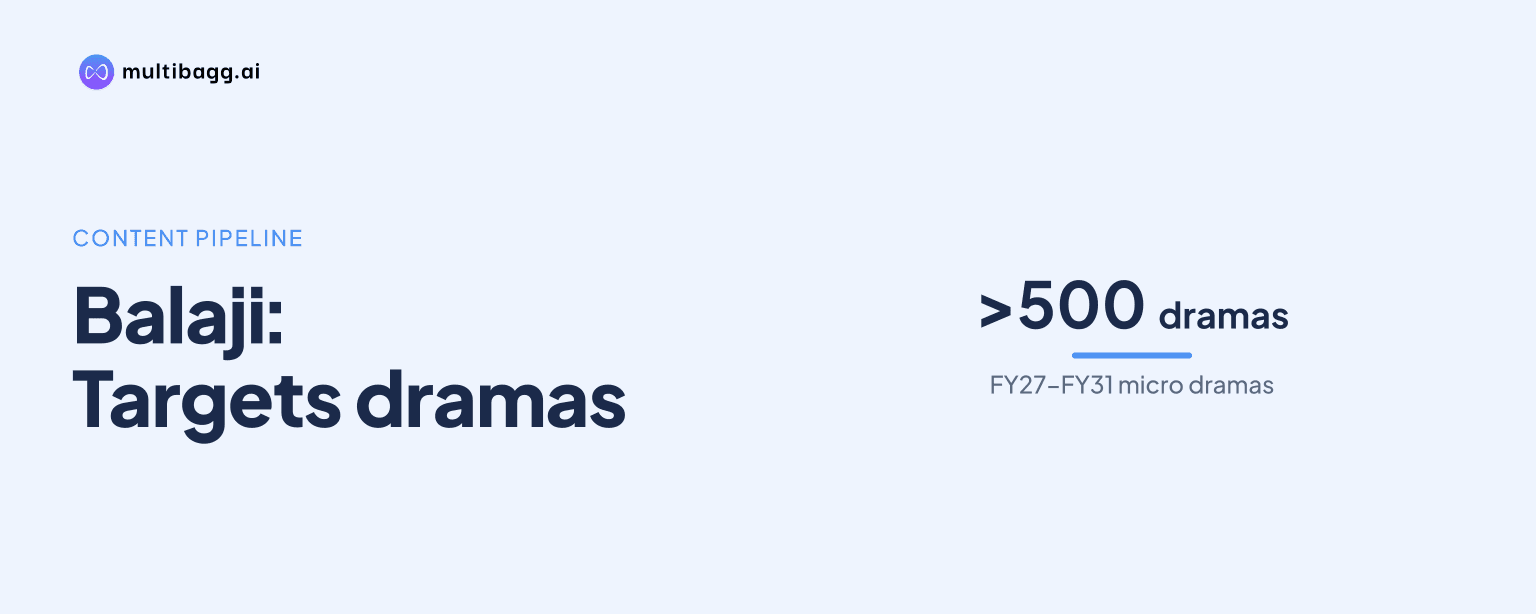
Balaji Telefilms Limited plans more than 500 micro dramas in its FY27-FY31 content pipeline, using Kutingg, Balaji Studio, owned intellectual property and an in-house artificial intelligence team. Management presented the target on November 16, 2026 as a production-line strategy, alongside a five-year slate of films, television, streaming and YouTube content.
Know Balaji Telefilms inside out
Results, valuation, peers and who's buying, in one view.
What is Balaji's micro-drama plan through FY31?
Balaji intends to develop more than 500 micro dramas from FY27 to FY31, within a five-year pipeline that also includes more than 30 films, more than 15 television shows, more than 25 over-the-top, or OTT, series and more than 10 YouTube shows. Management described the micro-drama programme as a production line rather than an experiment.
Management said the format depends on volume, speed, cost discipline and cliffhanger-led storytelling, capabilities it linked to Balaji's 30 years of serialised television production. It cited China, where a micro drama of 60 to 80 episodes can be shot in under two weeks, as an indication of the production model it seeks to apply to smartphone viewing.
India's micro-drama market was about USD300 million in 2025 and could reach USD4.5 billion by 2030, according to Lumikai figures cited by management. Management also said China’s market crossed CNY100 billion in 2025, with more than 800 million viewers, though these external market estimates do not constitute a forecast for Balaji's revenue.
How will Balaji make and distribute micro dramas?
Balaji plans to use three connected assets: Kutingg, Balaji Studio and its owned intellectual property, or IP. Kutingg is Balaji's platform for family-friendly vertical short-episode content, while Balaji Studio is intended to produce cost-optimised micro-drama assets for third-party platforms as well as Balaji's own services.
The company also expects to adapt its library, which includes around 53 films and more than 200 web series, into shorter vertical formats. Management said stories, characters and franchises can be recut or rewritten for micro dramas, allowing existing content assets to support the new format rather than requiring every title to originate from a new concept.
Balaji has set up an in-house artificial intelligence, or AI, team and said it will continue investing in it. Management said AI could complement creative work, improve production efficiency and assist content adaptation across multiple languages and formats, but it did not quantify AI spending or specify a production target enabled by the team.
How does the micro-drama strategy fit Balaji's wider content business?
Micro dramas form part of Balaji's “one studio for every screen” model, which management said combines films, television and digital content after merging its digital and Marinating Films businesses into Balaji. The stated structure uses one production engine, team, pipeline and cost base across cinema, television, streaming, YouTube and mobile viewing.
Commissioned digital work provides an existing platform route while Balaji develops its short-form business. Its digital business-to-business, or B2B, order book with leading platforms exceeded Rs 350 crore at the November 16, 2026 call. Management said its Netflix partnership had produced Lock Upp, while Kohinoor Season 1 and Pact of Silence were the next titles in the pipeline.
Balaji has also signed a YouTube partnership for five premium original shows and 200 episodes distributed globally, while retaining IP and creative control, according to management. The company reported more than 11 million YouTube subscribers after adding about 6.5 lakh in a few months, and said its combined YouTube and Meta subscriber base exceeded 21 million.
Got a follow-up? Ask IRIS
What financial capacity supports Balaji's content pipeline?
Balaji reported cash reserves of about Rs 200 crore and described its balance sheet as debt-free, providing funding flexibility for its content pipeline and ongoing productions. In H1 FY27, revenue from operations rose to Rs 421.4 crore from Rs 121.6 crore in H1 FY26, while profit before tax, or PBT, changed to Rs 72.9 crore from a loss of Rs 14.4 crore.
The improvement was led primarily by films, supported by the commission segment, according to management. In Q2 FY27, films generated Rs 106.3 crore of revenue and Rs 41.24 crore of PBT, compared with Rs 69.7 crore of revenue and Rs 7.03 crore of PBT for the commission business. Digital business-to-consumer, or B2C, operations recorded a loss while Balaji invested in digital initiatives.
Q2 FY27 consolidated revenue was Rs 181 crore, compared with Rs 48 crore in Q2 FY26, while profit after tax was Rs 32.5 crore against a loss of Rs 5 crore a year earlier. Management said Q2 profit after tax included a Rs 12.4 crore deferred-tax charge, which it described as non-cash.
What will show whether Balaji is executing the micro-drama plan?
Execution will be measured by whether Balaji converts its disclosed 500-plus micro-drama pipeline into content produced and monetised through Kutingg and third-party platforms. Management did not give a release timetable, production budget, revenue target or profitability target specifically for the micro-drama programme on the November 16 call.
Management instead pointed to its television production history, library and owned IP as the basis for scale. It also said commissioned projects have greater monetisation visibility because they are platform-backed, while investments in digital B2C are being scaled in a calibrated manner. The call did not disclose the allocation of planned micro dramas between Kutingg and external customers.
Capital discipline remains a stated consideration across the wider slate. For its previous six films, Balaji said presales of digital, satellite and music rights had recovered about 80% to 90% of production costs before release. It plans four to six films a year with average production costs of Rs 60 crore to Rs 75 crore and had four films under production, including Ragini 3 and Heer Ranjha.
Conclusion
Balaji's target of more than 500 micro dramas puts vertical mobile storytelling within an IP-led studio model spanning films, television, OTT, YouTube and its own Kutingg platform. Its FY27 financial performance improved sharply, with H1 revenue reaching Rs 421.4 crore and PBT reaching Rs 72.9 crore, while films supplied most Q2 segment profit.
The next developments to watch are execution in the second half of FY27, monetisation of the digital B2B order book exceeding Rs 350 crore, and evidence of micro-drama releases through Kutingg or outside platforms. Management has also identified delivery of its four films under production and continued calibrated digital B2C investment as near-term priorities.