










Balaji Telefilms expects about Rs 150 crore of OTT revenue in FY27
Key highlights
- Balaji expects about Rs 150 crore of its Rs 350 crore OTT order book to be recognised in FY27.
- Balaji reported Rs 69.7 crore of commission-business revenue and Rs 7.03 crore of PBT in Q2 FY27.
- Kohinoor is a Rs 100 crore show that management said would be close to two years in production by February.
- Balaji said its OTT order book could reach Rs 500 crore within six to eight months, referring to order-book value rather than revenue.
powered by IRIS
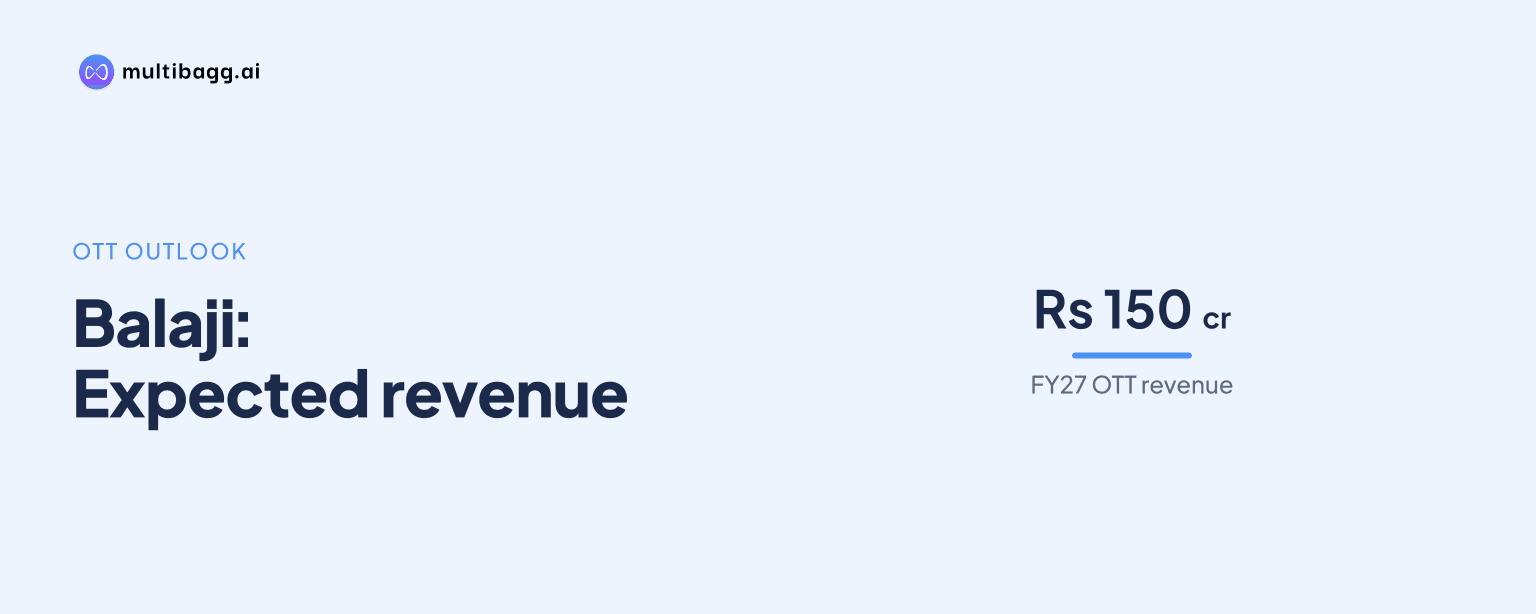
Balaji Telefilms expects about Rs 150 crore of its Rs 350 crore commissioned OTT order book to be recognised in FY27. Management described Rs 150 crore to Rs 175 crore as a conservative annual range, while delivery periods can range from four to five months of preparation for reality formats to nearly two years for a Rs 100 crore scripted show.
Know Balaji Telefilms inside out
Results, valuation, peers and who's buying, in one view.
How much of Balaji's OTT order book could be recognised in FY27?
Balaji expects about Rs 150 crore from its Rs 350 crore commissioned OTT order book to be recognised in FY27. Management said Rs 150 crore to Rs 175 crore was a conservative annual expectation for the OTT commission segment, with revenue recognised after completed shows are delivered to the platform.
The Rs 350 crore amount is an order book rather than revenue already recorded in the profit and loss account. Management separately said the television business could contribute Rs 125 crore to Rs 175 crore annually, while describing the commission business as around Rs 115 crore in the financial year with earnings before interest, tax, depreciation and amortisation, or EBITDA, of around Rs 18.5 crore.
Management did not provide projected profitability for the Rs 350 crore OTT order book. It said OTT-led platforms have a lower percentage yield than television shows because long-running television formats can benefit from marginal-cost economics after initial production costs are incurred.
Why will Balaji's OTT revenue arrive at different times?
Balaji's revenue-recognition timing depends on each show's format, scale and production requirements. Management said a captive or themed reality show may run for 45 to 50 days, but preparation typically takes four to five months before the programme can be produced and delivered.
Kohinoor illustrates the longer production cycle. Management said the Rs 100 crore show had been in the making for about 1.5 years and would be close to two years in production by February, with location use, studios, story complexity and project scale affecting delivery timing.
Lock Upp shows how platform demand can change that schedule. Management said it had initially expected one season, followed by a regional version if it worked, but Netflix proposed bringing forward the second season; Balaji therefore planned Lock Upp 2 for February, within six months of the first season.
The order book can be renewed alongside delivery. Management said Balaji had released Lock Upp and still retained an OTT order book of Rs 350 crore after adding three more shows, and it said the order book could reach Rs 500 crore in six to eight months, referring to contracted work rather than recognised revenue.
Got a follow-up? Ask IRIS
How does the OTT pipeline compare with Balaji's reported business?
Balaji's commission business reported Rs 69.7 crore of revenue and Rs 7.03 crore of profit before tax, or PBT, in Q2 FY27. The segment includes television and digital business-to-business, or B2B, work, so the Rs 350 crore OTT order book represents future activity within a segment that also has established television production.
Films generated more revenue and PBT than the commission business in Q2 FY27, while B2C recorded a loss during investment in digital-content initiatives. Consolidated revenue from operations increased to Rs 181 crore from Rs 48 crore in Q2 FY26, and PBT moved to Rs 44 crore from a Rs 6.6 crore loss, with management attributing the improvement primarily to films, supported by commission work.
The same pattern was evident in H1 FY27, when consolidated revenue from operations rose to Rs 421.4 crore from Rs 121.6 crore in H1 FY26. PBT was Rs 72.9 crore against a Rs 14.4 crore loss a year earlier, while profit after tax was Rs 54.9 crore after an Rs 18 crore deferred-tax charge, compared with a Rs 10.9 crore loss in H1 FY26.
What will Balaji need to execute next in OTT content?
Balaji said its second-half FY27 priority is to execute its commission order book and strengthen platform relationships. It reported cash reserves of about Rs 200 crore and said platform-backed commission projects offer greater visibility on monetisation while it assesses projects by turnaround time, monetisation visibility and return on capital employed.
The OTT order book sits alongside a broader FY27 to FY31 pipeline comprising more than 30 movies, over 15 television shows, more than 25 OTT series, over 500 micro dramas and more than 10 YouTube shows. Management described these as estimated opportunities rather than a revenue forecast and said execution would be the key challenge.
Balaji also disclosed a separate YouTube partnership for five premium original series and about 200 episodes. Management said YouTube had provided a Rs 200 crore minimum guarantee, Balaji retains intellectual property rights, and potential additional income could come from sponsorships, brand integration, advertising, syndication and licensing.
The company said it owns intellectual property in around 53 films and more than 200 web series, in addition to three decades of television content. Management said content costs are fully expensed at the final stage of monetisation rather than carried as library intangibles, meaning subsequent licensing and syndication can generate income without a fresh content cost in the profit and loss account.
Conclusion
Balaji's Rs 350 crore commissioned OTT order book provides a stated source of future B2B revenue, with management expecting about Rs 150 crore to be recognised in FY27. The timing will not be even because reality formats may require four to five months of preparation, while Kohinoor, a Rs 100 crore scripted production, was expected to approach two years in production by February.
The next disclosure to watch is second-half FY27 execution, as management has said it will focus on delivering the order book and strengthening platform relationships. Management's stated possibility that the OTT order book could reach Rs 500 crore within six to eight months will also show whether new commissions are replacing work delivered during the period.