










Balaji Telefilms Limited Q2 profit reaches Rs 32.5 crore on films
Key highlights
- Balaji Telefilms reported Q2 FY27 PAT of Rs 32.5 crore, versus a Rs 5 crore loss in Q2 FY26.
- Films generated Rs 106.3 crore of Q2 FY27 revenue and Rs 41.24 crore of PBT.
- Balaji Telefilms held approximately Rs 200 crore of cash reserves and described its balance sheet as debt-free.
- Digital B2C recorded a Q2 FY27 segment loss of Rs 3.92 crore on revenue of Rs 5.06 crore.
powered by IRIS
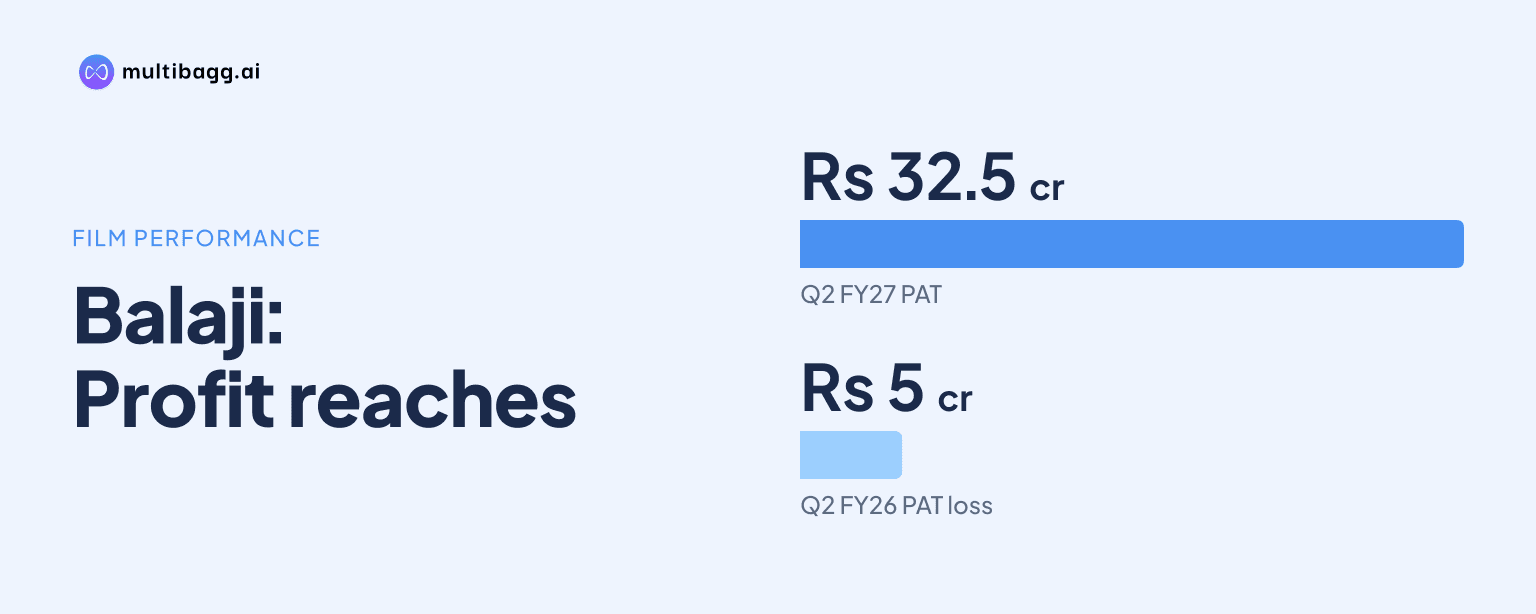
Balaji Telefilms Limited returned to a profit of Rs 32.5 crore in Q2 FY27, versus a Rs 5 crore loss a year earlier, led by Rs 41.24 crore of profit before tax from films. Revenue from operations rose to Rs 181 crore from Rs 48 crore, while cash reserves stood at about Rs 200 crore.
Know Balaji Telefilms inside out
Results, valuation, peers and who's buying, in one view.
What drove Balaji Telefilms' Q2 FY27 turnaround?
Balaji Telefilms' Q2 FY27 turnaround was driven principally by films, supported by commissioned television and digital business. Consolidated profit before tax, or PBT, was Rs 44 crore, compared with a Rs 6.6 crore loss in Q2 FY26. Profit after tax, or PAT, was Rs 32.5 crore after a Rs 12.4 crore deferred-tax charge, which management described as non-cash.
Revenue from operations increased by Rs 133 crore year on year to Rs 181 crore in Q2 FY27. For H1 FY27, revenue reached Rs 421.4 crore against Rs 121.6 crore in H1 FY26, while PBT moved to Rs 72.9 crore from a Rs 14.4 crore loss. H1 PAT was Rs 54.9 crore, compared with a Rs 10.9 crore loss a year earlier, after a Rs 18 crore deferred-tax charge.
Management said quarterly revenue can shift with the mix of television programmes and films. Q1 included Kyunki Saas Bhi Kabhi Bahu Thi and Naagin, with Naagin described as a higher-yield weekend show, while Bhooth Bangla contributed more revenue in Q1 than Vvan did in Q2. Management said it assesses projects using capital employed and internal rate of return, or IRR, rather than targeting a fixed quarterly revenue pattern.
Which segments made Balaji Telefilms profitable in Q2?
Films made Balaji Telefilms profitable in Q2 FY27, delivering Rs 106.3 crore of revenue and Rs 41.24 crore of PBT. That segment accounted for nearly all of the group's Rs 44 crore consolidated PBT. Management said a spillover from Bhooth Bangla, which it described as having a successful box-office run, contributed significantly to Motion Pictures results in the quarter.
The commission business, comprising television and digital business-to-business, or B2B, content, generated Rs 69.7 crore of revenue and Rs 7.03 crore of PBT. Digital business-to-consumer, or B2C, generated Rs 5.06 crore of revenue but recorded a Rs 3.92 crore segmental loss. Management attributed the B2C loss to continued investment in its digital ecosystem and new content initiatives.
The contrast between films and B2C digital defines the quarter's earnings mix. Films supplied the bulk of segment profit, while B2C remained loss-making as the company scaled its owned platforms and content initiatives. Management called the B2C investment calibrated, but did not provide a timetable or target for profitability in that segment.
How does Balaji Telefilms plan to manage film risk?
Balaji Telefilms plans to manage film risk by preselling digital, satellite and music rights before theatrical release. Management said platforms and partners had covered most production costs before release across the previous six films, with average pre-release recovery of about 80% to 90% of production costs. The stated approach is intended to make box-office collections an upside after much of the production cost has been covered.
Management aims to produce four to six films a year, with average production costs of Rs 60 crore to Rs 75 crore per title. Bhooth Bangla crossed Rs 240 crore in worldwide box-office collections, while Vvan, theatrically released in September, collected more than Rs 90 crore worldwide. The company had four films under production: Ragini 3, Hero Ki Horroin, Heer Ranjha and Obsessive Lover.
For H2 FY27, management expects Hero Ki Horroin and Ragini 3 to be released, depending on theatrical windows. It did not provide revenue or profit forecasts for either film. Management said its film decisions remain centred on turnaround time, pre-release monetisation and return on capital employed.
Got a follow-up? Ask IRIS
What support does the commission order book provide?
Balaji Telefilms has a digital B2B order book exceeding Rs 350 crore, which management said provides visibility but will be recognised as programmes are delivered. Management expects about Rs 150 crore of commissioned over-the-top, or OTT, show revenue in the current financial year. It did not disclose expected profitability from the order book.
Management said the commission business was around Rs 115 crore for the financial year at the time of the call, with earnings before interest, tax, depreciation and amortisation, or EBITDA, of about Rs 18.5 crore. It expects television business to contribute about Rs 125 crore to Rs 175 crore each year. Management also said OTT projects generally have a lower percentage yield than television shows because long-running television formats benefit from marginal-cost economics.
Order-book conversion depends on a show's scale and production requirements. Management said a reality programme may run for 45 to 50 days after four to five months of preparation, whereas Kohinoor had been in production for about 1.5 years and would be close to two years old by its expected February availability. It identified Kohinoor as a Rs 100 crore show and said Lock Upp 2 would arrive in February.
How much financial capacity does Balaji Telefilms have for expansion?
Balaji Telefilms reported cash reserves of approximately Rs 200 crore and described its balance sheet as debt-free. Management said the funds provide flexibility to support ongoing production requirements, finance its content pipeline and pursue new business opportunities. It said capital allocation would remain focused on presales in films, platform-backed commission projects and calibrated B2C digital investment.
The company outlined an FY27-to-FY31 estimated pipeline of more than 30 films, over 15 television shows, more than 25 OTT series, over 500 micro dramas and over 10 YouTube shows. Its YouTube partnership covers five premium original shows and 200 episodes, while management said Balaji Telefilms retains intellectual-property ownership and creative control. These pipeline figures are plans, not revenue guidance.
Balaji Telefilms also owns intellectual property for around 53 films and more than 200 web series, in addition to three decades of television content. Management said content costs are fully expensed at the last monetisation stage. It said later licensing, syndication, music receipts, free-ad-supported television and dubbed versions can therefore generate revenue without a new content-production cost in the profit and loss account.
Conclusion
Balaji Telefilms' Q2 FY27 return to profit was concentrated in films and commission content: films delivered Rs 41.24 crore of PBT and commission business contributed Rs 7.03 crore, while B2C digital posted a Rs 3.92 crore loss. The Rs 200 crore cash reserve and debt-free balance sheet give the company capacity to fund the pipeline, but the reported earnings recovery currently depends on execution in film and commissioned production.
The next items to watch are the planned H2 FY27 releases of Hero Ki Horroin and Ragini 3, subject to theatrical windows, and management's expectation of around Rs 150 crore of OTT commission revenue during the financial year. Delivery against the Rs 350 crore-plus digital B2B order book, film presales and the pace of B2C investment will indicate how the company deploys its cash reserves.