










Balkrishna Industries Revenue Rises 49% as Margin Falls
Key highlights
- Balkrishna Industries' Q2 FY27 standalone revenue rose 49% year-on-year to INR3,450 crore.
- Standalone EBITDA was INR629 crore in Q2 FY27, with an EBITDA margin of 18.24%.
- Q2 FY27 standalone profit after tax increased 10% year-on-year to INR291 crore.
- H1 FY27 tyre sales volume reached 185,187 metric tonnes, up 23% year-on-year.
powered by IRIS
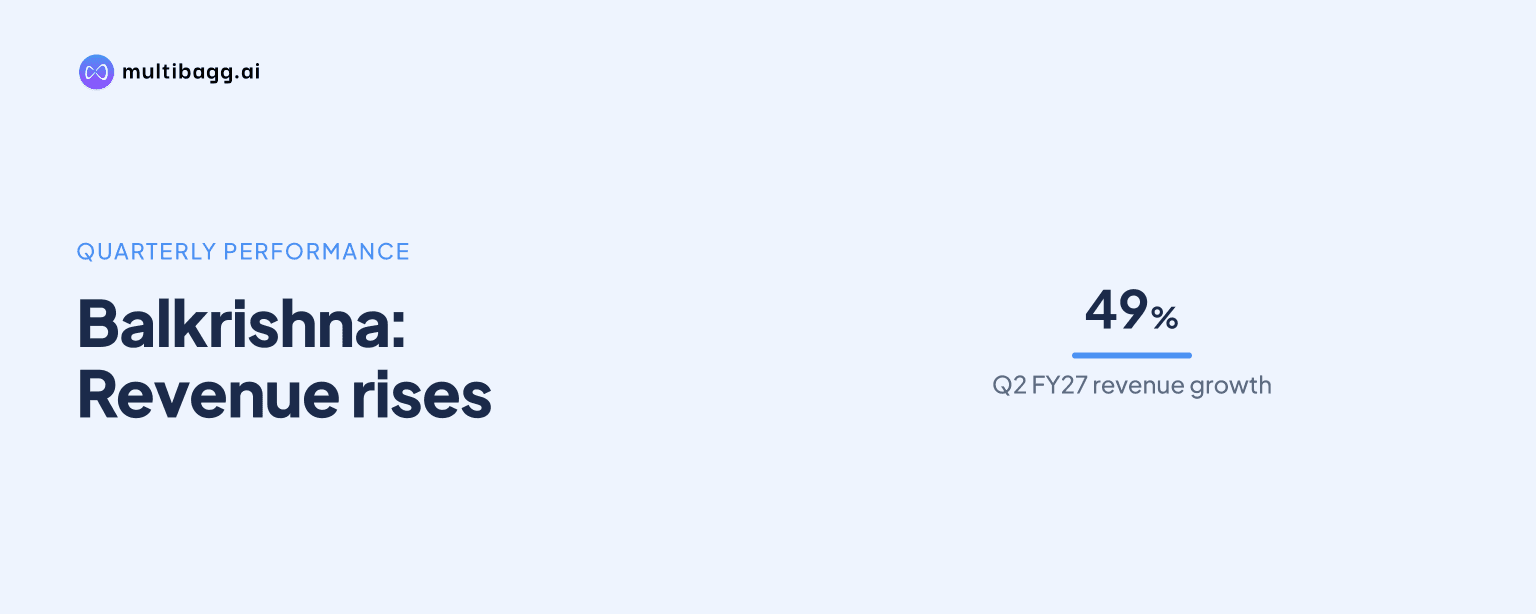
Balkrishna Industries Limited reported Q2 FY27 standalone revenue of INR3,450 crore, up 49% year-on-year, but its EBITDA margin fell to 18.24% as raw-material inflation and freight costs rose. The results show strong sales momentum across tyres and carbon black, alongside a clear increase in operating-cost pressure.
Know Balkrishna Industries inside out
Results, valuation, peers and who's buying, in one view.
What did Balkrishna Industries report for Q2 FY27?
Balkrishna Industries reported standalone total income of INR3,450 crore for the quarter ended September 2026, compared with INR2,320 crore a year earlier. EBITDA increased 26% year-on-year to INR629 crore, while profit after tax rose 10% to INR291 crore from INR265 crore in Q2 FY26.
The quarterly revenue figure included a realised foreign-exchange loss on sales of INR41 crore. The company said volume growth across its off-highway tyre portfolio and carbon black business supported the higher revenue base, even as global markets remained volatile.
For the first half of FY27, standalone revenue rose 35% year-on-year to INR6,859 crore. H1 profit after tax increased 31% to INR723 crore, compared with INR552 crore in the corresponding period of FY26. The H1 revenue number included a realised forex loss of INR76 crore on sales.
Why did Balkrishna Industries' operating margin decline?
Balkrishna Industries' EBITDA margin was affected by raw-material inflation, higher freight costs and a greater share of Indian sales in the volume mix. India accounted for around 40% of overall volumes during the quarter, according to management.
The company delivered substantial revenue growth, but EBITDA growth of 26% did not match the 49% rise in revenue. This gap indicates that higher input and logistics costs absorbed part of the benefit from additional sales volumes and pricing.
The Q2 results summary also pointed to a margin squeeze, with operating profitability under pressure despite higher sales. The reported standalone EBITDA margin of 18.24% reflects this cost environment. Management described the headwinds from raw materials and freight as significant while maintaining that volume growth remained strong.
Cost inflation is particularly relevant for tyre manufacturers because raw materials and transportation are major components of operating expenditure. The call summary did not provide a detailed material-cost breakup or a timetable for normalisation in freight costs.
How did tyre volumes and regional demand perform?
Balkrishna Industries sold 91,397 metric tonnes of tyres in Q2 FY27, up 30% year-on-year, while H1 tyre volumes reached about 185,000 metric tonnes, up 23%. The company reported H1 volume of 185,187 metric tonnes, while an earnings summary cited 185,167 metric tonnes, a small difference in reported summaries.
Management said the on-road tyre portfolio made an early single-digit contribution to Q2 volumes. The company is pursuing growth across off-highway tyres, on-road tyres and carbon black under its Vision 2030 strategy.
Demand conditions varied by region. India showed positive trends, the Americas were described as stable, and Europe faced weather-related pressure. These regional comments provide context for the company's focus on balancing volume growth and profitability across markets rather than relying on a single geography.
The strong volume increase helped drive the revenue expansion in the quarter. But revenue performance also reflected pricing, including the company's effort to recover a part of rising costs through price increases.
Got a follow-up? Ask IRIS
What has management said about prices and strategy?
Balkrishna Industries said it passed on roughly a 23% price increase, mainly in the Indian market, and intends to use a tactical mix of price and volume actions globally. Rajiv Poddar, Joint Managing Director, said management would remain judicious in balancing growth with profitability and did not disclose the size of any future price increases.
The statement is important because pricing is one of the main tools available to offset higher raw-material and freight expenses. However, the results indicate that cost pressures remained material in Q2 even after the reported price action.
Vision 2030 includes a FY30 revenue target of INR23,000 crore. The company has also identified expansion into premium passenger car radial tyres through its Pirelli partnership as part of its broader on-road tyre strategy.
These plans sit alongside the established off-highway tyre business, which remains central to current sales volumes. The available call information does not provide a revenue contribution or profitability breakdown for the planned premium PCR tyre expansion.
What do the Q2 figures mean for investors and operations?
Balkrishna Industries' Q2 FY27 figures show that demand and volumes supported revenue growth, but earnings growth was slower because of higher operating costs. Standalone profit after tax rose 10% to INR291 crore, well below the 49% increase in revenue, while the EBITDA margin stood at 18.24%.
For investors, the key issue is the relationship between pricing and input costs. The company has raised prices, particularly in India, but raw-material inflation and freight have continued to affect operating profitability. The call did not quantify the impact of each cost component separately.
The business also operates in different demand environments across its key markets. Positive momentum in India and stability in the Americas supported the sales outcome, while weather-related pressure in Europe remained a constraint. For customers and distributors, management's approach suggests price and volume decisions will be tailored by market conditions.
The company filed its Q2 and H1 FY27 results after a board meeting on November 4, 2026, and held its earnings call on November 5, 2026. It subsequently announced that the call recording was available on its website under SEBI's LODR disclosure requirements.
Conclusion
Balkrishna Industries combined strong Q2 FY27 revenue and tyre-volume growth with weaker operating leverage. Standalone revenue rose to INR3,450 crore and tyre volume increased 30%, but raw-material inflation, freight costs and the India-heavy volume mix held EBITDA margin at 18.24%. The quarter therefore reflects solid sales execution alongside a cost-led constraint on profitability.
Investors will watch whether further pricing actions can narrow the gap between revenue growth and profit growth, as well as trends in raw materials, freight and regional demand. Management's disclosed FY30 revenue target of INR23,000 crore and the planned expansion into premium PCR tyres through the Pirelli partnership remain longer-term strategic reference points.