










BKT targets 20% turnover from on-road tyres by 2030
Key highlights
- BKT targets 20% of turnover from on-road tyres and 5% market share by 2030.
- On-road tyres contributed an early single-digit share of BKT's Q2 FY27 sales volume.
- BKT plans to launch passenger-car radial tyres in January 2027.
- BKT reported H1 FY27 standalone revenue of Rs 6,859 crore, up 35% year on year.
powered by IRIS
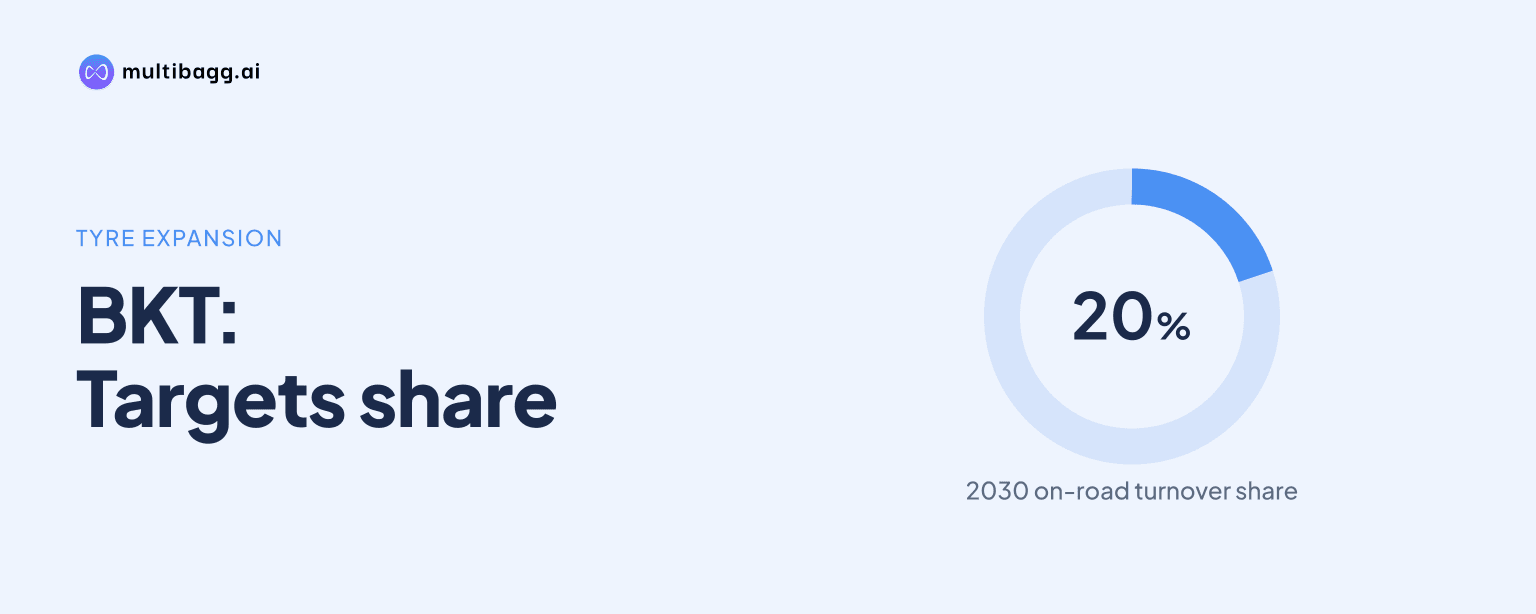
In Q2 FY27, Balkrishna Industries Limited said its on-road tyre portfolio was an early single-digit share of sales volume, while management targets 20% of turnover and 5% market share from the new vertical by 2030, supported by ramping truck and bus radial and two-wheeler lines and a planned January 2027 passenger-car radial launch.
Know Balkrishna Industries inside out
Results, valuation, peers and who's buying, in one view.
What is BKT's on-road tyre target for 2030?
BKT targets 20% of company turnover and 5% market share from its on-road vertical by 2030. Joint Managing Director Rajiv Poddar outlined the targets under Vision 2030 when asked about the revenue trajectory of the business, which includes truck and bus radial, two-wheeler and passenger-car tyre categories.
The current contribution is limited: BKT said on-road products made an early single-digit contribution to Q2 FY27 tyre sales volume, while Poddar described revenue contribution as low single digit. The company does not disclose a separate on-road sales figure because these products are included in an “others” category of about 8,000 metric tons.
The 2030 measures are management objectives, not reported results. Poddar said BKT was following its Vision 2030 map and was “quite sure” of meeting the vision, but the call did not provide annual on-road revenue, volume or market-share milestones between Q2 FY27 and 2030.
Which on-road tyre lines is BKT expanding?
BKT is ramping up truck and bus radial, or TBR, tyres and two-wheeler tyres, and plans to launch passenger-car radial, or PCR, tyres in January 2027. Senior President and Director, Strategy and Business Development Satish Sharma said the TBR and two-wheeler ranges had gained acceptance from both distribution channels and end users.
That response is supporting a steep increase in production and sales, according to Sharma, although BKT did not quantify capacity utilisation or orders for the two categories in Q2 FY27. The January 2027 PCR launch will add a third on-road product line to a portfolio that remained an early single-digit share of quarterly volume.
BKT has established its primary distributor network for all categories, including PCR before the scheduled January 2027 launch. Sharma said dealer additions would move in tandem with sales growth, meaning the dealer network is being expanded alongside commercial demand rather than against a disclosed outlet target.
How does BKT's on-road expansion fit its wider business?
BKT places on-road tyres alongside off-highway tyres and carbon black as the three areas of its Vision 2030 strategy. Poddar said the BKT 2.0 structure is for marketing and branding, not separate profit-and-loss accounts or balance sheets, so the company continues to operate and report as one entity.
Off-highway tyres, or OHT, remain BKT's established tyre business. H1 FY27 tyre sales volume was 185,167 metric tons, while management reported good OHT sales-volume growth in Q2. It cautioned that the year-on-year comparison was affected by low US sales in Q2 of the previous year amid the tariff situation.
Regional conditions varied in Q2 FY27. Europe faced pressure in agricultural markets linked to extreme weather, India showed positive trends despite erratic monsoons, and the Americas recorded stable sales. BKT also said its all-steel radial mining range was gaining acceptance in major mining markets, adding another growth lever within OHT.
Got a follow-up? Ask IRIS
What financial conditions accompany BKT's expansion?
BKT reported standalone revenue of Rs 3,450 crore in Q2 FY27, up 49% year on year, and Rs 6,859 crore in H1 FY27, up 35%. Q2 earnings before interest, tax, depreciation and amortisation, or EBITDA, were Rs 629 crore, compared with Rs 1,332 crore for H1 FY27.
The EBITDA margin was 18.24% in Q2 FY27, below the 19.42% reported for H1 FY27. Management attributed the pressure to higher raw-material and freight costs, and said India's share had increased to about 40% of overall volumes, which it said also affected margin slightly.
BKT took price increases of about 2% to 3%, mainly in India, but said these did not fully offset cost inflation. Management said it would use a tactical mix of price and volume in coming quarters, while its longer-term endeavour is to maintain an EBITDA margin in a 20% to 25% range.
What costs and investment plans could affect BKT's rollout?
BKT spent about Rs 1,850 crore on capital expenditure in H1 FY27. As of September 30, 2026, gross debt was about Rs 5,985 crore and cash and cash equivalents were about Rs 3,100 crore, resulting in reported net debt of about Rs 2,887 crore.
Management said the capital-expenditure programme was on track and that remaining spending would be undertaken over the next two years. Chief Financial Officer Saroj Khuntia said borrowing increased because BKT brought forward investment by a couple of quarters to accelerate project completion, with repayment expected through future earnings.
Freight represented about 6.5% of Q2 FY27 sales value, and management estimated sea freight would remain at elevated levels, with a possible marginal increase. Poddar said higher freight had not yet been passed through in average selling prices, while raw-material inflation was expected to continue for the coming quarters.
BKT's carbon black business accounted for another part of the wider investment programme, with third-party sales at around 10% of overall business in Q2 FY27. Management said newly added capacity had come online and would mainly support external sales as BKT works towards full utilisation.
Conclusion
BKT's plan would materially change its sales mix if on-road tyres rise from an early single-digit share of Q2 FY27 volume and revenue to 20% of turnover by 2030. The strategy combines an existing TBR and two-wheeler ramp-up with entry into PCR tyres, while OHT remains the principal volume base at 185,167 metric tons in H1 FY27.
The next disclosed milestone is BKT's planned January 2027 PCR launch, with dealer additions intended to track sales growth. Investors can also watch for progress in the on-road contribution, freight costs at about 6.5% of Q2 FY27 sales, raw-material inflation and capital expenditure scheduled to continue over the next two years.