










BKT’s H1FY27 cash flow turns negative on working capital
Key highlights
- BKT reported negative Rs 1 of net operating cash flow in H1FY27, compared with Rs 2,224 crore in FY26.
- Working capital absorbed Rs 1,224 crore in H1FY27 after adding Rs 165 crore of cash in FY26.
- Inventories reached Rs 2,423 crore and trade receivables reached Rs 2,135 crore at September 2026.
- Financing activities generated Rs 1,831 crore in H1FY27 while investing activities used Rs 1,804 crore.
powered by IRIS
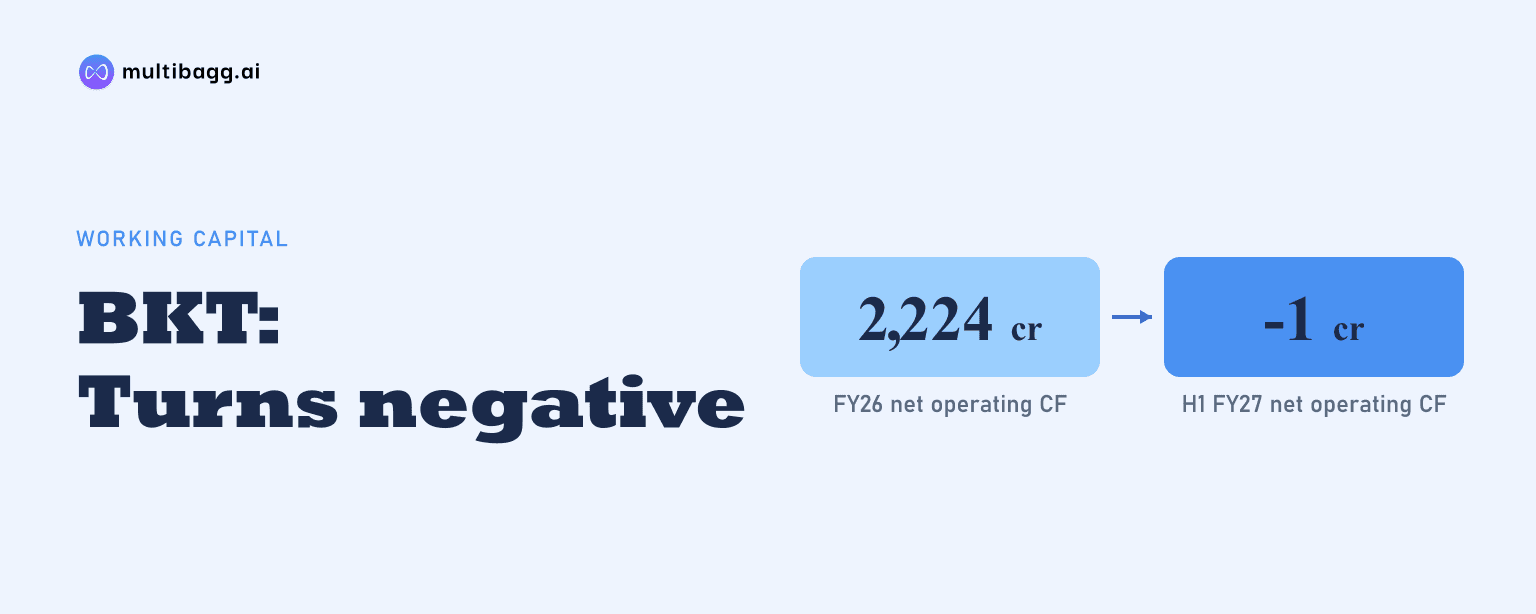
Balkrishna Industries Ltd. (BKT) reported net cash used in operating activities of Rs 1 in H1FY27, as a Rs 1,224 crore working-capital outflow and Rs 148 crore of tax and other payments absorbed cash despite Rs 1,332 crore of earnings before interest, tax, depreciation and amortisation (EBITDA). Financing activities supplied Rs 1,831 crore while investing activities used Rs 1,804 crore.
Know Balkrishna Industries inside out
Results, valuation, peers and who's buying, in one view.
Why did BKT’s operating cash flow turn negative in H1FY27?
BKT’s operating cash flow turned negative because working capital consumed Rs 1,224 crore in H1FY27, reversing a Rs 165 crore source of cash in FY26. Operating profit before working-capital changes was Rs 1,372 crore in the half year, but the working-capital movement reduced cash generated from operations to Rs 147 crore. Net direct taxes paid and other items of Rs 148 crore then took net cash from operating activities to negative Rs 1.
The comparison with FY26 shows a different cash-flow outcome, although FY26 covers a full year while H1FY27 covers six months. In FY26, operating profit before working-capital changes of Rs 2,445 crore and a Rs 165 crore working-capital release produced Rs 2,610 crore of cash generated from operations. After Rs 386 crore of taxes and other payments, FY26 net operating cash flow was Rs 2,224 crore.
BKT reported higher earnings in H1FY27, but its cash flow did not follow that increase during the period. Revenue from operations rose to Rs 6,935 crore from Rs 5,149 crore in H1FY26, while EBITDA increased to Rs 1,332 crore from Rs 1,155 crore. EBITDA margin declined to 19.4% from 22.7%, while the Rs 1,224 crore working-capital outflow exceeded the cash generated from operations.
Which balance-sheet items absorbed BKT’s working capital?
BKT’s inventories and trade receivables rose between March 2026 and September 2026, consistent with the higher working-capital requirement reported in H1FY27. Inventories increased by Rs 709 crore to Rs 2,423 crore, while trade receivables increased by Rs 513 crore to Rs 2,135 crore. Together, the two current-asset categories increased by Rs 1,222 crore over six months.
Current assets reached Rs 6,405 crore at September 2026, compared with Rs 5,132 crore at March 2026. Cash and cash equivalents increased to Rs 53 crore from Rs 27 crore, and other current assets increased to Rs 457 crore from Rs 415 crore. Current investments declined to Rs 1,292 crore from Rs 1,327 crore in the same period.
BKT’s current liabilities also increased, though the composition included a large rise in borrowing. Trade payables rose by Rs 95 crore to Rs 1,013 crore, while total current liabilities rose by Rs 1,326 crore to Rs 6,355 crore at September 2026. Current borrowings rose by Rs 1,209 crore to Rs 4,370 crore from Rs 3,161 crore.
Got a follow-up? Ask IRIS
How did BKT fund investment spending during H1FY27?
BKT funded its H1FY27 investment cash outflow principally through financing activities, which generated Rs 1,831 crore against net cash used in investing activities of Rs 1,804 crore. Net operating cash flow was negative Rs 1. The combined cash flows resulted in a Rs 26 crore increase in cash and cash equivalents during the half year.
The investing outflow coincided with increases in long-term operating assets. Property, plant and equipment increased to Rs 7,695 crore at September 2026 from Rs 7,297 crore at March 2026. Capital work-in-progress increased to Rs 3,741 crore from Rs 2,472 crore, a Rs 1,269 crore increase that exceeded the Rs 398 crore increase in property, plant and equipment.
Borrowings increased in both maturity categories on BKT’s September 2026 standalone balance sheet. Non-current borrowings rose to Rs 1,616 crore from Rs 888 crore, while current borrowings rose to Rs 4,370 crore from Rs 3,161 crore. Total reported borrowings were Rs 5,986 crore at September 2026, compared with Rs 4,049 crore at March 2026, while the cash-flow statement reported Rs 1,831 crore of net financing inflows in H1FY27.
What do BKT’s earnings and expansion plans indicate next?
BKT’s H1FY27 earnings increased even as working capital and investing activity constrained cash generation. Sales volume rose 23% year on year to 185,167 metric tonnes, revenue increased 35% to Rs 6,935 crore, and profit after tax increased 31% to Rs 723 crore. EBITDA margin was 19.4%, compared with 22.7% in H1FY26.
Management’s roadmap sets overall capital expenditure of Rs 6,800 crore through FY29 and a revenue target of about Rs 23,000 crore by FY30, compared with about Rs 10,600 crore in 2025. The stated FY30 revenue mix is approximately 70% off-highway tire business, 10% third-party carbon-black sales and 20% on-road business. Management also states a target of 8% global market share in the off-highway tire segment.
BKT’s reported volume mix shifted further toward India in H1FY27. India accounted for 39.4% of volume, compared with 36.3% in FY26, while Europe accounted for 39.2%, compared with 40.0%. Under BKT’s strategic agreement with Pirelli, Pirelli-branded passenger car radial tires are scheduled to begin production at the Bhuj plant in 2027, with supply planned to rise gradually to 800,000 tires in 2030.
Conclusion
BKT’s H1FY27 cash flow differed from its earnings result. EBITDA was Rs 1,332 crore and profit after tax was Rs 723 crore, but the Rs 1,224 crore working-capital outflow and Rs 148 crore of tax and other payments resulted in negative Rs 1 of net operating cash flow. Financing inflows of Rs 1,831 crore broadly matched the Rs 1,804 crore investment outflow, alongside reported borrowings of Rs 5,986 crore at September 2026.
The next disclosed markers are BKT’s Rs 6,800 crore capital-expenditure programme through FY29, its approximately Rs 23,000 crore FY30 revenue target, and the planned 2027 start of Pirelli-branded tire production at Bhuj. Inventory and receivable balances, which stood at Rs 2,423 crore and Rs 2,135 crore respectively at September 2026, are relevant to whether working capital continues to absorb cash as these plans progress.