










BKT targets Rs 23,000 crore FY30 revenue from new businesses
Key highlights
- BKT targets approximately Rs 23,000 crore of revenue by FY30, versus approximately Rs 10,600 crore in 2025.
- BKT has planned Rs 6,800 crore of capital expenditure until FY29.
- OHT is expected to contribute about 70% of FY30 revenue, while on-road tyres are targeted at about 20%.
- BKT plans 425,000 MTPA of OHT tyre capacity and approximately 8% global OHT market share.
powered by IRIS
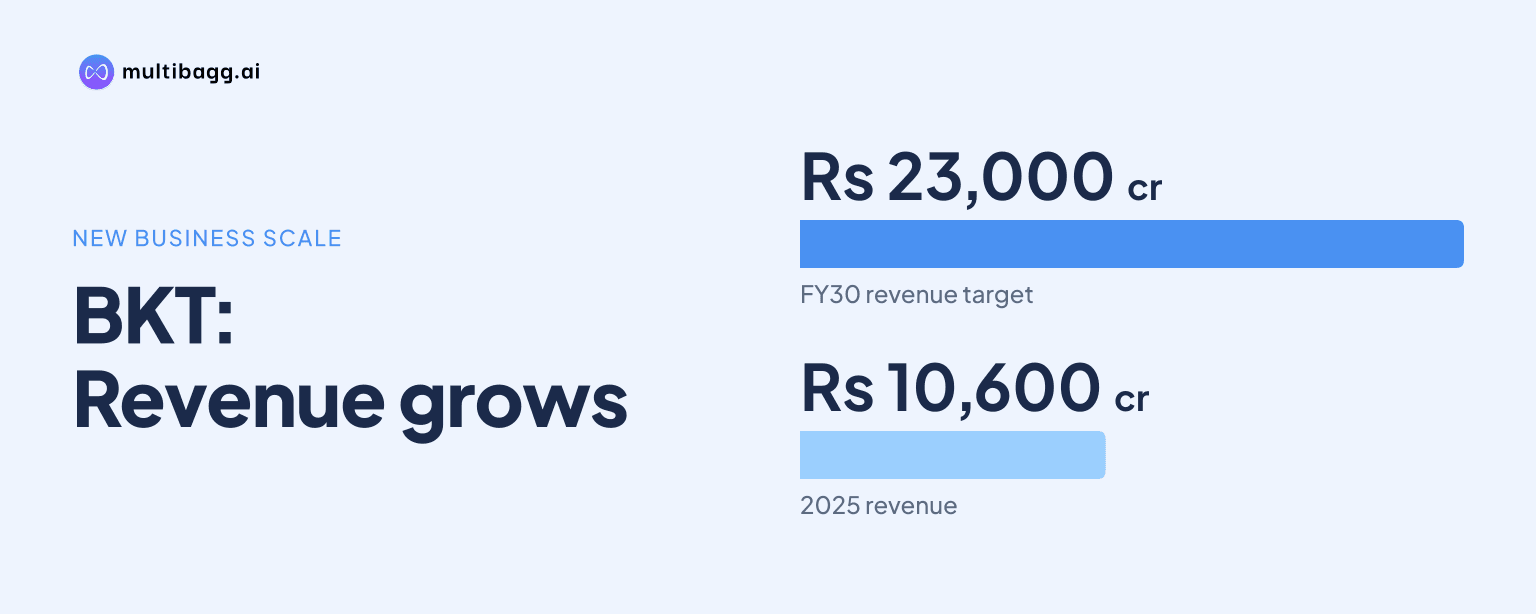
BKT targets approximately Rs 23,000 crore of revenue by FY30, compared with approximately Rs 10,600 crore in 2025, through Rs 6,800 crore of capital expenditure until FY29, OHT expansion, third-party carbon black sales and an on-road tyre entry. The roadmap implies roughly 2.2 times revenue growth and a five-year compound annual growth rate of about 17%.
Know Balkrishna Industries inside out
Results, valuation, peers and who's buying, in one view.
How will BKT reach Rs 23,000 crore of revenue by FY30?
BKT plans to build its FY30 revenue mix around OHT, third-party carbon black sales and on-road tyres. OHT is expected to contribute about 70% of FY30 revenue, carbon black about 10%, and on-road products about 20%. At the stated Rs 23,000 crore target, these shares imply about Rs 16,100 crore from OHT, Rs 2,300 crore from carbon black and Rs 4,600 crore from on-road tyres.
The FY30 plan broadens BKT beyond its established OHT operations while keeping OHT as the largest business. The presentation uses approximately Rs 10,600 crore of revenue in 2025 as the base for the target, while BKT reported FY26 revenue of Rs 10,656 crore. Management presents the move to approximately Rs 23,000 crore as 2.2 times growth over five years, or about 17% compound annual growth.
BKT links the revenue plan to total capex of Rs 6,800 crore until FY29 and an objective of achieving 8% global market share in OHT. The presentation does not disclose annual capex allocations, funding sources or annual revenue milestones. Capital work-in-progress was Rs 3,741 crore in September 2026, up from Rs 2,472 crore in March 2026, a Rs 1,269 crore increase in projects under construction.
What is BKT expanding in OHT?
BKT is expanding OHT tyre capacity through 35,000 metric tonnes per annum, or MTPA, of ongoing capex and debottlenecking measures. The company says these actions will lift OHT capacity to 425,000 MTPA and enable its stated goal of approximately 8% global OHT market share. OHT is planned to remain the main FY30 revenue contributor at about 70%.
The OHT strategy covers agricultural, mining, tracks, industrial and construction tyres. In mining, BKT says it is the only Indian manufacturer to develop all-steel radial technology up to 57 inches and offers both bias and radial products. It also says it has established portfolios in tracks, industrial and construction tyres, while agricultural tyres remain a segment where it aims to sustain and consolidate global leadership.
BKT states that its current tyre manufacturing capacity is 360,000 MTPA, compared with the 425,000-MTPA OHT capacity outlined in the roadmap. The difference is 65,000 MTPA, combining the 35,000-MTPA ongoing capex with debottlenecking. BKT is also expanding a dedicated tracks facility, although the presentation does not give a commissioning date or a separate capacity figure for tracks.
Management describes 10% global OHT market share as a longer-term strategic goal to be pursued through modular and carefully phased investments. That is distinct from the approximately 8% OHT market-share objective tied to the FY30 revenue roadmap. The presentation does not provide a regional sales split or a timetable for reaching the 10% objective.
How will carbon black contribute to BKT's FY30 plan?
BKT expects third-party carbon black sales to account for about 10% of FY30 revenue. Its carbon black capacity has increased to 360,000 MTPA at Bhuj, alongside 64 megawatts of co-generation power capacity. The company says the expansion supports raw-material availability, energy circularity and sustainability efforts within its tyre operations.
The carbon black plant has an integrated role because it generates power for BKT's tyre facilities and provides a key raw material. Separately, BKT aims to be a preferred supplier to tyre and non-tyre customers in domestic and international markets. The presentation does not disclose how much of the 360,000-MTPA capacity is used internally, sold externally or assigned to the 30,000 MTPA of high-value advanced carbon material.
At the Rs 23,000 crore FY30 target, the planned 10% contribution equates to approximately Rs 2,300 crore of carbon black revenue. This contribution depends on developing third-party sales alongside internal supply to tyre plants. BKT does not provide carbon black revenue, realised pricing or a separate margin forecast for the business.
Got a follow-up? Ask IRIS
When will BKT scale its on-road tyre business?
BKT launched a commercial vehicle, or CV, radial tyre pilot in the fourth quarter of FY26 and plans to begin a premium passenger car radial, or PCR, tyre pilot in January 2027. Both pilots are to ramp gradually, with the initial focus on India's replacement market. The on-road business is targeted to contribute about 20% of FY30 revenue and reach approximately 5% market share.
The planned on-road entry is modular and covers premium PCR tyres and CV radial tyres. At the FY30 revenue target of approximately Rs 23,000 crore, the planned 20% contribution implies about Rs 4,600 crore from on-road products. This would make on-road tyres a new material revenue stream alongside the OHT and carbon black businesses.
BKT announced capex for premium passenger-car and commercial-vehicle radial tyre segments in 2025. However, the presentation does not give manufacturing capacity for either category, a commercial launch date after the pilots or a PCR and CV revenue split for FY30. The stated 5% market-share aim is therefore linked to a business that remains in staged rollout.
What financial effects does BKT expect from the expansion?
BKT expects blended margins after full commercialisation to be in a range of 23% to 25%, according to management's presentation. Management says enhanced revenue, product mix and operating strengths could allow absolute earnings before interest, tax, depreciation and amortisation, or EBITDA, to grow significantly. This is an outlook rather than a reported FY30 financial result.
Management also says it does not anticipate a significant decline in return on capital employed, or ROCE, when the expansion reaches full potential. The statement accompanies Rs 6,800 crore of capex until FY29 and the planned on-road business rollout. BKT does not provide a numerical FY30 EBITDA target, a point estimate within the 23% to 25% margin range, or a ROCE target.
BKT's standalone balance sheet shows property, plant and equipment of Rs 7,695 crore in September 2026, up from Rs 7,297 crore in March 2026. Total borrowings were Rs 5,986 crore in September 2026, comprising Rs 1,616 crore of non-current borrowings and Rs 4,370 crore of current borrowings, compared with Rs 4,049 crore combined in March 2026. In H1FY27, net cash from investing activities was negative Rs 1,804 crore and net cash from financing activities was positive Rs 1,831 crore, versus negative Rs 2,504 crore and positive Rs 251 crore, respectively, in FY26.
Conclusion
BKT's FY30 roadmap combines a larger OHT platform with third-party carbon black sales and a new on-road tyre operation. The plan seeks to raise revenue from approximately Rs 10,600 crore in 2025 to approximately Rs 23,000 crore in FY30, while retaining OHT at about 70% of sales and assigning the remaining 30% to carbon black and on-road products.
The next disclosed operating milestones are the gradual CV radial tyre pilot ramp-up after Q4FY26 and the planned PCR pilot in January 2027. Progress toward 425,000 MTPA of OHT capacity, execution of the Rs 6,800 crore capex programme through FY29, and further disclosure on on-road capacity and commercial scale will determine how the FY30 mix develops.