










BKT targets 800,000 Pirelli-branded tyres annually by 2030
Key highlights
- BKT plans to begin Pirelli-branded passenger-car tyre production at Bhuj in 2027.
- BKT targets annual supply of 800,000 Pirelli-branded tyres in 2030.
- The proposed 50:50 joint venture is targeted for agreement and incorporation by 31 December 2030.
- India represented 39.4% of BKT’s H1FY27 sales volume, up from 36.3% in FY26.
powered by IRIS
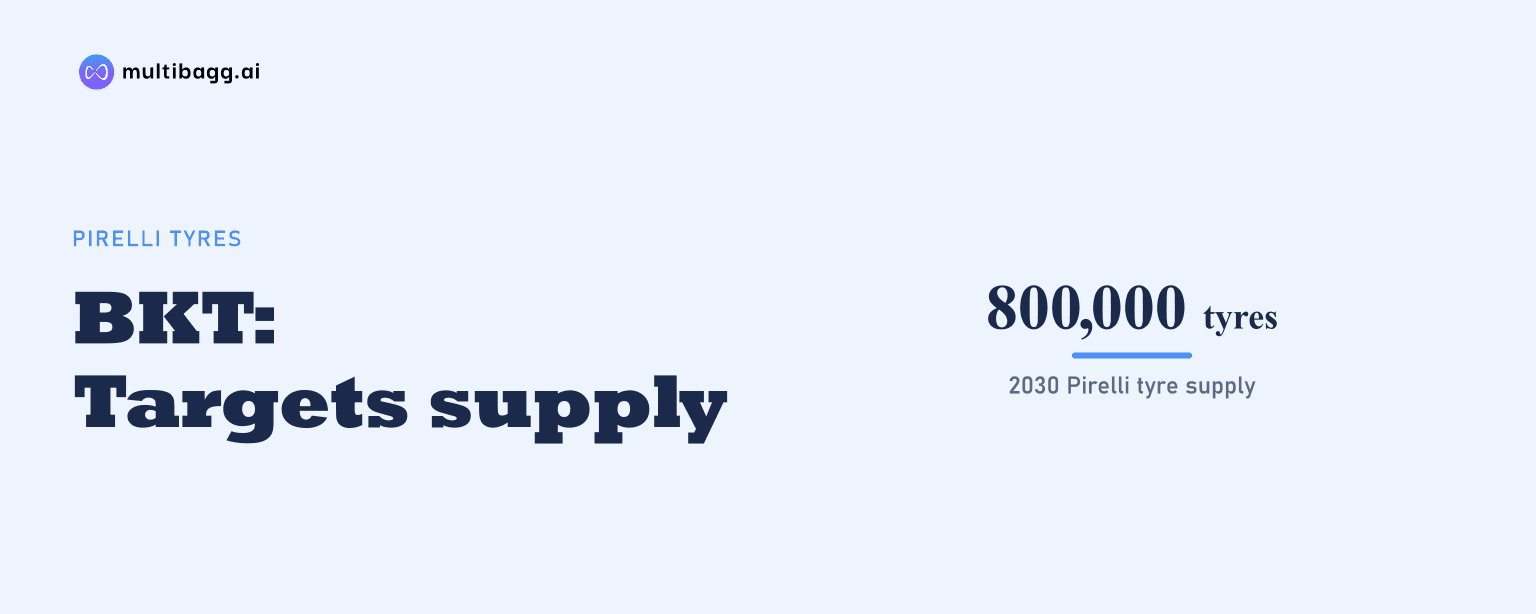
Balkrishna Industries Ltd. (BKT) plans to make Pirelli-branded passenger-car tyres at Bhuj from 2027 and raise annual supply to 800,000 tyres in 2030. The 22 October 2026 agreement pairs Pirelli’s minimum annual offtake commitment with BKT’s corresponding capacity commitment and envisages a separate 50:50 joint venture by 31 December 2030.
Know Balkrishna Industries inside out
Results, valuation, peers and who's buying, in one view.
What does BKT’s Pirelli agreement cover?
BKT’s agreement with Pirelli covers manufacture of Pirelli-branded passenger-car tyres at BKT’s Bhuj plant to Pirelli’s specifications. The arrangement addresses India’s passenger-car tyre market, distinct from BKT’s agricultural and off-the-road, or OTR, tyre segments, which together represented 93.0% of H1FY27 sales volume.
The parties also entered a separate service agreement under which Pirelli will provide technical support for testing BKT-branded tyres. The arrangement therefore includes Pirelli-branded production at Bhuj and support for BKT-branded products, but the presentation does not disclose the service agreement’s value, the number of tyre models covered or its commercial terms.
Pirelli has committed to a minimum annual offtake, while BKT has made a corresponding capacity commitment for Pirelli-branded tyres. BKT does not disclose the minimum annual quantity, meaning the 800,000-tyre figure is its stated 2030 supply target rather than a disclosed contractual minimum.
When will BKT make 800,000 Pirelli-branded tyres?
BKT expects production to start in 2027 and supplies to increase gradually until they reach 800,000 Pirelli-branded tyres in 2030. The presentation gives no annual production targets for 2027, 2028 or 2029, so the rate of the planned volume increase is not specified.
The 800,000-tyre target relates to production at the existing Bhuj plant under the offtake arrangement, not to the proposed new facility. The proposed plant is part of a separate joint-venture plan that remains subject to agreed conditions and conditions precedent.
BKT reported standalone tyre sales of 185,167 metric tonnes, or MT, in H1FY27, up 23% from 150,916 MT in H1FY26. Pirelli-branded supply is stated in tyre units rather than MT, so the presentation does not permit a direct comparison between the 2030 target and BKT’s reported current sales volume.
Got a follow-up? Ask IRIS
How does the agreement support BKT’s passenger-car tyre expansion?
BKT says the agreement supports its expansion into passenger-car tyres and creates potential in domestic and international markets. Its presentation estimates that Indian car registrations will grow by 5% to 7% annually from 2025 to 2030 and projects that the premium car-tyre market could grow almost fivefold over that period.
BKT’s reported sales mix has become more India-focused. India accounted for 39.4% of H1FY27 volume, up from 36.3% in FY26 and 26.8% in FY24, while Europe’s share fell to 39.2% from 47.1% over the FY24-to-H1FY27 comparison.
Agricultural tyres remained BKT’s largest segment at 58.4% of H1FY27 volume, followed by OTR tyres at 34.6% and other products at 7.0%. The other-products share was 3.7% in FY26, but the presentation does not identify passenger-car tyres within that category or disclose current passenger-car tyre revenue.
What must happen before BKT and Pirelli form a joint venture?
BKT and Pirelli envisage a 50:50 joint venture, subject to agreed conditions and conditions precedent, to establish a new India plant for passenger-car tyres under the Pirelli and BKT brands. The parties target signing the joint-venture agreement and incorporating the entity by 31 December 2030; the presentation does not state that the venture has been formed.
The intended new facility would manufacture passenger-car tyres for the two brands respectively. BKT does not disclose its location, capital expenditure, capacity, funding structure, governance arrangements or the specific conditions required before incorporation, leaving construction and incremental capacity unconfirmed.
BKT’s standalone balance sheet provides context for its industrial base but does not assign any existing expenditure to the Pirelli agreement. Capital work-in-progress was Rs 3,741 crore at September 2026, compared with Rs 2,472 crore at March 2026, while property, plant and equipment stood at Rs 7,695 crore at September 2026.
Management said the partnership combines Pirelli’s premium positioning and technology with BKT’s manufacturing scale and local industrial base. In the 22 October 2026 announcement, Chairman and Managing Director Arvind Poddar said the arrangement brought together complementary strengths to pursue a growing market; this was management’s rationale rather than a revenue or profit forecast.
Conclusion
BKT’s agreement with Pirelli establishes a defined route into passenger-car tyres through Bhuj production from 2027, minimum annual offtake and capacity commitments, and a target of 800,000 Pirelli-branded tyres a year in 2030. The arrangement also provides Pirelli technical support for testing BKT-branded tyres, alongside BKT’s rising India sales-volume share of 39.4% in H1FY27.
The next disclosed operating milestone is the planned start of Pirelli-branded production in 2027. BKT has also set 31 December 2030 as the target for the joint-venture agreement and incorporation, while the proposed plant’s location, cost, capacity and conditions precedent remain undisclosed.