










BEW Targets Full Factory Use by April 2027 With SAP Shift
Key highlights
- BEW began partial production at its expanded adjacent facility in October 2026 and targets full utilisation from April 2027.
- BEW targets solar-panel installation completion by 15 December 2026 and active load distribution from January 2027.
- BEW says SAP Business One is in final-stage testing and targets a complete shift from FY27-28.
- BEW's indicative stainless-steel price was Rs 345 per kg in September 2026, while Hastelloy was Rs 5,000 per kg.
powered by IRIS
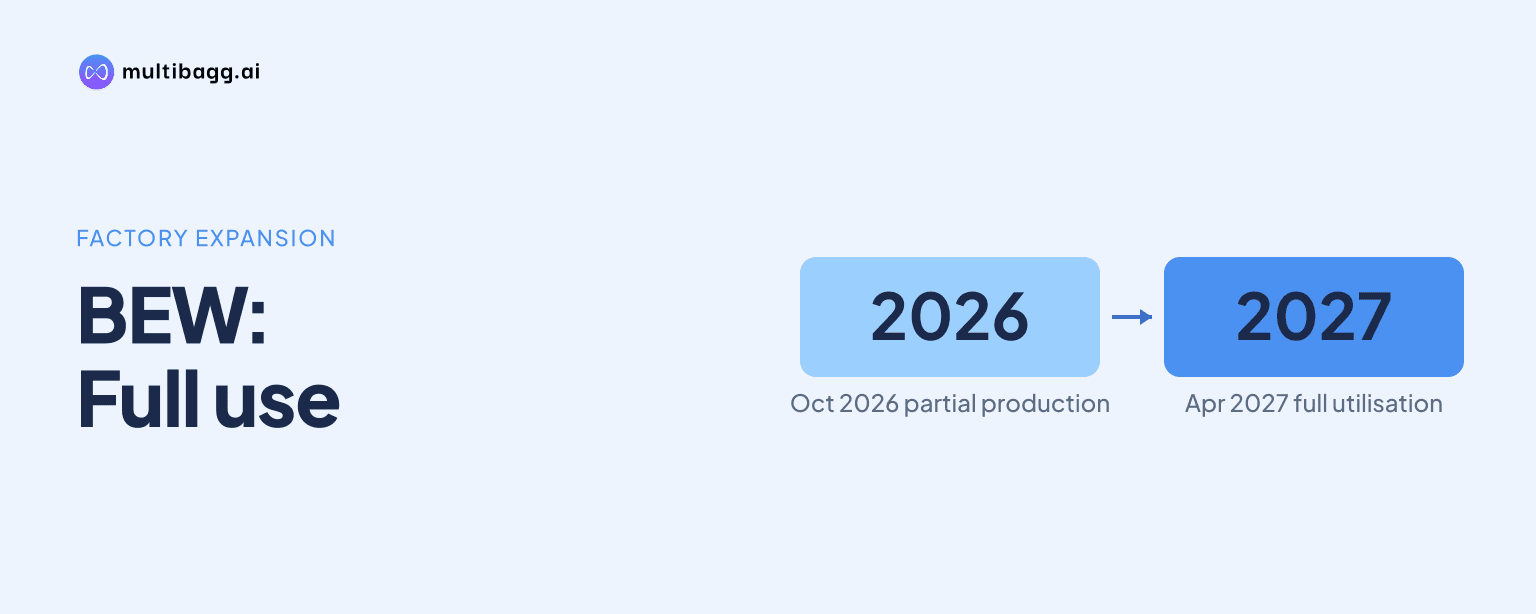
BEW Engineering Limited targets full utilisation of its expanded adjacent production facility from April 2027, after partial production began in October 2026. BEW also targets solar-panel installation completion by 15 December 2026, active load distribution from January 2027, and a complete SAP Business One shift from FY27-28.
Know BEW Engineering inside out
Results, valuation, peers and who's buying, in one view.
What is BEW's expanded-factory timeline?
BEW began partial production at its expanded adjacent production facility in October 2026 and targets full utilisation from April 2027. The company presents this as a staged manufacturing-infrastructure enhancement, with the October start marking partial commencement rather than completion of the facility ramp-up.
The business update does not disclose the facility's capacity, capital expenditure, current utilisation rate or incremental output expected from April 2027. Therefore, the April 2027 date is an operational target, not a stated forecast for revenue, production volume or profit contribution. Management said the investment is intended to strengthen manufacturing infrastructure and support a scalable operating environment.
In its commentary for the half year ended 30 September 2026, management said production had commenced in the additional facility while BEW pursued operational efficiencies in procurement, planning and sales. It linked the facility investment with efforts to improve productivity, production execution and working-capital management, but did not quantify the effect of any of these measures.
The timetable separates the October 2026 partial-production stage from the planned April 2027 full-utilisation stage. That distinction leaves several months of execution before the stated full-use target, and the presentation provides no intermediate commissioning target or monthly production measure for investors to assess the ramp-up.
How will BEW change its production planning system?
BEW says SAP Business One, or SAP B1, has entered the final phase of parallel testing and production-record updating, with a complete shift to SAP targeted from FY27-28. The company has not stated that the system was fully live during the half year ended 30 September 2026.
Management said SAP B1 and related process-improvement initiatives are designed to strengthen internal processes, production planning, execution and operational controls. It said the intended outcomes include improved productivity, optimised working capital and a more efficient operating environment. These are management's stated objectives rather than reported savings or achieved financial results.
The systems schedule differs from the factory schedule. Partial factory production began in October 2026 and full utilisation is targeted from April 2027, while the complete SAP shift is targeted from FY27-28. BEW has not disclosed a go-live month, implementation cost, software modules, employee-training programme or numerical target for working capital.
BEW's 30 September 2026 commentary places the SAP B1 project alongside the expanded facility and solar installation. This indicates that management views production records and planning controls as part of the operating framework for the expanded plant, although the presentation does not say that SAP completion is a condition for reaching full facility utilisation in April 2027.
Got a follow-up? Ask IRIS
When will BEW's solar power system operate?
BEW targets completion of solar-panel installation at its manufacturing facility by 15 December 2026, followed by active load distribution from January 2027 onward. Finance for the installation has been sanctioned through the Surya Shakti Cell of SBI, according to the business update.
Management expects the solar investment to reduce dependence on conventional electricity and lower power and energy costs in coming periods. It also expects the project to contribute positively to operating margins. BEW has not disclosed the solar system's capacity, project cost, expected electricity generation, annual cost saving or payback period.
The planned January 2027 start for active load distribution precedes the April 2027 full-utilisation target for the expanded facility. If the stated dates are met, solar power would be distributed during the final months of the factory ramp-up, but BEW has not specified what share of its manufacturing electricity requirement the installation would cover.
Management described solar power as part of its energy-efficient manufacturing approach in the half year ended 30 September 2026. The presentation identifies two near-term operational checkpoints, completion by 15 December 2026 and load distribution from January 2027, without providing a measure by which energy-cost effects can be quantified.
How have BEW's key material-price indicators changed?
BEW's indicative stainless-steel price was Rs 345 per kg in September 2026, up from Rs 325 per kg in FY26, while its indicative Hastelloy price was Rs 5,000 per kg, down from Rs 5,050 per kg. The latest movement was therefore higher for stainless steel and lower for Hastelloy.
From FY20 to September 2026, BEW's presented stainless-steel indicator increased by Rs 135 per kg, while the Hastelloy indicator increased by Rs 1,550 per kg. In the more recent FY26-to-September 2026 comparison, stainless steel rose by Rs 20 per kg and Hastelloy fell by Rs 50 per kg.
BEW labels both series as average indicative market prices and says actual purchase prices may vary case by case. The data provides context for management's procurement and planning focus, but the presentation does not disclose material consumption, customer price pass-through terms, inventory exposure or an identified effect on the expanded-facility programme.
Conclusion
BEW has set out a dated operational sequence across manufacturing capacity, systems and energy use. Partial production at the adjacent expanded facility began in October 2026, solar installation is targeted for completion by 15 December 2026, and active load distribution is planned from January 2027 before the April 2027 full-utilisation target. SAP B1 remains in final-stage testing, with a complete transition targeted from FY27-28.
The next disclosed milestones are solar-installation completion by 15 December 2026, active load distribution from January 2027 and full use of the expanded facility from April 2027. BEW's plan does not disclose the financial returns, capacity addition or SAP implementation cost, leaving subsequent company updates to show whether the projects deliver the productivity, working-capital and energy-cost effects management expects.