










BEW Engineering shifts focus to Hastelloy as 28% of revenue
Key highlights
- BEW Engineering said Hastelloy equipment contributes close to 28% of revenue.
- Management said one Hastelloy unit can generate revenue comparable with three SS equipment units.
- BEW Engineering cited an order book of about Rs 60 crore against its Rs 100 crore H2 target.
- Management estimated a possible 15%-20% operational delta for Hastelloy versus SS designs but said Hastelloy has better price recovery.
powered by IRIS
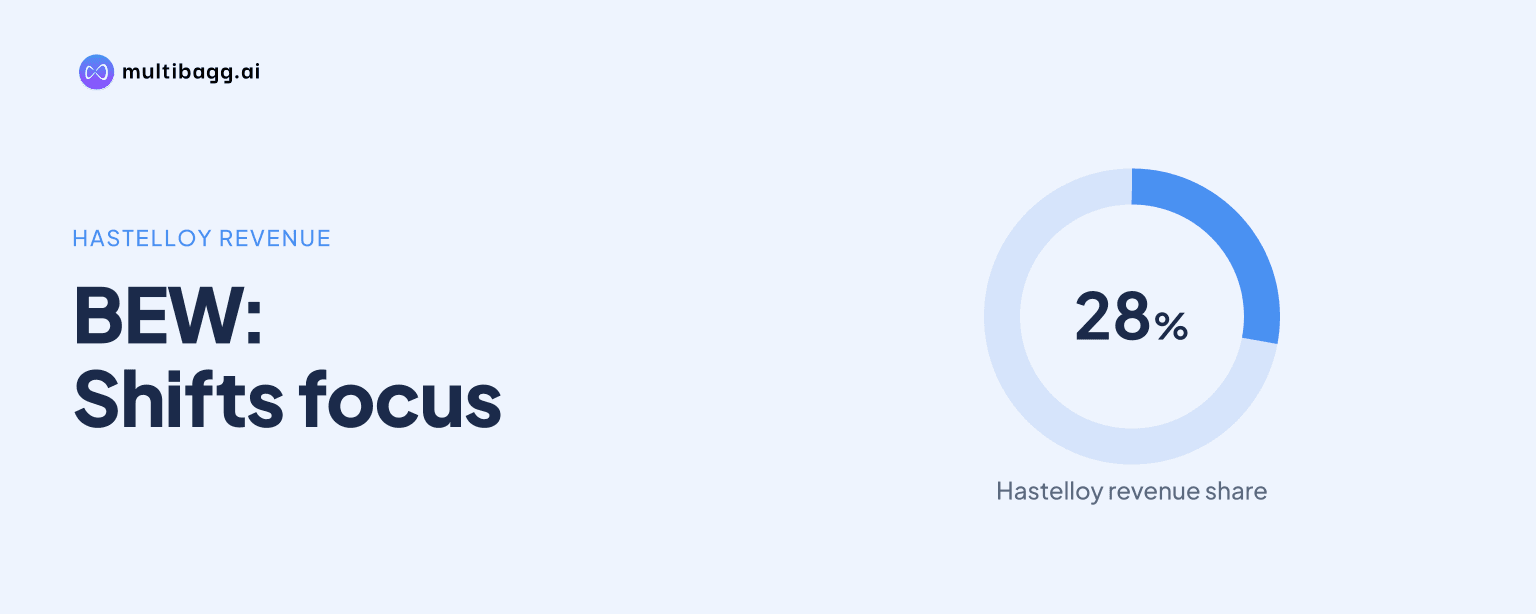
BEW Engineering Limited is focusing more on Hastelloy equipment orders because the product already contributes close to 28% of revenue and one Hastelloy unit can generate revenue comparable with three stainless-steel units. Management said this higher-value mix could support its Rs 100 crore H2 target against an order book of about Rs 60 crore.
Know BEW Engineering inside out
Results, valuation, peers and who's buying, in one view.
Why is BEW Engineering prioritising Hastelloy orders?
BEW Engineering is prioritising Hastelloy because management said a single Hastelloy equipment unit can produce roughly the revenue of three SS, or stainless-steel, equipment units. The company linked this order focus to its Rs 100 crore H2 revenue target, while responding to an analyst who cited an order book of about Rs 60 crore. Management said it also had a good pipeline and larger requirements that could move towards closure over the next couple of months.
The stated advantage is higher revenue per equipment delivery, rather than lower manufacturing effort. Management said producing one Hastelloy unit and three SS units involves a broadly comparable level of manpower in its rough comparison. It said a Hastelloy order can therefore help BEW Engineering reach a revenue objective with fewer individual equipment units than an equivalent SS-led order mix.
How much revenue does Hastelloy contribute at BEW Engineering?
Hastelloy equipment contributes close to 28% of BEW Engineering revenue, according to Anuj Kanodia during the call. Management did not provide a product-level revenue table, identify the period represented by the 28% figure, or give the value of Hastelloy orders within the Rs 60 crore order book. The disclosure nevertheless indicates that Hastelloy is an existing part of the sales mix rather than solely a pipeline opportunity.
Management said Hastelloy margins are better than margins on SS equipment, but did not quantify either product's margin. It also said the company could “play” somewhat with margin on Hastelloy orders. That supports a relative margin comparison only: the call does not disclose gross margin, operating margin, material cost, or pricing by equipment type.
Is Hastelloy equipment quicker to make than SS equipment?
No, BEW Engineering said Hastelloy equipment does not have a quicker turnaround time than SS equipment. When asked directly about speed, management said the production time is broadly the same and could be a little higher for Hastelloy. The company identified price recovery, rather than faster factory throughput, as the reason for favouring more Hastelloy orders.
Management said the design effort, labour and operating period for Hastelloy and SS products have little difference, although it estimated a possible 15%-20% delta. It did not specify whether that delta applies to labour, time, cost or another production measure. Its central point was that Hastelloy commands better price recovery despite broadly similar operational requirements, allowing more revenue in a similar operating period.
Got a follow-up? Ask IRIS
Can Hastelloy orders help BEW Engineering reach Rs 100 crore in H2?
Management said Hastelloy orders can help BEW Engineering reach Rs 100 crore in H2 faster in revenue terms because of their higher value per unit. The company had an order book of about Rs 60 crore when the target was discussed, implying a difference of about Rs 40 crore between that disclosed order book and the H2 objective. Management did not provide a revised order-book projection or a Hastelloy-specific revenue target.
BEW Engineering said it was seeing larger requirements that could close in the next couple of months and described its pipeline as good. Those comments were management's outlook, not a disclosure of booked orders. The analyst also said the company had previously fallen short of guidance and had cut guidance, but management did not provide a probability of achieving Rs 100 crore or the value of opportunities under discussion.
How does customer mix shape BEW Engineering's order strategy?
BEW Engineering said its customer profile is highly dynamic because its equipment is capital goods rather than regularly purchased products. Management said Lupin could be a top buyer in one month, while another pharmaceutical company could lead in a later period. It said the top five customers could differ substantially from the prior quarter or prior half-year in both names and order values.
Management did not disclose the revenue contribution of its top one, top two or top five customers, or a split between large pharmaceutical companies and smaller customers. It said H2 customer information could be shared following an email request. The transcript therefore does not support an estimate of revenue from Cipla, Lupin, or any other named customer.
Why does BEW Engineering prefer larger pharmaceutical customers?
BEW Engineering said it focuses more on larger pharmaceutical customers because they are more likely to maintain capital expenditure, expansion and greenfield-project requirements over time. Management contrasted this with smaller customers, which may undertake a project only once in five years. It referred to a post-COVID expansion period in the pharmaceutical market that subsequently slowed after a couple of years.
Management said large companies can continue to undertake projects even when broader expansion activity slows, while smaller customers may invest more heavily when seeking to become larger players. It also said margins can be better with larger customers than with smaller customers. No customer-wise order values, margin data, or historical large-versus-small revenue mix were disclosed on the call.
Conclusion
BEW Engineering's product-mix strategy centres on increasing Hastelloy orders, which already account for close to 28% of revenue. Management's case is that one higher-priced Hastelloy unit can produce revenue comparable with three SS units, while production time, labour and design effort remain broadly similar. It also said Hastelloy offers better price recovery and better margins than SS equipment, without quantifying the margin difference.
The next issue is whether the pipeline and larger requirements cited by management convert into enough orders to support the Rs 100 crore H2 target from an order book of about Rs 60 crore. Management also said new facilities are set to come online and described them as part of scalable growth, but it did not disclose a commissioning date, capacity addition or financial target for those facilities.