










Birla Opus Targets Double-Digit Share After ₹3,000 Crore H1
Key highlights
- Birla Opus reported ₹3,000 crore of H1 FY27 revenue, up 50% year on year.
- Birla Opus is targeting a double-digit revenue market share in H2 FY27.
- Birla Opus had billed more than 61,000 dealers across more than 12,600 towns by Q2 FY27.
- Contractor-painter scan-based secondary volume grew 34% year on year in Q2 FY27, versus 20% primary volume growth.
powered by IRIS
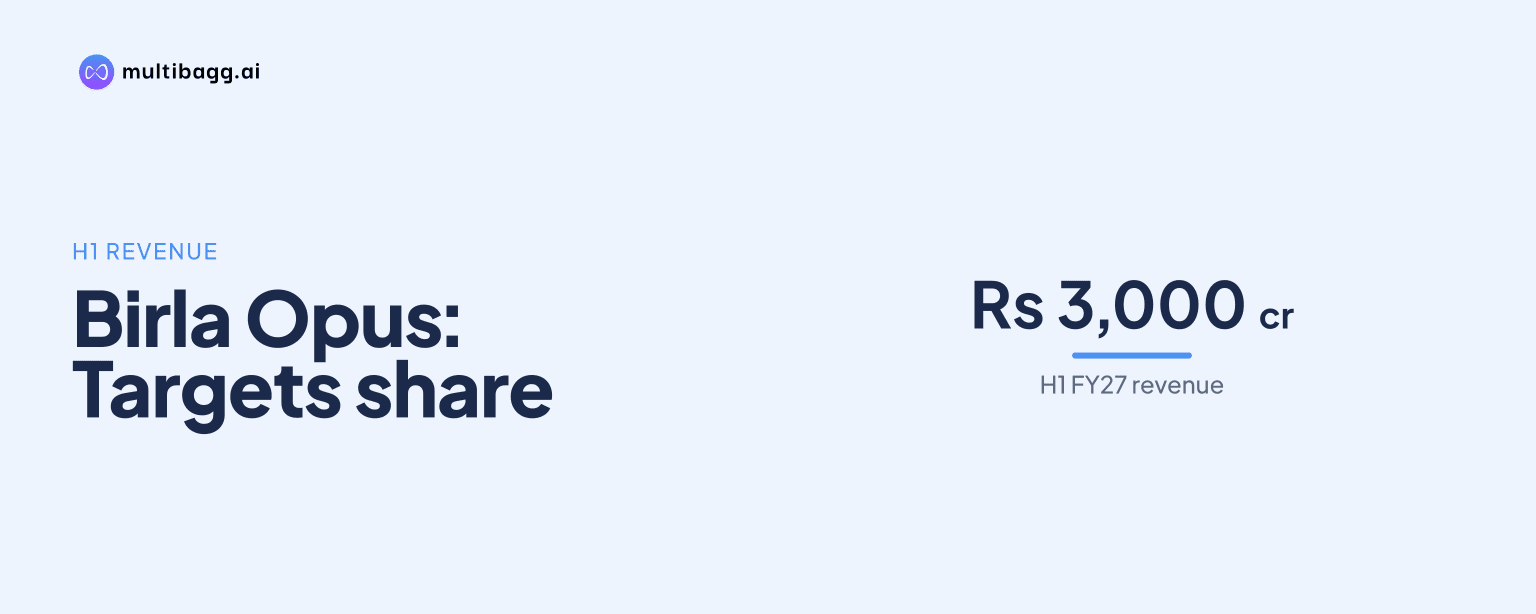
Birla Opus Paints is targeting a double-digit revenue market share in H2 FY27 after reporting ₹3,000 crore of revenue in H1 FY27, up 50% year on year. Management cited a 61,000-plus cumulative dealer footprint, 1,760-plus exclusive franchises and October volume growth above the H1 average as support for that objective.
Know Grasim Industries inside out
Results, valuation, peers and who's buying, in one view.
Can Birla Opus reach double-digit revenue market share in H2 FY27?
Birla Opus aims to achieve a double-digit revenue market share in H2 FY27, management said, with the target applying to the paint business alone. Its combined market share with Birla White Putty was in the early teens, and management said that position had narrowed the gap with the existing number-two player. The H2 plan is to lift sales productivity from the retail, franchise, institutional and influencer networks built during its first two years.
The target follows a seasonally softer Q2 FY27 for decorative paints, when monsoon conditions reduced painting activity and competitive schemes increased. Management said Birla Opus has lower dealer inventory than established brands because its emphasis is retailing rather than wholesaling. It also said rate realisation was almost flat quarter on quarter despite dealer list-price increases, making H2 execution across dealers, contractors and consumer engagement central to the outcome.
How fast did Birla Opus grow in H1 FY27?
Birla Opus reported ₹3,000 crore of H1 FY27 revenue, up 50% year on year, while Q2 FY27 revenue rose 35% to ₹1,337 crore. H1 volume increased 33%, compared with 20% in Q2. The lower Q2 volume growth coincided with the monsoon-affected period that management described as traditionally softer for decorative-paint demand.
Management said it reduced prices versus the market leader in stages as confidence in its brand and product quality grew. In September, Birla Opus prices were within a 2%-4% distance of the market leader, excluding the impact of the 10% free-paint proposition. Management said the 10% promotion would continue for a longer period alongside distribution expansion, product launches and painter engagement.
Premium and luxury offerings accounted for about 63% of Q2 sales value, despite the softer quarter, while waterproofing revenue doubled during the year. In Q2, Birla Opus introduced 11 products and more than 360 stock-keeping units, or SKUs, taking the range to 239 products and more than 2,300 SKUs. The additions covered emulsions, enamels, waterproofing, wood finishes and wallpaper for trade and institutional channels.
How large is Birla Opus’s distribution network?
Birla Opus had billed more than 61,000 dealers at least once across more than 12,600 towns by Q2 FY27, while over 44,000 dealers billed its products during the quarter. Nearly 150 depots support the dealer network through just-in-time deliveries and service standards. Management’s next focus is to deepen sales per outlet rather than only add distribution points.
The exclusive franchise network added around 300 stores in Q2 FY27, taking operational outlets beyond 1,760. Management called this India’s largest exclusive franchise network in decorative paints. The stores provide PaintCraft painting services, equated monthly instalment facilities, Opus Assurance and warranties, extending the channel beyond product availability to customer service.
Institutional sales grew 59% year on year in Q2 FY27, with nearly 10,000 project sites billed during the quarter. Birla Opus said more than 60,000 project sites were at different stages of work, including the pipeline, and management expects institutional volumes to accelerate in H2. That expectation matters because management said the institutional channel took longer to develop than retail.
Got a follow-up? Ask IRIS
How are products and advertising supporting Birla Opus growth?
Birla Opus reported aided brand awareness of 92% and unaided awareness of 59% in Q2 FY27, based on its internal studies. Management said advertising is moving from broad brand-building toward a combination of brand-led and product-led communication. The Style campaign focused on economy interior paints in Uttar Pradesh, Bihar, Rajasthan and Madhya Pradesh.
In November 2026, Birla Opus launched the Opus Alldry campaign for interior, exterior and roof waterproofing products. Management said additional sub-brand campaigns are planned in H2 FY27, after earlier campaigns linked to Onam, Ganpati and Durga Puja. These campaigns are intended to move consumers from recognising the brand to understanding product-specific benefits.
The company is also using its portfolio to cover different consumer needs and price points rather than concentrating on a narrow paint range. The 2,300-plus SKU portfolio includes products for decorative and waterproofing applications, while the 63% premium and luxury sales-value mix shows the relevance of higher-end categories in Q2. Management described differentiated performance and premiumisation as priorities for the product pipeline.
How do PaintCraft and painters affect Birla Opus sales?
PaintCraft operated across more than 7,700 PIN codes by Q2 FY27 and had completed more than 12,000 sites across metros, large towns and smaller towns. Revenue from the painting-services platform increased 1.5 times from the prior quarter. Management said direct consumer contact through the service gives feedback on product quality and research and development.
Nearly 10 lakh contractors and painters had applied Birla Opus products at least once since launch, and more than 3 lakh used them during Q2 FY27. The company uses its Opus ID platform, product demonstrations, on-ground interactions and events to increase recommendations by this group. Management said painter and contractor recommendations can affect the brand eventually selected by consumers.
Reported secondary volume from contractor-painter scans rose 34% year on year in Q2 FY27, ahead of 20% primary sales-volume growth. Management interpreted the difference as evidence of declining dealer inventory and said it was reflected in strong October sales. It also said October volume growth was far above the average year-on-year rate for H1, without disclosing an October percentage.
Conclusion
Birla Opus enters H2 FY27 with ₹3,000 crore of H1 revenue, 50% year-on-year sales growth and a stated double-digit revenue-market-share objective. Management’s case rests on the combination of 61,000-plus billed dealers, more than 1,760 exclusive franchises, institutional sales growth of 59% and scan-based secondary-volume growth that exceeded Q2 primary volume growth.
The next measure is whether October momentum continues through Q3 FY27 and the rest of H2. Management plans further sub-brand advertising, expects institutional volume to accelerate and intends to activate more dealer and contractor networks. Its longer-term target is to become India’s second-largest decorative paints company and build a ₹10,000 crore brand by the end of FY28.