










Birla Pivot targets H2 FY27 break-even after 66% revenue rise
Key highlights
- Birla Pivot's Q2 FY27 revenue rose 66% year on year to Rs 2,785 crore.
- Birla Pivot's annualised revenue run rate crossed Rs 11,000 crore in Q2 FY27.
- Management aims for Birla Pivot to exceed Rs 12,000 crore of revenue in FY27.
- Birla Pivot said its retail operation is EBITDA-profitable and the overall platform is on track for H2 FY27 break-even.
powered by IRIS
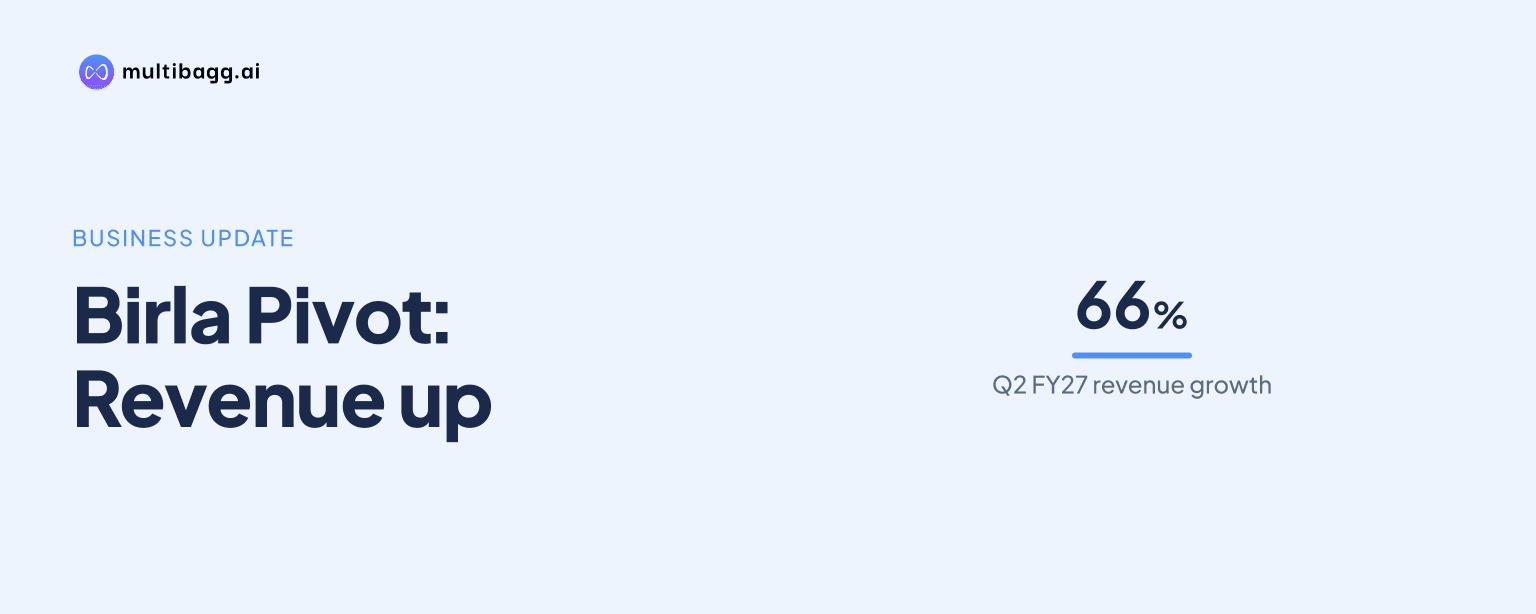
Birla Pivot reported Q2 FY27 revenue of Rs 2,785 crore, up 66% year on year, and management said the business remains on track to reach break-even in H2 FY27 after its annualised revenue run rate crossed Rs 11,000 crore. Management also said Birla Pivot's retail operation is already profitable at the EBITDA level.
Know Grasim Industries inside out
Results, valuation, peers and who's buying, in one view.
How fast did Birla Pivot grow in Q2 FY27?
Birla Pivot grew revenue by 66% year on year to Rs 2,785 crore in Q2 FY27, taking its annualised revenue run rate above Rs 11,000 crore. Management aims for Birla Pivot to exceed Rs 12,000 crore of revenue in FY27, an objective it described as nearly 50% year-on-year growth on a reasonably large base.
Management attributed Q2 FY27 growth to activity across project and retail channels, with orders increasing month on month. Birla Pivot said its demand includes project-led and manufacturing purchases alongside a growing retail proposition, broadening the platform beyond larger project transactions.
The FY27 revenue aim is above the Rs 11,000 crore annualised run-rate threshold crossed in Q2 FY27, so it requires continued growth through the balance of the year. The call did not disclose a preceding-quarter revenue figure, a gross-margin percentage or separate project and retail revenue, preventing a calculation of sequential growth or individual channel contribution.
What is driving Birla Pivot's revenue growth?
Birla Pivot says customer acquisition, repeat engagement and fulfilment execution are driving growth, while its focus is moving toward transaction frequency and share of wallet. The company is seeking more active transacting buyers and a broader product basket from existing customers rather than relying only on new-customer additions.
On the supply side, Birla Pivot said deeper brand and seller partnerships are intended to improve product availability, pricing competitiveness and fulfilment. It identified on-time, in-full delivery, or OTIF, as an operating priority, although management did not provide an OTIF percentage for Q2 FY27.
Management expects more dependable supply chains and better customer experience to improve retention and transaction volumes. The transcript does not provide Q2 FY27 figures for repeat-purchase rates, transacting customer numbers, seller numbers or average order value, so the reported 66% revenue growth is the principal disclosed measure of commercial progress.
Birla Pivot also cited India’s B2B, or business-to-business, trade pool at about USD4 trillion, with roughly 2% occurring online in fiscal 2026. Management expects the online share to exceed 5% by 2030, implying a USD200 billion market, but this is management’s industry assessment rather than a forecast of Birla Pivot’s revenue or market share.
Got a follow-up? Ask IRIS
Why do retail and financing matter to Birla Pivot?
Retail matters because it expands Birla Pivot beyond larger project-led purchases and is already EBITDA-profitable, according to management. EBITDA means earnings before interest, tax, depreciation and amortisation; the call did not disclose retail revenue, retail margin or the date at which the operation reached EBITDA profitability.
Management said the retail proposition can create more frequent customer engagement, complementing project and manufacturing demand. Birla Pivot expects a larger supplier ecosystem, broader product availability and fulfilment improvements to support repeat transactions, although it did not quantify retail order frequency or customer retention in Q2 FY27.
Birla Pivot is developing a financing ecosystem through Pivot Vault and partnerships with banks and non-banking financial companies, or NBFCs. Management said the credit-linked offering is designed to address working-capital constraints for dealers, contractors and micro, small and medium enterprises, or MSMEs, that procure through the platform.
Management expects financing to increase purchasing capacity, facilitate larger transactions and improve customer stickiness by connecting credit with procurement and fulfilment. Birla Pivot did not disclose a Q2 FY27 loan book, credit disbursal, delinquency level, funding cost or financing income, so the financial contribution from Pivot Vault cannot be measured from the call.
What must Birla Pivot do to reach H2 FY27 break-even?
Birla Pivot must turn its scale into better economics through margin improvement, tighter working-capital management and operating leverage to reach H2 FY27 break-even, management said. It reported that gross margin continued to improve but did not disclose a Q2 FY27 gross-margin percentage or comparison with Q2 FY26.
Management said Q2 FY27 EBITDA was affected by one-time employee-related expenses. It did not quantify those costs, report Birla Pivot’s total EBITDA or state the quarterly EBITDA margin, leaving the underlying loss and the revenue level required for break-even undisclosed.
The stated H2 FY27 plan rests on deeper customer engagement, supplier expansion, improved margins and working-capital discipline. Operating leverage would result if operating costs rise more slowly than transaction volumes, which management expects to support as repeat purchasing and fulfilment reliability improve.
There is a distinction between the reported profitability of retail and the target for the overall platform. Retail is EBITDA-profitable, management said, while Birla Pivot as a whole is targeted to reach break-even in H2 FY27; the transcript provides no segment-level EBITDA figures to explain the difference quantitatively.
Conclusion
Birla Pivot’s Q2 FY27 performance shows rapid scale creation, with revenue reaching Rs 2,785 crore and annualised run rate exceeding Rs 11,000 crore. The 66% year-on-year revenue increase, EBITDA-profitable retail operation, repeat-purchase strategy and financing partnerships are the disclosed elements of management’s plan to move the overall platform toward profitability.
The next milestones are management’s FY27 revenue aim of more than Rs 12,000 crore and its H2 FY27 break-even target. Future updates on gross margin, EBITDA, one-time employee expenses, working-capital movement, retail revenue and Pivot Vault activity will show whether higher transaction volumes are delivering the economics management expects.