










Grasim Industries Q2 FY27 Revenue Rises 26% to ₹50,105 Crore
Key highlights
- Grasim Industries reported record Q2 FY27 consolidated revenue of ₹50,105 crore, up 26% year-on-year.
- Reported Q2 FY27 consolidated net profit was ₹1,029 crore, down 34.7% after a ₹767 crore pulp-mill idling charge.
- Birla Opus Q2 FY27 revenue rose 66% year-on-year to ₹2,785 crore.
- Grasim aims to exceed ₹12,000 crore of B2B revenue in FY27 after its annualised run rate crossed ₹11,000 crore.
powered by IRIS
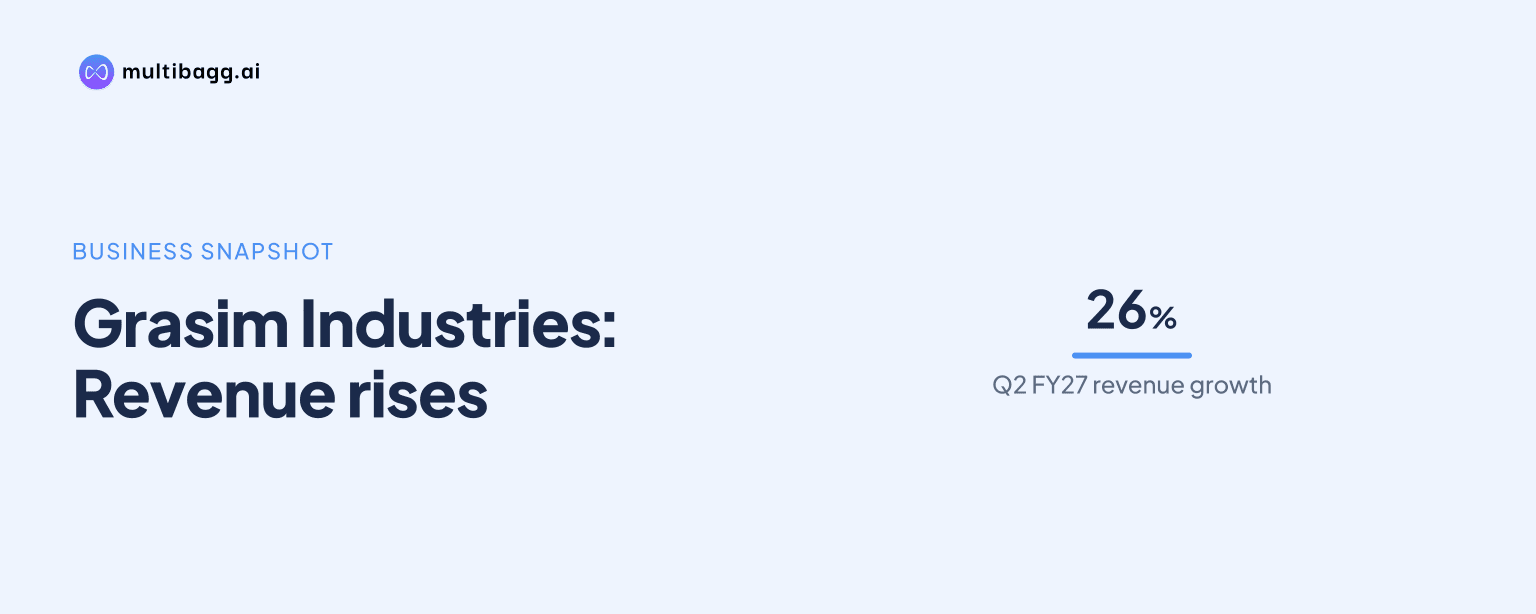
Grasim Industries Limited reported record consolidated revenue of ₹50,105 crore in Q2 FY27, a 26% year-on-year increase, while reported net profit declined 34.7% to ₹1,029 crore after a ₹767 crore pulp-mill idling charge. The result shows broad revenue growth across its operating businesses alongside the effect of a specific cost on profit.
Know Grasim Industries inside out
Results, valuation, peers and who's buying, in one view.
What did Grasim Industries report for Q2 FY27?
Grasim Industries reported consolidated revenue of ₹50,105 crore for the quarter ended September 2026, the highest quarterly revenue disclosed by the company. Revenue increased 26% from a year earlier, supported by cellulosic fibres, building materials and financial services. Consolidated EBITDA rose 25% year-on-year to ₹6,513 crore.
Reported consolidated net profit was ₹1,029 crore, down 34.7% year-on-year. Management said a ₹767 crore charge related to pulp-mill idling weighed on profitability. A call summary cited adjusted profit after tax of ₹536 crore, compared with ₹595 crore a year earlier, reflecting the impact of the pulp-related item.
The standalone business reported revenue of ₹12,747 crore in the September quarter, compared with ₹11,795 crore in the preceding June quarter. That represented sequential growth of 8.1%. Standalone net profit was ₹2,306 crore, compared with ₹247 crore in the prior quarter, while operating margin improved to 29.7% from 9.3%.
Which businesses drove Grasim Industries' revenue growth?
Grasim said its growth was broad-based, with cellulosic fibres, building materials and financial services contributing to the consolidated performance. Its trailing 12-month consolidated revenue stood at ₹194,234 crore, 11% above the FY26 figure, according to management's earnings-call remarks.
The Birla Opus decorative paints business recorded Q2 revenue of ₹2,785 crore, up 66% year-on-year. Management said its annualised revenue run rate crossed ₹11,000 crore during the quarter and that the business aims to exceed ₹12,000 crore of revenue in FY27. It also reiterated its ambition to build a ₹10,000 crore paints brand by the end of FY28.
Management linked its H2 paints outlook to the retail selling season, including wedding-related demand. It indicated an expectation of 50% year-on-year paints revenue growth in the second half of FY27. However, the company also said it did not gain revenue market share during Q2 and is targeting a double-digit revenue share in H2 FY27.
What is Grasim Industries' plan for paints and B2B operations?
Grasim is continuing to expand Birla Opus while targeting profitability once the paints business reaches the ₹10,000 crore revenue scale. The company has stated its objective of becoming India's second-largest decorative paints company, but its Q2 commentary showed that revenue growth and market-share progress may not move in a straight line.
The company cited aided brand awareness of 92% and unaided awareness of 59% for Birla Opus. Its planned brand-building activity includes influencer advocacy and regional cultural initiatives. These figures indicate the company is tracking consumer recognition as it increases the reach of its relatively new decorative-paints brand.
In B2B operations, Grasim said revenue was running at an annualised rate above ₹11,000 crore in Q2. The stated FY27 revenue goal is ₹12,000 crore, which management described as nearly 50% year-on-year growth. It also reiterated that Birla Pivot remains on track for EBITDA break-even in H2 FY27.
Got a follow-up? Ask IRIS
How is Grasim Industries expanding chlorine and specialty fibre capacity?
Grasim is raising downstream chlorine integration through new chemical projects at its Vilayat, or VLAG, site. A 50,000-tonne CPVC project was commissioned in August 2026, followed by a 50,000-tonne epichlorohydrin project in October 2026. Management expects these additions to help improve chlorine integration to 67%.
The company said it is India's leading pan-India chlor-alkali producer, with total capacity of nearly 2.6 million tonnes per annum. This comprises 1.5 million tonnes of caustic soda capacity and 1.1 million tonnes of chlorine-derivative capacity. Better integration can increase the use of chlorine generated alongside caustic soda production, though management also noted pressure on caustic and epoxy margins.
In specialty fibres, phase one of a planned expansion, representing 55,000 tonnes per annum, has been completed. Clearance for phase two, representing 110,000 tonnes, has progressed. The two phases would take the planned specialty-fibre plant capacity to 165,000 tonnes per annum.
What does the quarter mean for investors and the industry?
The quarter highlights the different earnings drivers within Grasim's portfolio. Consolidated revenue and EBITDA increased strongly, but reported profit declined because of the disclosed pulp-mill idling charge. For investors, this makes it important to distinguish operating growth from the quarter's specific exceptional cost.
Paints remains a major investment and execution focus. Grasim's Q2 revenue growth in the segment was substantial, but the absence of revenue market-share gain in the quarter places added importance on its H2 target. The company is pursuing a larger presence in a decorative paints market estimated in the source material at ₹80,000 crore to ₹82,000 crore in FY27.
For the chemical business, commissioning CPVC and epichlorohydrin capacity is relevant because it supports higher chlorine utilisation. At the same time, management flagged margin pressure in caustic soda and epoxy, while viscose staple fibre margins were described as range-bound. These conditions show why volume growth, product mix and integration remain central operating variables.
Conclusion
Grasim Industries delivered record Q2 FY27 consolidated revenue of ₹50,105 crore and 26% year-on-year growth, led by several business lines. Profitability was affected by the ₹767 crore pulp-mill idling charge, while the standalone business recorded sequential improvement in revenue, profit and operating margin.
The next disclosures to watch are progress toward more than ₹12,000 crore of FY27 B2B revenue, Birla Pivot's targeted H2 FY27 EBITDA break-even, and the planned improvement in chlorine integration to 67%. Investors will also track whether Birla Opus converts its stated H2 growth and market-share targets into reported performance.