










Blue Star targets Rs 4,000 crore data-centre revenue in three years
Key highlights
- Blue Star targets data-centre revenue of Rs 4,000 crore in three years, up from Rs 2,000 crore currently.
- Blue Star estimates about Rs 2,000 crore of its Rs 5,000 crore projects order book is related to data centres.
- Management expects data-centre order booking of about Rs 4,000 crore in the current year and Rs 8,000 crore by 2030.
- Infrastructure contributes an estimated 20% of current billing, but Blue Star is no longer booking major new orders in that segment.
powered by IRIS
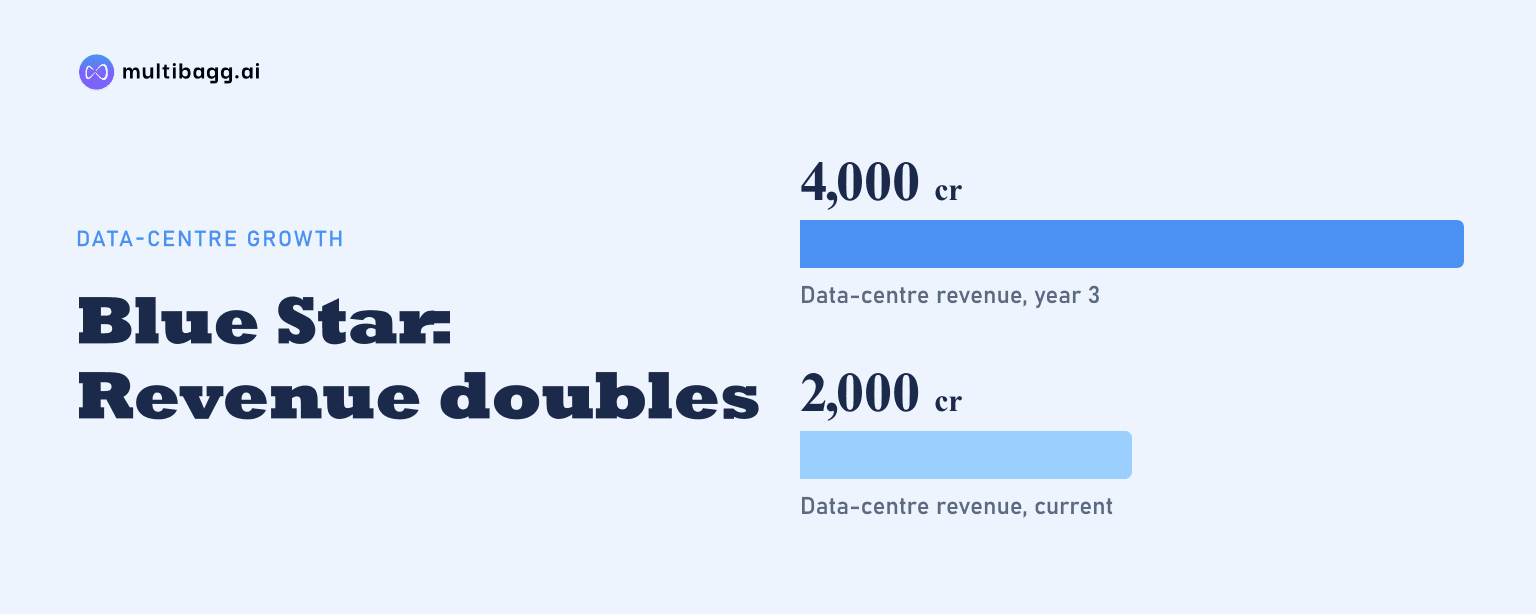
Blue Star expects data-centre revenue to rise from Rs 2,000 crore to Rs 4,000 crore in three years, as management shifts projects resources away from infrastructure contracts affected by delays and cost overruns. The company said data centres and factories will drive growth in its electromechanical projects business, while it evaluates work by profitability and free cash flow rather than market share.
Know Blue Star inside out
Results, valuation, peers and who's buying, in one view.
Why is Blue Star moving resources from infrastructure to data centres?
Blue Star is moving resources because management considers data centres and factories the main projects growth areas, while infrastructure work has continued to face cost overruns, delays and margin pressure. Its projects opportunities include commercial buildings such as malls and hospitals, infrastructure projects including railway electrification, substations, water projects and metro rail, and data centres and factories.
Management said Blue Star will not pursue market share in electromechanical projects and will instead select work based on margins, free cash flow and profitability. Data-centre projects require specialised resources, and management said this limits the case for taking additional infrastructure contracts such as railway electrification projects.
Infrastructure still represented an estimated 20% of current billing, based on management's rough estimate, but this contribution is shrinking because Blue Star is no longer booking major new orders in the segment. Management noted that individual infrastructure orders can range from Rs 450 crore to Rs 600 crore, making the segment's contribution variable from year to year.
What is Blue Star's data-centre revenue target?
Blue Star targets data-centre revenue of Rs 4,000 crore in three years, compared with Rs 2,000 crore currently. Management confirmed this target when an analyst summarised the company's Rs 5,000 crore projects order book and approximately Rs 2,000 crore of data-centre orders.
Management expects data-centre order booking of about Rs 4,000 crore in the current year, comprising roughly Rs 2,000 crore already secured and a further Rs 2,000 crore expected to be booked. It estimated that Rs 10,000 crore to Rs 12,500 crore of data-centre orders could be finalised across the market this year.
Management also outlined a conservative FY30 company revenue illustration of Rs 20,000 crore, including Rs 4,000 crore from data centres. It indicated that total electromechanical projects revenue could reach Rs 6,000 crore to Rs 7,000 crore by FY30, which would make data centres a significant part of that business if the plan is achieved.
How do Blue Star data-centre projects differ from infrastructure contracts?
Blue Star says data-centre projects generally run for eight to nine months and have good payment terms, so management does not expect cash flow to be an issue. That contrasts with the delays and cost overruns management identified in infrastructure projects, where it is reducing new order intake.
The work remains technically demanding: management said data-centre execution requires sophisticated workers and supervisors, greater prefabrication, workshop-type facilities and stringent processes. Some project items are priced on a base-rate mechanism, which can permit price escalation, while the additional specialist costs are incorporated into pricing, according to management.
Blue Star identified three data-centre opportunities: mechanical, electrical and plumbing, or MEP, contracting; conventional chillers adapted for data-centre applications; and advanced liquid cooling. Management estimated the Indian MEP or engineering, procurement and construction market at about Rs 12,000 crore, compared with up to Rs 2,000 crore for chillers and around Rs 500 crore for liquid-cooling coolant distribution units.
Management said Blue Star does not yet have liquid-cooling technology, including for India, and is holding multiple discussions on possible arrangements. It said the domestic MEP market is currently the largest part of the data-centre opportunity, while the company has an estimated 15% share of the chiller market.
Got a follow-up? Ask IRIS
Will data centres increase Blue Star's projects margin?
Blue Star maintains its segment-one margin guidance at 7% to 7.5%, although management said a data-centre-only business could potentially produce a 10% to 12% margin. Segment one includes commercial air-conditioning products, including packaged air conditioners, chillers and ducted systems, as well as project activity, so its reported mix is broader than data centres.
Management said segment-one margin could move to 8.5% as data centres become a larger portion of the business, but it has not changed the 7% to 7.5% guidance. It said a double-digit segment margin is not currently visible because packaged air conditioners remain part of the mix and use inputs including compressors, coils, steel and copper.
Management expects a clearer profitability indication when data-centre execution reaches a peak in the fourth quarter. Much of the data-centre order booking occurred in the first half, so Blue Star said it has not yet completed a full execution cycle on which to base a firmer margin assessment.
What other projects will Blue Star retain alongside data centres?
Blue Star will retain commercial buildings, factories and data centres in its projects portfolio, while management identifies data centres and factories as the verticals driving growth. Factories can include solar, semiconductor and electric-vehicle battery facilities, which require air conditioning and substantial electromechanical work.
Management described Blue Star as having interests in products, manufacturing, services and engineering, procurement and construction rather than operating as a full-fledged engineering, procurement and construction contractor. The strategy therefore focuses on projects that fit those capabilities rather than on every available large infrastructure contract.
Commercial refrigeration provides a contrasting near-term demand picture. Management said the business remained in decline, expected only single-digit growth for the full year and would be pleased with about 10% growth in the second half, following weaker demand for deep freezers and cold-chain equipment.
Management linked the commercial refrigeration slowdown to slower fast-moving consumer goods expansion and a moderation in quick-commerce infrastructure additions after substantial purchases in FY25. It also said input-cost pressure could require price increases of around 24% to 25% in commercial refrigeration products with higher steel, plastic and petroleum-based material content.
Conclusion
Blue Star's plan is a selective reallocation within projects rather than a withdrawal from electromechanical work. Management is winding down major new infrastructure orders, which still account for an estimated 20% of billing, while pursuing a rise in data-centre revenue from Rs 2,000 crore to Rs 4,000 crore over three years through shorter-duration projects with payment terms it considers supportive of cash flow.
The next disclosed checkpoint is the fourth quarter, when management expects peak data-centre execution to provide a clearer profitability indication. Progress toward current-year data-centre order booking of Rs 4,000 crore, the three-year Rs 6,000 crore order-book possibility and the maintained 7% to 7.5% segment-one margin guidance will show how the transition is developing.